
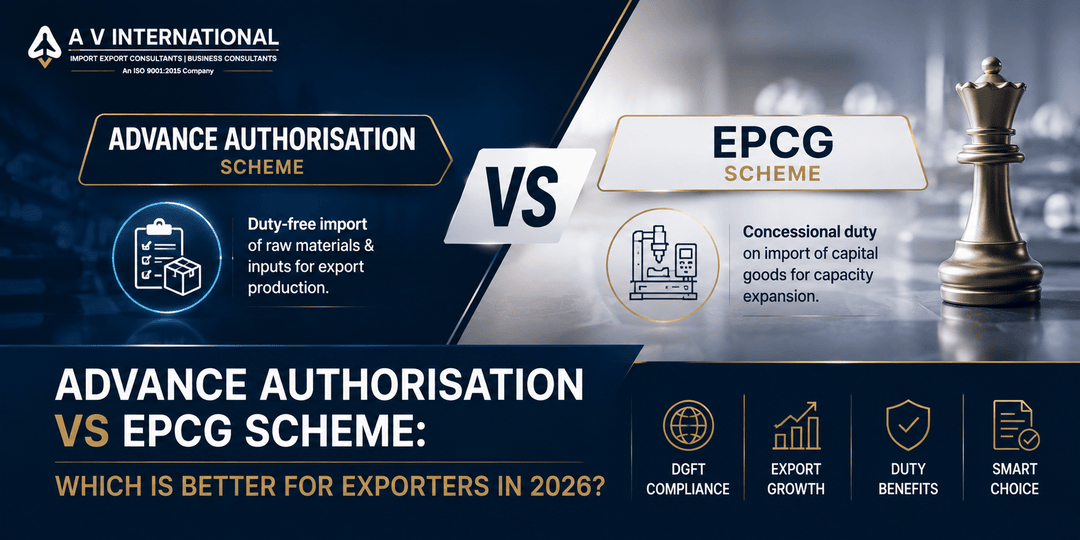

Advance Authorisation vs EPCG Scheme: Which Is Better for Exporters in 2026?
Key Takeaways
- Both schemes provide customs duty benefits but serve different purposes.
- Advance Authorisation is ideal for importing raw materials used in export production.
- EPCG is designed for importing capital goods at concessional or zero customs duty.
- Choosing the wrong scheme may increase compliance costs and delay export benefits.
- Understanding export obligations before applying is essential.
- Businesses should evaluate their production cycle, investment plans, and export commitments before selecting a scheme.
Introduction
The Directorate General of Foreign Trade (DGFT) offers several export promotion schemes to improve the competitiveness of Indian exporters. Among them, the Advance Authorisation Scheme and the Export Promotion Capital Goods (EPCG) Scheme are the two most widely used.
Although both schemes reduce import costs, they are intended for different business needs. Choosing the correct scheme can significantly lower customs duty, improve cash flow, and enhance profitability.
This guide compares Advance Authorisation vs EPCG Scheme to help exporters, manufacturers, and MSMEs determine which option is better for their business in 2026.
What is the Advance Authorisation Scheme?
The Advance Authorisation Scheme allows exporters to import raw materials, components, consumables, and packing materials without paying customs duties, provided these inputs are used to manufacture products meant for export.
Suitable for
- Manufacturers
- Merchant exporters
- Job workers
- Export-oriented businesses
What is the EPCG Scheme?
The EPCG Scheme allows businesses to import capital goods such as machinery, production equipment, tools, and technology at concessional or zero customs duty against an export obligation.
It is primarily designed to encourage modernization and expansion of manufacturing capabilities.
Suitable for
- Manufacturers
- Service exporters
- Industrial units
- MSMEs upgrading production facilities
Advance Authorisation vs EPCG Scheme: Key Differences
| Feature | Advance Authorisation | EPCG Scheme |
|---|---|---|
| Purpose | Import raw materials | Import capital goods |
| Imports Covered | Inputs & consumables | Machinery & equipment |
| Customs Duty | Exempt | Concessional or zero |
| Export Obligation | Yes | Yes |
| Best For | Regular exporters | Manufacturing expansion |
| Investment Required | Lower | Higher |
| Long-Term Asset Creation | No | Yes |
| Typical Users | Export manufacturers | Manufacturing industries & service providers |
Which Scheme Should You Choose?
Choose Advance Authorisation if:
- You frequently import raw materials.
- Your export production depends on imported inputs.
- You want to reduce manufacturing costs.
- You have continuous export orders.
Choose EPCG if:
- You are investing in new machinery.
- You plan to increase manufacturing capacity.
- You want long-term duty savings on capital equipment.
- Your business is expanding exports over the coming years.
Benefits of Advance Authorisation
- Duty-free import of raw materials
- Lower manufacturing costs
- Improved export competitiveness
- Better working capital management
- Reduced production expenses
Benefits of EPCG
- Lower cost of importing machinery
- Encourages technology upgrades
- Improves production efficiency
- Supports long-term business expansion
- Reduces capital investment costs
Compliance Requirements
Regardless of the scheme selected, businesses should:
- Maintain accurate import and export records.
- Fulfil export obligations within the prescribed period.
- Keep supporting invoices and shipping documents.
- Submit required reports to DGFT when applicable.
- Ensure proper utilization of imported goods.
Failure to comply may result in duty recovery, interest, penalties, or cancellation of benefits.
Common Mistakes to Avoid
- Choosing EPCG instead of Advance Authorisation for raw material imports.
- Applying for Advance Authorisation when importing machinery.
- Miscalculating export obligations.
- Maintaining incomplete documentation.
- Delaying fulfilment of export commitments.
- Ignoring DGFT compliance timelines.
Practical Tips Before Applying
- Evaluate whether you need machinery or production inputs.
- Estimate future export volumes realistically.
- Calculate expected duty savings.
- Review export obligations before filing.
- Consult a DGFT compliance expert for complex cases.
Featured Snippet Answer
Advance Authorisation is best for exporters importing raw materials required for manufacturing export products, while the EPCG Scheme is ideal for businesses importing capital goods such as machinery at concessional or zero customs duty. The right scheme depends on the type of imports, investment plans, production requirements, and export obligations.
FAQs
1. Can I use both Advance Authorisation and EPCG?
Yes. Eligible businesses may use both schemes for different import requirements, subject to DGFT regulations.
2. Which scheme offers greater customs duty savings?
Both provide significant duty benefits, but the savings depend on whether you are importing raw materials or capital goods.
3. Is export obligation mandatory?
Yes. Both schemes require exporters to fulfil prescribed export obligations within the specified period.
4. Who should apply for Advance Authorisation?
Businesses importing raw materials, components, consumables, or packing materials for export production.
5. Who should apply for EPCG?
Manufacturers and service providers planning to import machinery or capital equipment for export-oriented operations.
6. Can MSMEs apply under these schemes?
Yes. Eligible MSMEs can apply for both schemes if they satisfy DGFT requirements.
Conclusion
Advance Authorisation and the EPCG Scheme are both valuable export promotion initiatives, but they address different business objectives. If your priority is reducing the cost of imported production inputs, Advance Authorisation is generally the better option. If you are investing in machinery and long-term manufacturing growth, the EPCG Scheme offers greater strategic advantages.
Selecting the appropriate scheme after evaluating your business model, import requirements, and export commitments can improve compliance, reduce costs, and strengthen your global competitiveness.
Need Expert Assistance?
A V International has over 35 years of experience in DGFT consultancy, import-export compliance, EPCG licensing, Advance Authorisation, IEC registration, and other regulatory approvals.
Our experts assist businesses with documentation, application filing, export obligation compliance, and end-to-end DGFT support to ensure faster approvals and hassle-free compliance.
Written By
Akash Bhangare
Having more than 10 years of experience in EPR Compliance, Legal Metrology, DGFT Regulations, and Import Export Consulting Services in India.
Associated with A V International, a company with over 35 years of expertise in Environmental Compliance, EPR Registrations, Licensing, and Regulatory Approvals.
Recent Posts
- Advance Authorisation vs EPCG Scheme: Which Is Better for Exporters in 2026?
- How to Apply for EPCG License in India: Complete Step-by-Step Guide (2026)
- How to Apply for AEO Certification in India: Complete Step-by-Step Guide (2026)
- Top LMPC Registration Rejection Reasons and How to Avoid Them in 2026
- LMPC Certificate for Imported Pre-Packaged Commodities | Complete Guide 2026
FeATURED ARTICLES
SARAL SIMS for Steel Imports in India – Complete Guide The Government of India has introduced SARAL SIMS (Simplified Steel…
Top Export Compliance Mistakes: DGFT Advance Authorization, EPCG & CPCB (2025 Guide) Exporting in India can feel like a legal…
Environmental Clearance CPCB: Quick Guide for Exporters If you’re an Indian exporter or manufacturer working under schemes like the Advanced…
DGFT e-BRC Rule 2025: Key Update for Advance Authorization & EPCG Holders The Directorate General of Foreign Trade (DGFT) has…

