

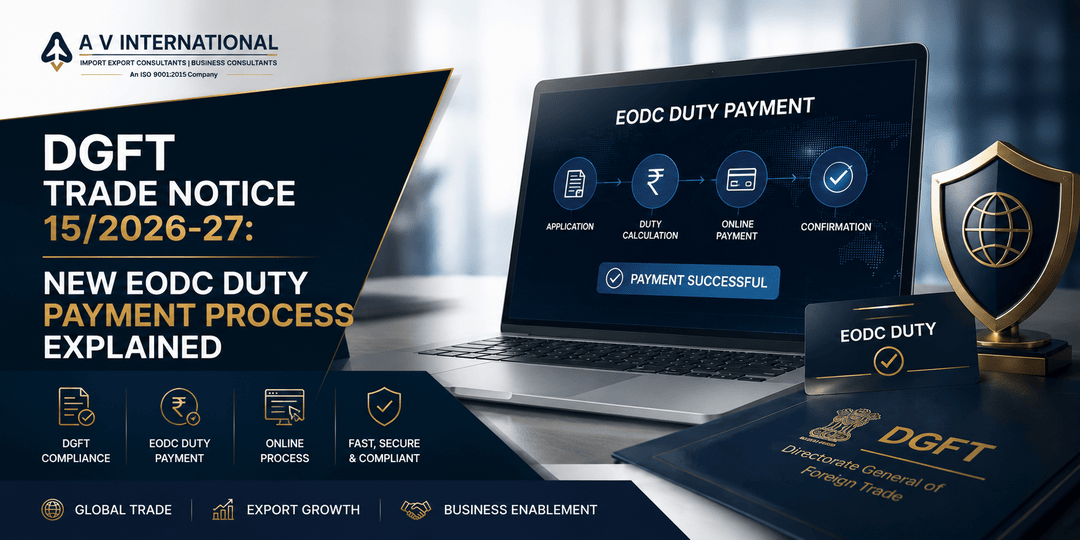
DGFT Trade Notice 15/2026-27: New EODC Duty Payment Process Explained
DGFT Trade Notice 15/2026-27: New EODC Duty Payment Process Explained
If you have an Advance Authorisation (AA) or EPCG Authorisation and are preparing to apply for an Export Obligation Discharge Certificate (EODC), there is an important DGFT system update you should understand.
The Directorate General of Foreign Trade (DGFT) has introduced a mechanism to integrate license-wise voluntary duty payment information received from Customs/ICEGATE with the DGFT online system.
The objective is straightforward: instead of relying heavily on manual verification and physical payment records, authenticated duty payment information can now be made available electronically to DGFT officers and exporters through the DGFT portal.
This change is covered under DGFT Trade Notice No. 15/2026-27 dated 5 August 2026.
Importantly, this Trade Notice is not announcing a new Advance Authorisation or EPCG benefit. It primarily changes how voluntary duty payment information is electronically made available and recognized during EODC processing.
For exporters with pending or upcoming EODC applications, understanding this change can help prevent unnecessary discrepancies, delays and confusion.
Quick Take: What Exporters Need to Know
- DGFT has issued Trade Notice No. 15/2026-27 dated 5 August 2026.
- The update concerns license-wise voluntary duty payment details received from Customs/ICEGATE.
- The data is being integrated into the DGFT online system.
- The mechanism applies to EODC processing under Advance Authorisation and EPCG Schemes.
- Exporters can view the relevant voluntary payment information through the DGFT Customer Portal.
- DGFT Regional Authorities can view the information through their BO Portal.
- For EODC processing, only voluntary duty payment details reflected on the DGFT portal based on Customs/ICEGATE data will be recognized under the new system.
- The specific payment data covered by the instructions is for payments made on or after 1 August 2026.
- Authorisation holders should enter the correct License No. and IEC in the relevant ICEGATE fields when making payment under a licence.
- Exporters should verify the payment information appearing on the DGFT portal before submitting their EODC application.
- If a payment made on or after 1 August 2026 is not electronically reflected, the exporter can raise a DGFT Helpdesk ticket and provide the payment receipt or other proof.
What Is DGFT Trade Notice No. 15/2026-27?
DGFT Trade Notice No. 15/2026-27 was issued on 5 August 2026 by the Directorate General of Foreign Trade, Department of Commerce, Ministry of Commerce & Industry.
Its subject is:
“Availability of License-wise Voluntary Duty Payment Details for processing of Export Obligation Discharge Certificate (EODC) applications under Advance Authorisation (AA) and Export Promotion Capital Goods (EPCG) Schemes.”
The Trade Notice forms part of DGFT’s broader effort to improve:
- transparency,
- reliability,
- data accuracy,
- paperless processing,
- digital information exchange, and
- ease of doing business.
DGFT states that it has undertaken an initiative to integrate license-wise voluntary duty payment information received from Customs/ICEGATE with its online system.
In simple words, what does this mean?
Suppose an authorisation holder has made a voluntary duty payment against an Advance Authorisation or EPCG-related obligation.
Under the new mechanism, relevant payment information received electronically from Customs/ICEGATE can become visible within the DGFT system.
Therefore, DGFT officers do not have to depend exclusively on manually submitted payment records for the relevant electronically available transactions.
For exporters, the practical message is:
Make sure your payment is correctly linked to the relevant licence and IEC, and verify that the payment is appearing correctly on the DGFT portal before submitting EODC
What Has Changed?
The major change is the digital availability and recognition of license-wise voluntary duty payment data.
Previously, an exporter dealing with duty payment information during an EODC process could face greater dependence on supporting payment records and manual verification.
The new mechanism creates an electronic link between:
Customs/ICEGATE → DGFT System → EODC Processing
DGFT says the initiative is intended to reduce manual intervention, reduce dependence on physical receipts, improve data accuracy and create greater uniformity in processing by Regional Authorities.
Before vs Now
| Particular | Earlier / Practical Position | New Position under Trade Notice 15/2026-27 |
|---|---|---|
| Duty payment information | May require supporting payment records and verification | License-wise data received electronically from Customs/ICEGATE can be reflected on DGFT |
| Data source | Greater dependence on submitted records for verification | Customs/ICEGATE electronic data integrated with DGFT |
| DGFT verification | Manual intervention could be involved | Digital data is available to the concerned DGFT system |
| Exporter verification | Exporter may need to rely on payment documentation | Exporter can check reflected payment details on Customer Portal |
| Regional Authority | Verification of relevant payment records | DGFT system data is treated as official record for covered payments |
| Physical documentation | Supporting payment evidence may be relevant where electronic data is unavailable | Electronic data is intended to reduce manual/physical dependency |
| Covered payment period under this instruction | — | Payments made on or after 1 August 2026 |
The Trade Notice specifically states that voluntary duty payment details reflected on the DGFT Portal based on data received from Customs/ICEGATE shall be recognized for processing and closure of EODC applications under AA and EPCG.
Why Is This Important for Exporters?
At first glance, this may look like a technical portal improvement.
For exporters, however, the practical impact can be significant because EODC is the final compliance stage for an authorisation after the applicable export obligations and other requirements have been fulfilled or otherwise regularized.
An incorrect or missing payment record can create questions during the closure process.
The new system is intended to make the process more transparent by allowing payment information to flow electronically from Customs/ICEGATE to DGFT.
DGFT specifically states that the initiative is intended to improve:
- transaction transparency,
- data reliability,
- accuracy,
- paperless processing,
- consistency across Regional Authorities, and
- overall efficiency of EODC processing.
For exporters, this means data accuracy at the time of payment becomes even more important.
Who Is Affected by This DGFT Update?
Exporters Who May Benefit
The update is particularly relevant to:
- Advance Authorisation holders applying for EODC;
- EPCG authorisation holders applying for EODC;
- businesses that have made relevant voluntary duty payments;
- export/commercial teams handling authorisation closure;
- finance teams responsible for duty payment records;
- consultants and compliance teams managing AA/EPCG closure.
The Trade Notice is specifically addressed to exporters, members of trade and industry, Export Promotion Councils, trade associations and DGFT Regional Authorities.
Exporters Who Need to Pay Particular Attention
Businesses should be particularly careful if:
- an EODC application is being prepared;
- a voluntary duty payment was made on or after 1 August 2026;
- the payment was made against a specific authorisation;
- the payment information is not appearing correctly;
- the License No. or IEC may have been entered incorrectly;
- the business is relying on electronic data for EODC processing.
Who May Not Be Directly Affected?
The Trade Notice is specifically concerned with voluntary duty payment details used in EODC processing under Advance Authorisation and EPCG.
It should therefore not be interpreted as a general change to every DGFT licence, export incentive or Customs payment process.
The notification does not state that all DGFT schemes are being moved to this particular mechanism.
How Does This Affect Advance Authorisation?
The Trade Notice expressly covers EODC applications under Advance Authorisation.
Advance Authorisation is a duty exemption scheme under which eligible inputs can be imported subject to the applicable conditions and export obligation.
The important point here is that Trade Notice 15/2026-27 does not announce a new Advance Authorisation eligibility benefit or change the substantive export obligation conditions.
Instead, it deals with the availability of relevant voluntary duty payment information during the EODC/closure process.
If an AA holder has made a covered voluntary duty payment, the exporter should verify that the payment information is correctly reflected on the DGFT Customer Portal before submitting the EODC application.
DGFT’s current EODC framework provides for online processing of EODC applications, and the current Handbook of Procedures contains provisions governing EODC procedures.
What AA Holders Should Check
Before filing EODC, review:
- Advance Authorisation number;
- IEC details;
- relevant Customs/ICEGATE payment information;
- payment date;
- payment amount;
- voluntary duty payment details reflected on DGFT;
- export obligation records;
- other documents required for EODC;
- any discrepancies between Customs records and DGFT records.
Exporter Tip: Do not assume that making the payment automatically means that the payment will immediately appear on the DGFT portal. Verify the electronic record before submitting the EODC application.
How Does This Affect EPCG?
The Trade Notice also specifically covers EPCG EODC applications.
Under EPCG, the authorisation holder is required to fulfil the applicable export obligation and comply with the scheme’s conditions. The DGFT Handbook of Procedures provides for online EODC application under ANF 5B, followed by processing by the concerned Regional Authority.
The new Trade Notice introduces an important digital verification mechanism for covered voluntary duty payments.
For EPCG Authorisation Holders
If you have made a voluntary duty payment and are preparing your EODC application, you should:
- ensure the correct EPCG licence number is linked to the payment;
- ensure the correct IEC has been entered;
- check the payment details on the DGFT Customer Portal;
- identify any mismatch before filing EODC;
- retain the payment receipt as supporting evidence;
- raise a DGFT Helpdesk ticket if the payment is not electronically reflected.
The DGFT FAQ also recognizes duty payment as relevant in EPCG cases involving default and explains the role of payment documentation such as a TR-6 Challan in appropriate circumstances.
However, exporters should not confuse the general EPCG rules concerning duty payment/default with the specific digital data-integration mechanism introduced by Trade Notice 15/2026-27.
The Trade Notice is principally about the availability and recognition of voluntary duty payment data received from Customs/ICEGATE.
What About Other DGFT Schemes?
Trade Notice No. 15/2026-27 specifically identifies:
- Advance Authorisation (AA); and
- Export Promotion Capital Goods (EPCG)
in connection with EODC applications.
It does not state that the same mechanism has been introduced for all DGFT schemes such as RoDTEP, RoSCTL, DFIA, SCOMET or Status Holder benefits.
Therefore, exporters should avoid assuming that the Trade Notice automatically changes procedures under unrelated schemes.
This is an important regulatory distinction.
Exporter Tip: A portal integration announcement should not automatically be treated as an amendment to the substantive rules of every DGFT scheme.
Where Can Exporters See the Voluntary Duty Payment Details?
The Trade Notice identifies separate interfaces for DGFT officers and exporters.
1. DGFT BO Portal — Officer Side
The concerned Regional Authority can access the information through:
Closure File → Payment Details Tab → Voluntary Payment Details
The Trade Notice also provides another route:
DGFT BO Portal → License Room → Bills Repository → Select Bill → Voluntary Payment Details.
2. DGFT Customer Portal — Exporter Side
Exporters can access the information through:
DGFT CP Portal → My Dashboard → Repositories → Bills Repositories → Select Bill → Voluntary Payment Details
The information is also shown in the closure file immediately before submission through the Print Summary.
This gives exporters an opportunity to verify the information before submitting the EODC application.
Important Date: 1 August 2026
One of the most important points in the Trade Notice is the date 1 August 2026.
The instructions specifically refer to voluntary duty payments made on or after 1 August 2026.
For authorisation holders, DGFT advises verification of voluntary duty payment details made on or after this date before submitting EODC applications.
Important Timeline
| Date | Significance |
| 1 August 2026 | Voluntary duty payments from this date are specifically covered by the instructions |
| 5 August 2026 | DGFT issued Trade Notice No. 15/2026-27 |
| After implementation | Exporters should verify reflected payment data before EODC submission |
For Regional Authorities, the Trade Notice states that voluntary duty payment details for payments made on or after 1 August 2026 and displayed through the BO Portal shall be treated as the official record received from Customs/ICEGATE.
What Happens If the Duty Payment Is Not Showing on DGFT?
This is one of the most practical questions exporters may have.
Suppose you made a voluntary duty payment on or after 1 August 2026, but the corresponding electronic record is not appearing on the DGFT system.
The Trade Notice provides a specific support mechanism.
The exporter can raise a ticket through the:
DGFT Helpdesk Services → Create New Request → “Other” category
If the electronic record is unavailable, the applicant may upload:
- a copy of the payment receipt; or
- other proof of payment.
DGFT Helpdesk Channels
The Trade Notice provides the following support channels:
Helpdesk Ticket: DGFT Helpdesk Services → Create New Request → Other
Toll-Free Helpline: 1800-572-1550 / 1800-111-550
Email: dgftedi@nic.in
Practical Example: How the New Process Could Help an Exporter
Consider a hypothetical manufacturer-exporter, ABC Engineering Pvt. Ltd., holding an EPCG authorisation.
The company has fulfilled its export obligation and is preparing its EODC application.
During the relevant compliance process, it has made a voluntary duty payment against the authorisation on 10 August 2026.
Earlier Practical Concern
The exporter would need to maintain appropriate payment evidence and ensure that the payment can be verified during the closure process.
Under the New Digital Mechanism
Because the payment was made after 1 August 2026, the exporter should check whether the voluntary duty payment details received from Customs/ICEGATE are appearing in the DGFT Customer Portal.
If the information appears correctly, it can be verified before EODC submission.
If it does not appear, the exporter should not simply assume that everything is fine.
The exporter should raise a DGFT Helpdesk ticket and attach the payment receipt or other proof as permitted under the Trade Notice.
Practical impact: The exporter gets an opportunity to identify an electronic data issue before it becomes a larger EODC processing problem.
This example is hypothetical and intended only to explain the process.
Exporter Tip: Enter Correct License and IEC Details
One of the clearest operational instructions in the Trade Notice is that authorisation holders should enter the correct:
- License No.
- IEC
in the respective ICEGATE fields while making payment under a licence.
This is critical because the purpose of the new system is to make payment information license-wise available in DGFT.
An incorrect licence number or IEC can therefore create a data-matching issue.
Before Making Payment
Your finance/customs team should verify:
☐ Correct IEC
☐ Correct authorisation/licence number
☐ Correct payment details
☐ Correct transaction information
☐ Payment receipt retained
This simple verification step can help reduce avoidable discrepancies.
What Should Exporters Do Now?
Exporters holding Advance Authorisation or EPCG authorisations should consider the following action plan.
Step 1: Identify Relevant Authorisations
Prepare a list of:
- active Advance Authorisations;
- active EPCG authorisations;
- authorisations approaching EODC;
- authorisations where voluntary duty payment has been made.
Step 2: Check Payments Made From 1 August 2026
Identify any voluntary duty payments made on or after 1 August 2026.
Step 3: Verify Licence and IEC Details
Check whether the correct authorisation/license number and IEC were entered at the time of payment.
Step 4: Check DGFT Customer Portal
Navigate to the relevant repository and review:
My Dashboard → Repositories → Bills Repositories → Select Bill → Voluntary Duty Payment Details
Step 5: Compare With Your Records
Compare the portal information with:
- payment receipt;
- Customs/ICEGATE records;
- authorisation details;
- internal finance records.
Step 6: Resolve Discrepancies
If the electronic record is missing or incorrect, raise the matter through the DGFT Helpdesk as prescribed.
Step 7: Submit EODC Only After Verification
Where relevant, verify the reflected information before submitting the EODC application.
Common Mistakes Exporters Should Avoid
1. Assuming the payment will automatically appear
The Trade Notice creates an electronic mechanism, but exporters should still verify the information.
2. Entering an incorrect licence number
A wrong licence number can create a mismatch between the payment and the authorisation.
3. Entering incorrect IEC details
The IEC is another important identifier for linking the transaction correctly.
4. Ignoring the 1 August 2026 date
The instructions specifically refer to voluntary duty payments made on or after 1 August 2026.
5. Filing EODC without checking the portal
Exporters should verify the relevant voluntary duty payment details before EODC submission.
6. Discarding payment receipts
Digital integration does not mean exporters should stop maintaining their underlying records.
If an electronic record is unavailable, the Trade Notice specifically permits the applicant to upload payment proof while raising a Helpdesk ticket.
7. Assuming the Trade Notice changes AA/EPCG substantive rules
The Trade Notice primarily addresses the availability and recognition of voluntary duty payment data for EODC processing.
It should not be interpreted as a blanket amendment to eligibility, export obligation or other substantive scheme conditions.
Does Trade Notice 15/2026-27 Change the EODC Procedure?
It changes the way relevant voluntary duty payment information is electronically made available and used during EODC processing.
It does not, based on the Trade Notice itself, announce a new export obligation or create a new duty benefit.
The purpose is to integrate authenticated information received from Customs/ICEGATE with DGFT and reduce manual intervention.
DGFT’s existing procedural framework already provides for online EODC processing under the relevant schemes. For example, the current HBP provides that EPCG authorisation holders apply online for EODC in ANF 5B, with the Regional Authority processing the application after examining the prescribed requirements.
Therefore, exporters should view Trade Notice 15/2026-27 as an important digital-process and data-verification update, rather than as a replacement of the underlying AA/EPCG scheme rules.
Frequently Asked Questions
1. What is DGFT Trade Notice No. 15/2026-27?
DGFT Trade Notice No. 15/2026-27, dated 5 August 2026, provides for the availability of license-wise voluntary duty payment details received from Customs/ICEGATE for processing EODC applications under Advance Authorisation and EPCG.
2. What is the main purpose of this DGFT update?
The main purpose is to integrate voluntary duty payment data received from Customs/ICEGATE with the DGFT online system, reducing manual intervention and improving transparency, accuracy and paperless EODC processing.
3. Does the update apply to Advance Authorisation?
Yes. The Trade Notice specifically covers EODC applications under the Advance Authorisation Scheme.
4. Does the update apply to EPCG?
Yes. EPCG EODC applications are also specifically covered by the Trade Notice.
5. From which date are the relevant payments covered?
The instructions specifically refer to voluntary duty payments made on or after 1 August 2026.
6. Where can exporters check voluntary duty payment details?
Exporters can check the details through the DGFT Customer Portal under My Dashboard → Repositories → Bills Repositories → Select Bill → Voluntary Payment Details. The information is also displayed in the closure file before submission through the print summary.
7. What if my voluntary duty payment is not showing on DGFT?
If a payment made on or after 1 August 2026 is not electronically available, the exporter can raise a DGFT Helpdesk ticket under Create New Request → Other and upload the payment receipt or other proof of payment.
8. Should exporters retain the payment receipt?
Yes. Although DGFT is integrating electronic payment data, exporters should continue maintaining appropriate transaction records. The Trade Notice specifically allows payment proof to be uploaded when raising a Helpdesk ticket for an unavailable electronic record.
9. What details should be entered correctly when making payment?
Authorisation holders are advised to enter the correct License No. and IEC in the respective ICEGATE fields while making payment under a licence.
10. Does Trade Notice 15/2026-27 create a new Advance Authorisation benefit?
No such new benefit is stated in the Trade Notice. The notice concerns the digital availability and recognition of voluntary duty payment details for EODC processing under AA and EPCG.
11. Does the notification change EPCG export obligation?
The Trade Notice does not announce a new EPCG export obligation. It addresses the electronic availability of relevant voluntary duty payment information for EODC processing.
12. What should an exporter do before filing EODC?
Exporters with relevant voluntary duty payments should verify the payment information displayed on the DGFT Customer Portal before submitting their EODC application. If there is a discrepancy, it should be brought to DGFT’s notice through the prescribed support channels.
Final Takeaway for Exporters
DGFT Trade Notice No. 15/2026-27 is an important step toward more digital, transparent and paperless EODC processing.
The key change is the integration of license-wise voluntary duty payment information received from Customs/ICEGATE into the DGFT system for EODC processing under Advance Authorisation and EPCG.
For exporters, the most important practical points are:
1. Check payments made on or after 1 August 2026.
2. Ensure the correct License No. and IEC were entered during payment.
3. Verify the voluntary duty payment information on the DGFT Customer Portal before filing EODC.
4. Keep payment receipts and supporting records safely.
5. If the electronic record is missing, raise a DGFT Helpdesk ticket and provide payment proof.
The broader direction is clear: DGFT is moving more EODC-related verification toward authenticated electronic data exchange between Customs/ICEGATE and DGFT.
For businesses holding Advance Authorisation or EPCG licences, this makes accurate transaction data and timely portal verification increasingly important.
Need Help With Advance Authorisation or EPCG EODC?
DGFT procedures can look simple when viewed individually, but an EODC application may involve multiple records, export obligation calculations, authorisation details, Customs data, duty payment information and supporting documentation.
A mismatch between Customs/ICEGATE data and DGFT records can create unnecessary complications during closure.
A V International can assist exporters with relevant DGFT compliance and authorisation-related requirements, including:
- Advance Authorisation
- EPCG Authorisation
- EODC / Redemption
- Export Obligation compliance
- Norms Fixation
- DGFT licensing
- Duty payment-related verification
- DGFT documentation and procedural assistance
If you have an AA or EPCG authorisation approaching closure, it is advisable to review your records and DGFT portal data in advance rather than waiting until a discrepancy arises during EODC processing.
Note: The applicability of DGFT provisions can depend on the specific authorisation, transaction, payment record and applicable rules. Where a case involves a discrepancy or complex compliance issue, exporters should obtain case-specific verification from DGFT/Customs or a qualified professional.
Recent Posts
- EPCG Compliance Audit Checklist Every Exporter & Manufacturer Needs in 2026
- TRACE Scheme DGFT: How MSME Exporters Can Get Certification Costs Reimbursed
- DGFT TRACE Scheme Update 2026: Higher Reimbursement for MSMEs Explained
- How to Apply for Star Export House Certificate in India: Complete 2026 Guide
- Fast Approval Tips to Reduce CDSCO Dual Use NOC Processing Time in 2026
FeATURED ARTICLES
SARAL SIMS for Steel Imports in India – Complete Guide The Government of India has introduced SARAL SIMS (Simplified Steel…

Top Export Compliance Mistakes: DGFT Advance Authorization, EPCG & CPCB (2025 Guide) Exporting in India can feel like a legal…

Environmental Clearance CPCB: Quick Guide for Exporters If you’re an Indian exporter or manufacturer working under schemes like the Advanced…

DGFT e-BRC Rule 2025: Key Update for Advance Authorization & EPCG Holders The Directorate General of Foreign Trade (DGFT) has…
