
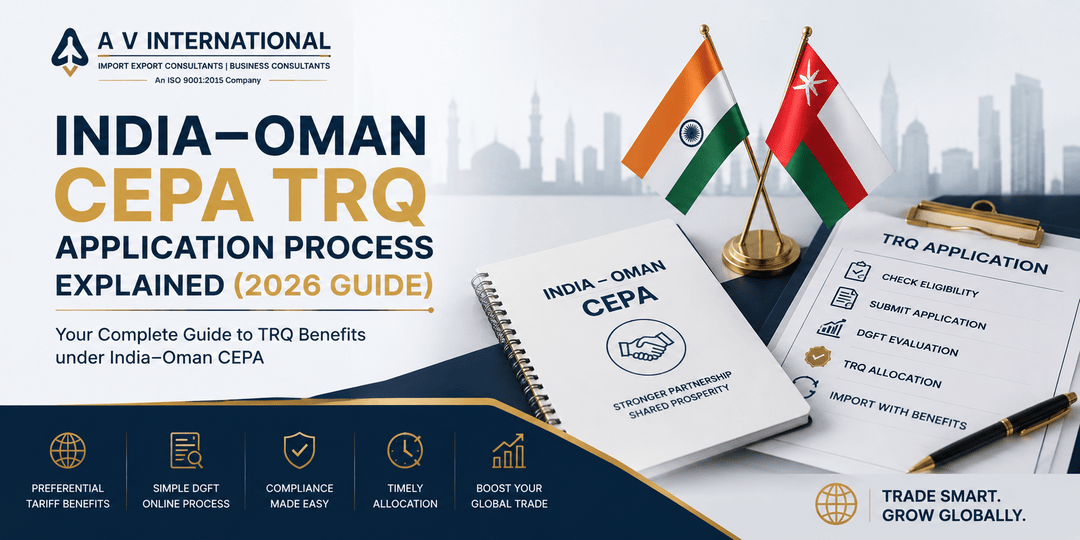

India–Oman CEPA TRQ Application Process Explained (2026 Guide)
Key Takeaways
-
India–Oman CEPA offers Tariff Rate Quota (TRQ) benefits on specified products.
-
Eligible businesses must apply through the DGFT portal within the prescribed application period.
-
Accurate documentation and product classification are essential for approval.
-
Missing deadlines or incorrect HS codes may result in rejection.
-
Early preparation improves approval chances and helps businesses maximize duty savings.
Introduction
The India–Oman Comprehensive Economic Partnership Agreement (CEPA) has opened new trade opportunities by providing reduced customs duties on selected products through the Tariff Rate Quota (TRQ) mechanism.
For businesses planning to import eligible products under the agreement, understanding the DGFT TRQ application process is critical. A properly submitted application can reduce import costs, improve competitiveness, and simplify trade planning.
This guide explains the complete India–Oman CEPA TRQ application process for 2026, including eligibility, required documents, application steps, timelines, and practical compliance tips.
What Is TRQ Under India–Oman CEPA?
A Tariff Rate Quota (TRQ) allows eligible products to be imported at a reduced or preferential customs duty up to a specified quota limit. Once the quota is exhausted, normal customs duties generally apply.
Under the India–Oman CEPA, DGFT administers TRQ allocations for notified products through a structured application process.
Why the TRQ Process Matters
Importers can benefit from:
-
Reduced customs duty
-
Lower landed costs
-
Improved pricing competitiveness
-
Better procurement planning
-
Increased trade opportunities under CEPA
However, businesses must follow DGFT procedures carefully to claim these benefits.
Who Can Apply?
Generally, eligible applicants include:
-
Importers holding a valid IEC
-
Manufacturers importing eligible products
-
Traders meeting DGFT requirements
-
Businesses importing notified TRQ products under CEPA
Eligibility depends on the applicable DGFT notification and product category.
Step-by-Step India–Oman CEPA TRQ Application Process
Step 1: Check Eligible Products
Verify whether your product is covered under the notified TRQ list and confirm the correct HS Code.
Step 2: Review DGFT Notification
Read the relevant DGFT Public Notice or Trade Notice to understand:
-
Quota quantity
-
Application window
-
Allocation criteria
-
Supporting document requirements
Step 3: Prepare Required Documents
Gather all necessary documents before starting the application.
Step 4: Submit Through DGFT Portal
Complete the online TRQ application within the prescribed timeline.
Step 5: Track Application Status
Monitor your application through the DGFT portal for updates or clarification requests.
Step 6: Receive TRQ Allocation
Approved applicants can utilize the allotted quota according to DGFT conditions.
Documents Required
While document requirements vary depending on the notification, businesses commonly need:
-
IEC Certificate
-
GST Registration
-
PAN
-
Product details
-
Correct HS Code
-
Import-related declarations
-
Additional documents specified by DGFT
Ensure all information matches your application exactly.
Featured Snippet Answer
To apply for India–Oman CEPA TRQ benefits in 2026, businesses must verify product eligibility, prepare the required documents, submit an online application through the DGFT portal within the prescribed timeline, and follow DGFT’s allocation procedure. Correct HS classification and complete documentation significantly improve approval chances.
Common Reasons for TRQ Application Rejection
Many applications face delays because of avoidable mistakes.
Watch out for:
-
Incorrect HS Code
-
Incomplete documentation
-
IEC mismatches
-
Late submission
-
Incorrect product classification
-
Missing declarations
Careful document verification before submission helps reduce these risks.
Best Practices for Faster Approval
Before applying:
-
Verify the latest DGFT notification.
-
Confirm HS Code accuracy.
-
Prepare documents in advance.
-
Submit before the deadline.
-
Keep digital copies of all records.
-
Monitor portal updates regularly.
Practical Business Tips
Businesses planning multiple imports should:
-
Estimate quota requirements early.
-
Coordinate with suppliers.
-
Track allocation timelines.
-
Maintain proper compliance records.
-
Plan customs clearance based on quota availability.
A proactive approach helps businesses maximize CEPA benefits.
FAQs
1. What is TRQ under India–Oman CEPA?
TRQ allows eligible products to be imported at preferential customs duty within notified quota limits.
2. Who manages TRQ applications?
The Directorate General of Foreign Trade (DGFT).
3. Is an IEC mandatory?
Yes, eligible applicants generally require a valid IEC.
4. Can incorrect HS Codes affect approval?
Yes. Incorrect classification is one of the most common reasons for application issues.
5. When should businesses apply?
Applications should be submitted during the DGFT-notified application window.
6. Does TRQ guarantee unlimited imports?
No. Benefits apply only within the allocated quota.
Conclusion
The India–Oman CEPA TRQ application process offers valuable duty-saving opportunities for businesses importing eligible products. However, success depends on accurate documentation, correct HS classification, timely submission, and careful compliance with DGFT requirements.
Planning ahead and maintaining proper records can help businesses secure TRQ allocations and avoid costly application errors.
Need Help with India–Oman CEPA TRQ Applications?
A V International has over 35 years of experience helping businesses with DGFT compliance, IEC-related services, TRQ applications, import-export documentation, and regulatory approvals across India.
Our experts assist businesses from application preparation to compliance support, helping reduce delays and improve approval success.
Written By
Akash Bhangare
Having more than 10 years of experience in EPR Compliance, Legal Metrology, DGFT Regulations, and Import Export Consulting Services in India.
Associated with A V International, a company with over 35 years of expertise in Environmental Compliance, EPR Registrations, Licensing, and Regulatory Approvals.
Recent Posts
- India–Oman CEPA TRQ Application Process Explained (2026 Guide)
- CPCB Lost Credentials Facility for Plastic EPR: Complete Guide for Businesses (2026)
- Customs Clearance Delay Due to SIMS 2.0 Filing Error? Complete Solution Guide (2026)
- How to Calculate Battery Waste EPR Targets Accurately in 2026
- DGFT Trade Notice 15/2026-27: New EODC Duty Payment Process Explained
FeATURED ARTICLES
SARAL SIMS for Steel Imports in India – Complete Guide The Government of India has introduced SARAL SIMS (Simplified Steel…
Top Export Compliance Mistakes: DGFT Advance Authorization, EPCG & CPCB (2025 Guide) Exporting in India can feel like a legal…
Environmental Clearance CPCB: Quick Guide for Exporters If you’re an Indian exporter or manufacturer working under schemes like the Advanced…
DGFT e-BRC Rule 2025: Key Update for Advance Authorization & EPCG Holders The Directorate General of Foreign Trade (DGFT) has…

