
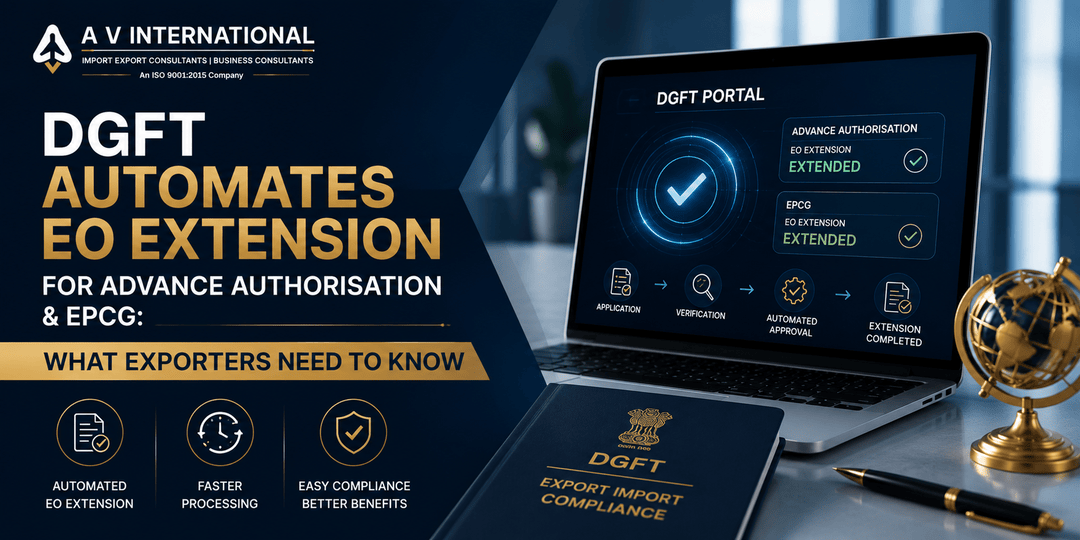

DGFT Automates EO Extension for Advance Authorisation & EPCG: What Exporters Need to Know
If your Advance Authorisation or EPCG Authorisation is approaching its Export Obligation (EO) deadline, DGFT has introduced an important process simplification that can reduce paperwork and manual follow-up.
DGFT has now introduced an automated facility for processing Export Obligation extensions in Advance Authorisation and EPCG cases considered by the PRC/EPCG Committee.
The biggest change is simple: once the Committee approves the EO extension, exporters covered by this facility will no longer need to file a separate EO-extension application with the concerned Regional Authority.
However, this does not mean that EO extensions are automatically granted.
Quick Take: What Exporters Need to Know
- DGFT has introduced automated processing of EO extensions for relevant Advance Authorisation and EPCG cases.
- The facility applies to cases considered by the PRC/EPCG Committee.
- If the Committee approves the extension, no separate EO-extension application is required before the concerned RA under this workflow.
- The exporter must pay the prescribed EO extension fee through the DGFT portal.
- After payment and submission of the response, the EO extension file will be automatically created and approved.
- The EO Extension Letter will be generated automatically.
- The revised EO expiry date will be updated in DGFT records and transmitted to ICEGATE.
What Has Changed?
Under the earlier process, even after the relevant Committee approved an EO extension, further processing before the concerned Regional Authority could be required.
DGFT has now automated this subsequent process.
Before
Committee approval → Separate EO extension application → RA processing → EO Extension Letter
Now
Committee approval → DGFT fee payment → Response submission → Automatic approval → EO Extension Letter
This is intended to reduce repetitive applications, manual intervention and processing requirements.
Is EO Extension Now Automatic?
No.
This is the most important point exporters should understand.
The new facility automates the processing of an approved extension. It does not automatically approve an EO extension merely because an exporter has an outstanding Export Obligation.
Where Committee consideration is required, the exporter must still approach the relevant PRC/EPCG Committee, and the Committee must approve the extension.
Exporter Tip: Do not allow your EO deadline to approach assuming that the new system will automatically extend your Export Obligation period.
How Does This Affect Advance Authorisation?
The Trade Notice specifically covers Advance Authorisation cases considered by the PRC.
Where the PRC approves an EO extension, the exporter will follow the automated process:
- DGFT issues communication for payment of the prescribed fee.
- Exporter pays the fee through the DGFT portal.
- Exporter submits the required response.
- The EO extension file is automatically created and approved.
- The EO Extension Letter is generated.
- The revised EO expiry date is updated in the system.
The underlying Advance Authorisation provisions relating to Export Obligation and extension continue to apply.
How Does This Affect EPCG?
The same automation applies to relevant EPCG Authorisation cases considered by the EPCG Committee.
Once the EPCG Committee approves the extension, the exporter does not need to initiate a separate EO-extension application before the concerned RA under the new automated workflow.
The exporter simply completes the prescribed payment and response through the DGFT portal, following which the system processes the extension and generates the EO Extension Letter.
Important Date
21 August 2026 – Date of DGFT Trade Notice No. 21/2026-27 introducing the automated EO-extension facility.
The Trade Notice does not separately specify a different effective date or state that all previously approved extensions will automatically be migrated to the new system.
Therefore, existing cases should be examined individually.
What Should Exporters Do Now?
Exporters with Advance Authorisations or EPCG Authorisations should:
- Review all upcoming EO expiry dates.
- Check the Export Obligation already fulfilled.
- Identify potential EO shortfalls.
- Determine whether an extension is required.
- Check whether PRC/EPCG Committee consideration is necessary.
- Keep supporting export and EO documents ready.
- Monitor the DGFT portal for the fee-payment communication.
- Complete payment and submit the required response.
- Download and preserve the EO Extension Letter.
- Verify the revised EO expiry date in the DGFT system.
Common Mistakes to Avoid
Do not assume that EO extension is automatically granted.
Also avoid:
- Waiting until the EO deadline before taking action.
- Assuming every AA/EPCG case requires Committee approval.
- Missing the prescribed fee payment.
- Assuming Committee approval alone completes the process.
- Failing to verify the system-generated EO Extension Letter.
- Assuming the new facility automatically applies retrospectively to every existing authorisation.
FAQs
Does DGFT now automatically extend Export Obligation?
No. The new facility automates processing after the relevant Committee approves the extension.
Does this apply to Advance Authorisation?
Yes, for relevant Advance Authorisation cases considered by the PRC.
Does this apply to EPCG?
Yes, for relevant EPCG cases considered by the EPCG Committee.
Do I need to file a separate RA application after Committee approval?
For cases covered by the new automated facility, no separate EO-extension application is required after Committee approval.
Will the revised EO date be updated in ICEGATE?
Yes. DGFT states that the revised EO expiry date will also be transmitted to ICEGATE.
Final Takeaway
DGFT Trade Notice No. 21/2026-27 is an important Ease of Doing Business initiative for exporters dealing with Advance Authorisation and EPCG Export Obligation extensions.
The key benefit is that after Committee approval, the subsequent EO-extension process is now automated, reducing duplicate applications and manual intervention.
However, exporters should remember:
Automated processing does not mean automatic approval.
If your Advance Authorisation or EPCG Export Obligation deadline is approaching, review your position early and determine the appropriate extension procedure.
Need Help With Your DGFT EO Extension?
A V International can assist exporters with Advance Authorisation, EPCG, Export Obligation Extension, PRC matters, Norms Fixation, Redemption/EODC and other DGFT compliance requirements.
With 35+ years of experience in DGFT and Customs consultancy, we help Indian exporters understand regulatory changes and complete the applicable DGFT procedures correctly.
Have an upcoming EO deadline? Contact A V International to review your case and determine the appropriate course of action.
Recent Posts
- DGFT Automates EO Extension for Advance Authorisation & EPCG: What Exporters Need to Know
- Latest ROSCTL Rates for Textile Products (2026 Updated List)
- ROSCTL Pending Status on ICEGATE? Here’s the Exact Solution
- RoDTEP Claim Rejected Due to Shipping Bill Error? Complete Solution Guide
- India–Oman CEPA TRQ Application Process Explained (2026 Guide)
FeATURED ARTICLES
SARAL SIMS for Steel Imports in India – Complete Guide The Government of India has introduced SARAL SIMS (Simplified Steel…
Top Export Compliance Mistakes: DGFT Advance Authorization, EPCG & CPCB (2025 Guide) Exporting in India can feel like a legal…
Environmental Clearance CPCB: Quick Guide for Exporters If you’re an Indian exporter or manufacturer working under schemes like the Advanced…
DGFT e-BRC Rule 2025: Key Update for Advance Authorization & EPCG Holders The Directorate General of Foreign Trade (DGFT) has…

