
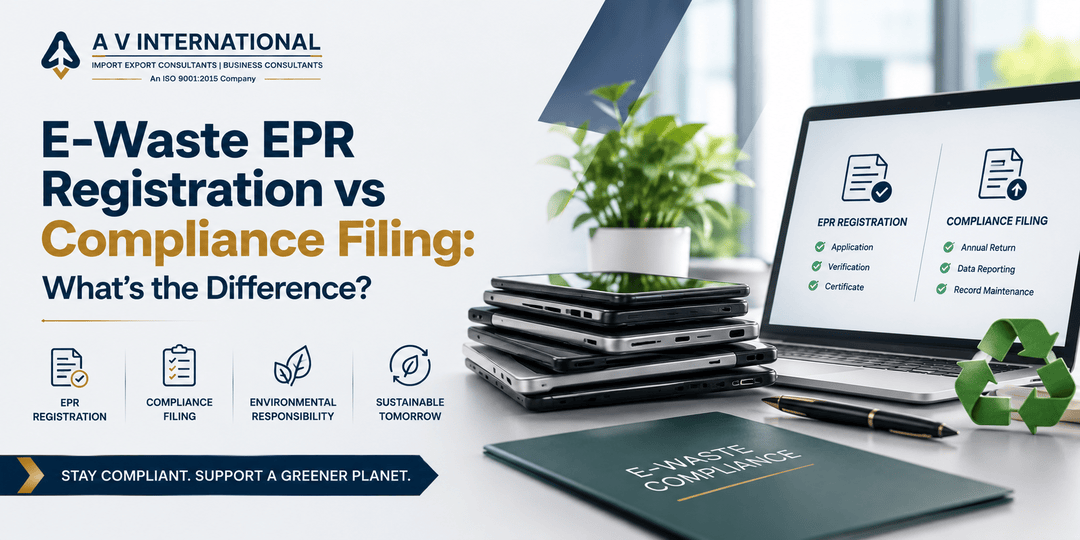

E-Waste EPR Registration vs Compliance Filing: What’s the Difference?
Key Takeaways
-
E-Waste EPR registration and compliance filing are two separate regulatory requirements.
-
Registration establishes the entity’s eligibility to operate under the applicable E-Waste Management Rules.
-
Compliance filing involves reporting required information, meeting EPR obligations, and submitting applicable returns.
-
Producers, manufacturers, recyclers, and refurbishers have different responsibilities.
-
Registration alone does not mean that all ongoing compliance obligations have been fulfilled.
-
Businesses should maintain accurate sales, recycling, and transaction records and monitor CPCB portal updates.
Introduction
Businesses dealing with electrical and electronic equipment often confuse E-Waste EPR registration with compliance filing. Although both are connected to the Central Pollution Control Board (CPCB), they serve different purposes.
Registration is generally the initial step for covered entities to enter the regulatory framework. Compliance filing involves meeting the applicable obligations after registration, including submitting prescribed information and returns.
Understanding this distinction is important for importers, manufacturers, producers, brand owners, and recycling businesses. Missing either requirement can create regulatory complications and affect business operations.
What Is E-Waste EPR Registration?
E-Waste Extended Producer Responsibility (EPR) registration is the process through which eligible entities register on the CPCB E-Waste EPR portal under the E-Waste (Management) Rules, 2022, as amended.
Registration requirements depend on the entity’s role and the applicable rules.
The portal provides registration facilities for relevant stakeholders, including:
-
Producers: Businesses manufacturing or importing covered electrical and electronic equipment or selling such equipment under their own brand, subject to the regulatory definition.
-
Manufacturers: Entities manufacturing covered electrical and electronic equipment.
-
Recyclers: Entities involved in recycling e-waste through authorized and registered operations.
-
Refurbishers: Entities undertaking covered refurbishment activities.
Registration establishes the entity’s regulatory status under the applicable framework. However, it does not automatically complete every future reporting or operational requirement.
Official reference: CPCB E-Waste EPR Portal.
What Is E-Waste EPR Compliance Filing?
Compliance filing refers to the ongoing reporting and regulatory activities required under the applicable E-Waste Management Rules and CPCB procedures.
Depending on the stakeholder category, these activities may include:
-
Filing applicable quarterly returns and annual returns.
-
Reporting sales, manufacturing, recycling, or refurbishment data.
-
Maintaining records supporting the information submitted.
-
Meeting applicable EPR targets.
-
Purchasing and transferring valid EPR certificates where required.
-
Correcting portal discrepancies and responding to regulatory queries.
For producers, compliance includes fulfilling applicable EPR obligations through the prescribed mechanism, including purchasing eligible EPR certificates from registered recyclers and submitting the required information through the portal.
Recyclers and other registered stakeholders have their own reporting and operational responsibilities. The precise requirements depend on the category and the applicable rules.
E-Waste EPR Registration vs Compliance Filing: Key Differences
| Basis | EPR Registration | Compliance Filing |
|---|---|---|
| Main purpose | Establishes registration under the applicable framework | Demonstrates ongoing compliance |
| Timing | Usually required before commencing covered regulated activities | Repeated as applicable after registration |
| Main focus | Business details, stakeholder category, and supporting documents | Returns, operational data, EPR obligations, and records |
| Portal activity | Application submission and registration status | Reporting, return submission, and obligation-related transactions |
| Frequency | According to registration requirements and changes requiring updates | Quarterly, annually, or as otherwise prescribed |
| Result | Registration approval or certificate, where applicable | Reporting record and compliance status for the relevant obligation |
| Common risk | Operating without required registration | Missing returns, inaccurate data, or unfulfilled obligations |
Important: The table provides a general comparison. Exact requirements and timelines must be checked against the current rules, CPCB instructions, and the entity’s category.
Documents and Information Required
For E-Waste EPR Registration
Depending on the applicant category and current CPCB standard operating procedure (SOP), information may include:
-
PAN and business identification details.
-
GST registration details, where applicable.
-
Importer or manufacturer information.
-
Brand and electrical/electronic equipment details.
-
Product categories and relevant technical information.
-
Manufacturing, recycling, or refurbishment facility details, where applicable.
-
Supporting declarations and documents prescribed by CPCB.
The required documents vary by stakeholder category. Applicants should follow the relevant registration SOP rather than relying on a generic checklist.
For Compliance Filing
Businesses should maintain the records relevant to their role, such as:
-
Product-wise sales or manufacturing data.
-
Import and supply records.
-
EPR target calculations and supporting data.
-
EPR certificate purchase and transfer records, where applicable.
-
Recycling, processing, or refurbishment records.
-
Previous returns, acknowledgements, and portal communications.
Accurate and consistent records help businesses reconcile portal submissions with their underlying transactions.
How to Manage Both Requirements Correctly
Step 1: Identify your stakeholder category. Determine whether your business qualifies as a producer, manufacturer, recycler, or refurbisher under the applicable rules.
Step 2: Complete the relevant registration. Apply through the official CPCB E-Waste EPR portal and submit the information required for your category.
Step 3: Review your ongoing obligations. Identify the applicable EPR targets, reporting periods, returns, and recordkeeping requirements.
Step 4: Reconcile business data. Match sales, import, production, and other relevant information with supporting records before filing.
Step 5: Complete applicable EPR transactions. Producers should track their obligations and ensure that required EPR certificates and related transactions are handled through the prescribed system.
Step 6: Submit returns and retain evidence. File applicable returns within the prescribed timelines and preserve acknowledgements and supporting documents.
Step 7: Monitor portal notices. Check CPCB announcements for changes to filing schedules, procedures, or documentation requirements.
Common Mistakes Businesses Should Avoid
-
Assuming that an approved registration completes all EPR obligations.
-
Missing quarterly or annual return deadlines.
-
Reporting sales or recycling data inaccurately.
-
Failing to reconcile EPR targets with available certificates.
-
Using incomplete or inconsistent supporting records.
-
Ignoring portal notices, errors, or requests for clarification.
The CPCB portal has specifically reminded stakeholders to file applicable quarterly returns regularly and on time. Non-compliance may lead to regulatory action. Official CPCB portal.
Featured Snippet Answer: What Is the Difference Between E-Waste EPR Registration and Compliance Filing?
E-Waste EPR registration establishes a covered business’s registration under the applicable CPCB framework. Compliance filing involves meeting ongoing obligations, such as submitting prescribed returns, reporting relevant business data, maintaining records, and fulfilling applicable EPR targets. Registration and compliance filing are separate responsibilities, and businesses must complete both wherever required.
Frequently Asked Questions
1. Is E-Waste EPR registration the same as compliance filing?
No. Registration establishes the entity’s regulatory registration, while compliance filing covers ongoing reporting and other obligations under the applicable rules.
2. Is registration mandatory for every business selling electronic products?
Applicability depends on the entity’s activities, the product category, and the definitions under the E-Waste (Management) Rules, 2022, as amended. Businesses should verify their status before applying.
3. Do registered producers need to file returns?
Producers must fulfil the applicable reporting requirements, including prescribed quarterly and annual returns, as required under the rules and current CPCB procedures.
4. Can a business complete registration and still be non-compliant?
Yes. A business may hold registration but fail to meet return-filing, EPR target, recordkeeping, or other applicable obligations.
5. Who should purchase EPR certificates?
Registered producers must fulfil applicable EPR obligations through the prescribed mechanism, which includes purchasing eligible EPR certificates from registered recyclers where required.
6. Where can businesses check E-Waste EPR requirements?
Businesses should consult the official CPCB E-Waste EPR portal for the applicable rules, amendments, SOPs, FAQs, and notices.
Conclusion
E-Waste EPR registration and compliance filing serve different but connected purposes. Registration establishes the required regulatory status, while ongoing compliance ensures that the business fulfils its applicable reporting and EPR responsibilities.
Businesses should verify their stakeholder category, maintain accurate records, track deadlines, and review CPCB updates regularly. A structured compliance process can help reduce reporting errors and regulatory risks.
Need Professional Help with E-Waste EPR Compliance?
A V International assists businesses with E-Waste EPR registration, compliance documentation, return filing support, and regulatory requirements in India.
Contact our team for assistance in understanding the applicable requirements for your business and managing your EPR compliance process efficiently.
Written By
Akash Bhangare
Having more than 10 years of experience in EPR Compliance, Legal Metrology, DGFT Regulations, and Import Export Consulting Services in India.
Associated with A V International, a company with over 35 years of expertise in Environmental Compliance, EPR Registrations, Licensing, and Regulatory Approvals.
Recent Posts
- E-Waste EPR Registration vs Compliance Filing: What’s the Difference?
- DGFT Norms Fixation Documents Required: Complete Checklist for Exporters
- RoDTEP Scheme Extended Till 31 December 2026: What Exporters Need to Know
- Ad-Hoc Norms Fixation for Advance Authorisation: DGFT Process 2026
- How to Claim ROSCTL Benefits for Textile Exporters in India (2026 Guide)
FeATURED ARTICLES
SARAL SIMS for Steel Imports in India – Complete Guide The Government of India has introduced SARAL SIMS (Simplified Steel…
Top Export Compliance Mistakes: DGFT Advance Authorization, EPCG & CPCB (2025 Guide) Exporting in India can feel like a legal…
Environmental Clearance CPCB: Quick Guide for Exporters If you’re an Indian exporter or manufacturer working under schemes like the Advanced…
DGFT e-BRC Rule 2025: Key Update for Advance Authorization & EPCG Holders The Directorate General of Foreign Trade (DGFT) has…

