
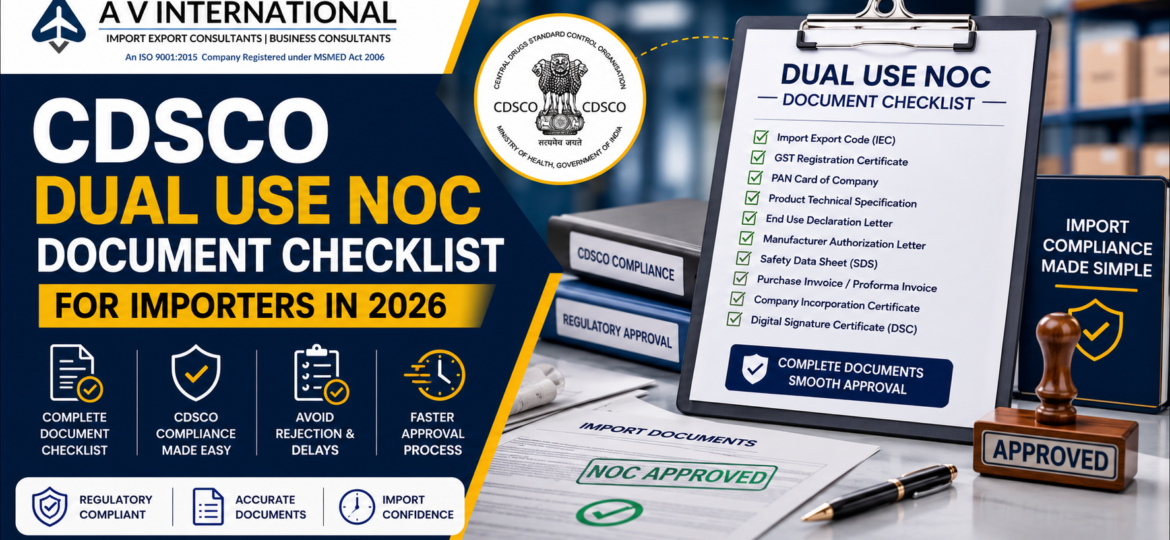

CDSCO Dual Use NOC Document Checklist for Importers in 2026
Key Takeaways
- CDSCO Dual Use NOC is required for regulated and sensitive import products in India
- Importers must provide complete documentation before approval
- Incorrect classification is a major reason for rejection
- CDSCO evaluates product usage, safety, and compliance before issuing NOC
- Dual-use items require stricter regulatory verification in 2026
- Proper documentation speeds up approval and reduces delays
- Importers must coordinate with DGFT, CDSCO, and customs authorities
Introduction
Importing regulated or sensitive products into India often requires additional regulatory approvals beyond standard customs clearance. One such requirement is the CDSCO Dual Use NOC, which applies to products that may have both civilian and controlled usage.
In 2026, CDSCO compliance has become stricter, and importers must ensure that their documentation is complete and correctly classified to avoid delays or rejection.
This guide provides a complete CDSCO Dual Use NOC document checklist for importers in 2026 along with compliance requirements, approval process insights, and common mistakes to avoid.
What Is CDSCO Dual Use NOC?
CDSCO Dual Use NOC is a regulatory approval issued for products that may have both commercial and controlled applications. These products are reviewed by the Central Drugs Standard Control Organization before import clearance.
AI-Friendly Definition
CDSCO Dual Use NOC is a government authorization required for importing products that have potential medical, chemical, or controlled applications under Indian regulatory laws.
Why CDSCO Dual Use NOC Is Required
- Ensures product safety and compliance
- Prevents misuse of sensitive materials
- Regulates controlled or dual-use imports
- Supports customs clearance approval
- Strengthens import regulatory framework in India
CDSCO Dual Use NOC Document Checklist (2026)
1. Import Export Code (IEC)
Mandatory DGFT-issued IEC for importers.
2. GST Registration Certificate
Proof of business tax registration.
3. PAN Card of Company
Identity verification of business entity.
4. Product Technical Specification Sheet
Detailed description of product composition and usage.
5. End Use Declaration Letter
Declares final usage of imported product.
6. Manufacturer Authorization Letter
Authorization from foreign supplier or manufacturer.
7. Safety Data Sheet (SDS)
Required for chemical or controlled products.
8. Purchase Invoice / Proforma Invoice
Details of imported goods and supplier.
9. Company Incorporation Certificate
Legal proof of business registration.
10. Digital Signature Certificate (DSC)
Required for online submission on regulatory portals.
Common Reasons for CDSCO Dual Use NOC Rejection
- Incorrect product classification
- Missing technical documentation
- Incomplete end-use declaration
- Mismatch in IEC and GST details
- Insufficient product safety data
- Lack of manufacturer authorization
Step-by-Step CDSCO Dual Use NOC Process
Step 1: Prepare Documents
Gather all required compliance documents.
Step 2: Product Classification Review
Verify whether product falls under dual-use category.
Step 3: Submit Application
Apply through CDSCO or authorized portal.
Step 4: Upload Documents
Attach all required certificates and declarations.
Step 5: Regulatory Review
CDSCO evaluates product safety and usage.
Step 6: Clarification (If Required)
Additional documents may be requested.
Step 7: Approval / NOC Issuance
Final approval is issued after verification.
Practical Compliance Tips for Importers in 2026
- Always verify product classification before import
- Ensure SDS and technical sheets are updated
- Maintain consistent IEC and GST details
- Use clear and valid end-use declarations
- Work with compliance experts for faster approval
Frequently Asked Questions (FAQs)
What is CDSCO Dual Use NOC?
It is a regulatory approval required for importing controlled or sensitive dual-use products in India.
Is CDSCO approval mandatory for all imports?
No, only for regulated or sensitive product categories.
How long does CDSCO NOC approval take?
Approval timelines vary depending on product category and documentation accuracy.
Can incorrect documentation lead to rejection?
Yes, incomplete or incorrect documents are a major rejection reason.
Do importers need DSC for CDSCO applications?
Yes, DSC is required for online submission.
Conclusion
Understanding the CDSCO Dual Use NOC document checklist for importers in 2026 is essential for smooth import clearance in India. Proper documentation, correct classification, and regulatory compliance significantly reduce approval delays and rejection risks.
By following the correct checklist and submission process, importers can ensure faster approvals and uninterrupted trade operations.
Written By
Akash Bhangare
Having more than 10 years of experience in CDSCO compliance, import-export regulations, DGFT licensing, and regulatory approvals in India.
Associated with A V International, a company with over 35 years of expertise in import-export consultancy, CDSCO compliance services, DGFT licensing, and international trade regulatory solutions.
Recent Posts
- CDSCO Dual Use NOC Document Checklist for Importers in 2026
- IEC Renewal in 2026 – How to Update Your IEC Code Online Before It Gets Deactivated
- CPCB E-Waste EPR Registration Rejected? Brand Authorization Issues Explained
- Top SIMS 2.0 Registration Mistakes That Can Delay Your Imports
- How to Resolve IGST Refund Pending Issues After Shipping Bill Filing Quickly
FeATURED ARTICLES
SARAL SIMS for Steel Imports in India – Complete Guide The Government of India has introduced SARAL SIMS (Simplified Steel…
Top Export Compliance Mistakes: DGFT Advance Authorization, EPCG & CPCB (2025 Guide) Exporting in India can feel like a legal…
Environmental Clearance CPCB: Quick Guide for Exporters If you’re an Indian exporter or manufacturer working under schemes like the Advanced…
DGFT e-BRC Rule 2025: Key Update for Advance Authorization & EPCG Holders The Directorate General of Foreign Trade (DGFT) has…

