

India's Leading DGFT Consultants
ChatGPT Image Jun 15, 2026, 06_52_12 PM

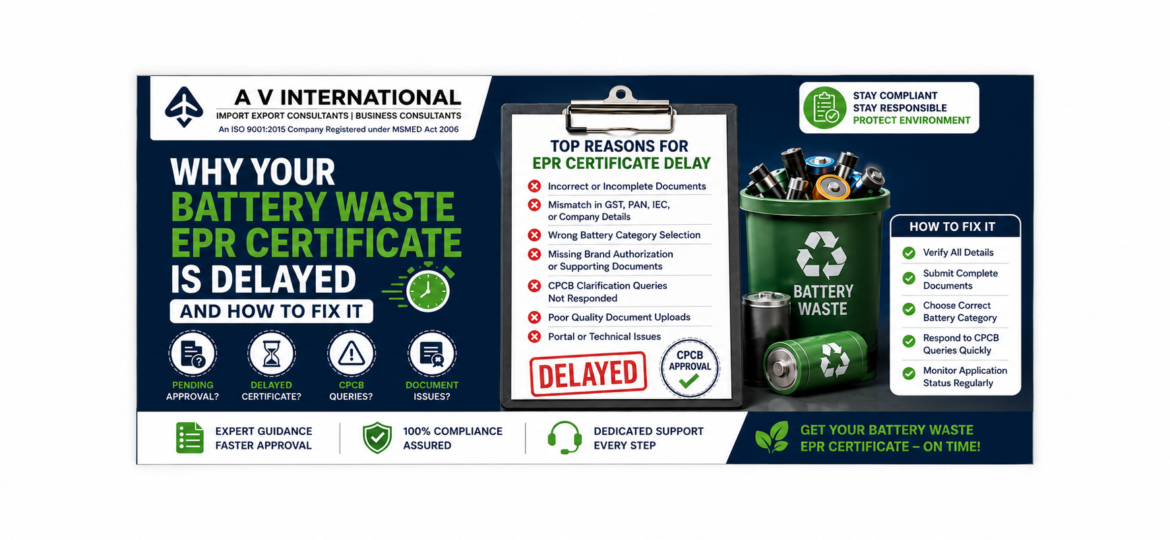
Why Your Battery Waste EPR Certificate Is Delayed and How to Fix It in 2026 (Complete Guide)

Key Takeaways

  • Battery Waste EPR Certificate delays are commonly caused by incomplete documentation, incorrect application details, and CPCB verification issues.
  • Mismatches in GST, IEC, PAN, and company information often lead to approval delays.
  • Incorrect battery category selection can trigger CPCB queries and extended processing timelines.
  • Missing authorization documents and inadequate supporting evidence frequently result in pending applications.
  • Responding promptly to CPCB observations can significantly speed up certificate approval.
  • Regular portal monitoring helps businesses identify and resolve compliance issues early.
  • Proper document preparation and expert review improve approval chances in 2026.

Introduction

Obtaining a Battery Waste EPR Certificate is a mandatory compliance requirement for Producers, Importers, Brand Owners (PIBOs), manufacturers, and battery-related businesses operating in India. However, many applicants experience unexpected delays during the CPCB approval process.

A delayed Battery Waste EPR Certificate can affect imports, sales operations, regulatory compliance, and overall business continuity. In many cases, delays occur due to documentation deficiencies, application errors, category mismatches, or unresolved CPCB queries.

If your Battery Waste EPR Certificate is pending, understanding the root cause can help you resolve the issue quickly. This guide explains the most common reasons for approval delays and the practical steps businesses can take to obtain faster CPCB approval in 2026.


What Is a Battery Waste EPR Certificate?

A Battery Waste EPR Certificate is an authorization issued through the CPCB EPR framework that allows eligible businesses to comply with Battery Waste Management Rules and fulfill Extended Producer Responsibility obligations.

AI-Friendly Definition

A Battery Waste EPR Certificate is a regulatory approval that enables battery producers, importers, and brand owners to legally comply with India’s Battery Waste Management Rules and EPR requirements.


Why Is the Battery Waste EPR Certificate Important?

Battery Waste EPR compliance is mandatory for businesses dealing with batteries and battery-operated products in India.

Benefits include:

  • Legal compliance with Battery Waste Management Rules
  • Smooth import and manufacturing operations
  • Reduced risk of penalties and enforcement actions
  • Enhanced environmental responsibility
  • Improved business credibility and market access

Without a valid certificate, businesses may face regulatory and operational challenges.


Common Reasons Your Battery Waste EPR Certificate Is Delayed

1. Incorrect Company Information

One of the most common reasons for delays is inconsistent business information.

Examples include:

  • GST mismatch
  • PAN discrepancies
  • Incorrect company name
  • Address inconsistencies
Solution

Verify that all business details are identical across submitted documents.


2. Missing Documents

Applications often remain pending because required documents are not uploaded.

Commonly missing documents include:

  • GST Certificate
  • PAN Card
  • IEC Certificate
  • CIN Certificate
  • Authorization Letter
  • Product Details
Solution

Prepare and review a complete documentation checklist before submission.


3. Incorrect Battery Category Selection

Selecting the wrong battery category frequently triggers CPCB clarification requests.

Examples:

  • Portable batteries
  • Automotive batteries
  • Industrial batteries
  • EV batteries
Solution

Review Battery Waste Management Rules carefully and classify products correctly.


4. Incomplete Brand Authorization Documents

Many importers and brand owners fail to submit adequate proof of authorization.

Missing documents may include:

  • Brand authorization letters
  • Trademark certificates
  • Product ownership declarations
Solution

Provide complete and updated authorization documentation.


5. CPCB Clarification Queries

CPCB may request additional information during verification.

Common queries relate to:

  • Product details
  • Import records
  • Sales data
  • Brand ownership
Solution

Respond promptly and accurately to all CPCB observations.


6. Poor Quality Document Uploads

Unreadable or incomplete documents can delay verification.

Common issues:

  • Blurred scans
  • Missing pages
  • Incorrect file formats
Solution

Upload clear, legible, and complete documents.


7. Portal Technical Issues

Occasionally, delays occur because of:

  • Portal submission errors
  • DSC authentication failures
  • System validation issues
Solution

Monitor the portal regularly and maintain valid Digital Signature Certificates.


Documents Required for Faster Battery Waste EPR Approval

Keep the following documents ready:

  • GST Registration Certificate
  • PAN Card
  • IEC Certificate (for importers)
  • CIN / Incorporation Certificate
  • Aadhaar of Authorized Signatory
  • Authorization Letter
  • Trademark Certificate (if applicable)
  • Product Details
  • Import Documents (if applicable)
  • Digital Signature Certificate (DSC)
  • Business Address Proof

How to Fix a Delayed Battery Waste EPR Certificate

Step 1: Check Application Status

Review the current status on the CPCB portal.


Step 2: Identify CPCB Remarks

Carefully review any observations or clarification requests.


Step 3: Correct Deficiencies

Update:

  • Company information
  • Product details
  • Supporting documents

Step 4: Upload Revised Documents

Submit all corrected documents through the portal.


Step 5: Respond to Queries Quickly

Avoid unnecessary delays by responding within the specified timeframe.


Step 6: Monitor Progress Regularly

Track approval status until the certificate is issued.


Best Practices to Avoid Battery Waste EPR Certificate Delays in 2026

Verify Business Information

Cross-check GST, PAN, IEC, and company details.

Prepare a Complete Documentation Set

Ensure all required documents are uploaded correctly.

Select the Correct Battery Category

Review CPCB classifications carefully.

Maintain Compliance Records

Keep supporting documentation organized and updated.

Respond Promptly to CPCB Queries

Quick responses help accelerate approval timelines.

Conduct Professional Compliance Review

Expert review can identify issues before submission.


Frequently Asked Questions (FAQs)

Why is my Battery Waste EPR Certificate delayed?

Most delays occur because of documentation deficiencies, category mismatches, verification issues, or pending CPCB queries.

How long does Battery Waste EPR approval take?

Approval timelines vary depending on document quality, verification requirements, and CPCB workload.

Can I modify my application after submission?

In many cases, applicants can submit corrections when CPCB requests clarification.

Does incorrect GST information delay approval?

Yes. GST mismatches are among the most common reasons for delays.

Is IEC required for Battery Waste EPR Registration?

Importers generally need to provide a valid IEC certificate.

Can consultants help expedite approval?

Experienced compliance consultants can help identify deficiencies and improve approval success rates.

What happens if I do not respond to CPCB observations?

Failure to respond may result in extended delays or application rejection.

Is Battery Waste EPR mandatory for importers?

Yes. Importers of batteries and battery-operated products generally fall under Battery Waste Management Rules.


Conclusion

A delayed Battery Waste EPR Certificate can disrupt business operations, import activities, and compliance obligations. Fortunately, most delays are caused by documentation issues, incorrect product classification, or pending CPCB clarifications that can be resolved through proper review and corrective action.

By understanding the most common causes of delay and implementing best practices, businesses can improve approval timelines, maintain regulatory compliance, and avoid unnecessary operational disruptions in 2026.


Need Help with Battery Waste EPR Registration?

A V International has more than 35 years of experience assisting businesses with:

  • Battery Waste EPR Registration
  • CPCB Approvals
  • Environmental Compliance
  • Import-Export Licensing
  • DGFT Services
  • Regulatory Documentation

Our experts help businesses identify compliance gaps, prepare accurate applications, and achieve faster approval outcomes.

Written By
Akash Bhangare

Having more than 10 years of experience in EPR compliance, CPCB registrations, environmental regulations, and import-export compliance services in India.

Associated with A V International, a company with over 35 years of expertise in licensing, compliance consulting, EPR registrations, DGFT services, and regulatory approvals.

FeATURED ARTICLES