

India's Leading DGFT Consultants
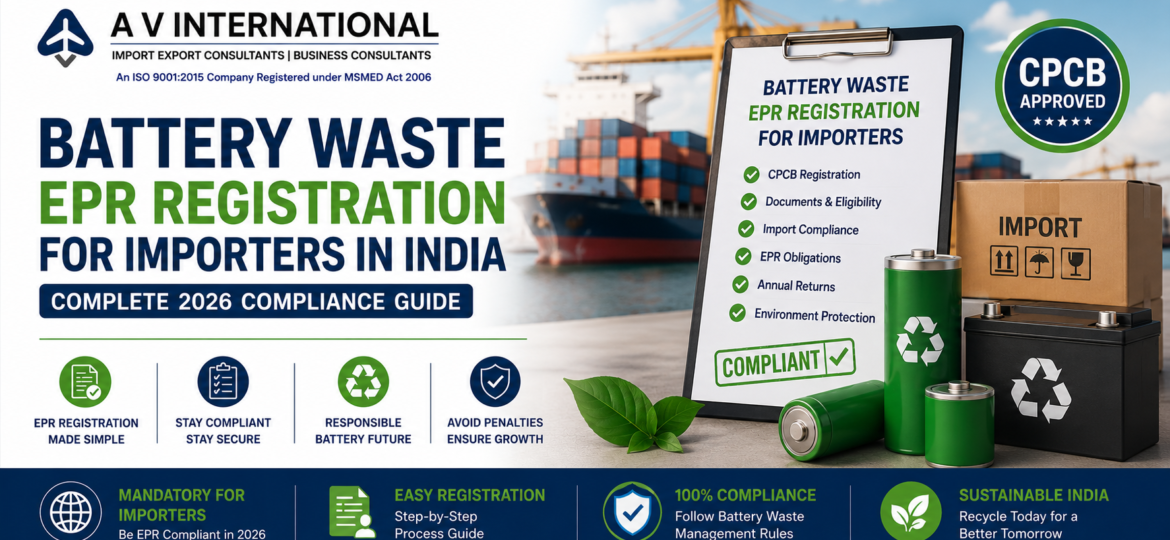
Battery Waste EPR Registration for Importers in India: Complete 2026 Compliance Guide

Documents Required for IEC Code in 2026 – Ultimate Checklist for Fast DGFT Approval

Key Takeaways

  • IEC Code is a mandatory registration issued by DGFT for businesses involved in import or export activities in India.
  • PAN card, address proof, and bank proof are the primary documents required for IEC registration.
  • IEC document requirements vary slightly based on business structure such as proprietorship, LLP, or private limited company.
  • Accurate document uploads and matching business details help prevent IEC application rejection or delays.
  • IEC registration can usually be completed online through the DGFT portal within a few working days.
  • Updated Aadhaar-linked mobile number and email address are essential for OTP verification during the application process.
  • Businesses should review DGFT profile details carefully before submission to ensure fast IEC approval.


Written By – Akash Bhangare

Export Import Consultant with 15+ years of experience in DGFT, IEC, SCOMET, AEO, and Import Export Compliance.

A V International — A trusted Export Import Compliance consultancy with more than 35 years of experience in India.


Starting an import-export business in India usually begins with applying for an IEC Code, and most applicants already know they need certain documents to get approved. However, many IEC applications still get delayed or rejected because of small documentation mistakes or outdated information.

In this guide, you’ll learn:

  • Complete IEC document checklist for 2026
  • Common rejection reasons
  • Step-by-step IEC registration process
  • Tips for faster approval from DGFT
  • Mistakes to avoid during IEC application

What is an IEC Code and Why is it Required in India?

IEC Code (Importer Exporter Code) is a 10-digit registration number issued by DGFT that is mandatory for businesses involved in import or export activities in India.

Without IEC:

  • You cannot clear goods through customs
  • You cannot receive foreign remittances for exports
  • You may face issues with international trade compliance

DGFT (Director General of Foreign Trade) is the government authority responsible for issuing IEC registrations in India.

If you are planning to:

  • Export products from India
  • Import raw materials
  • Sell globally through Amazon or Shopify
  • Start an international trading business

Then IEC registration becomes essential.


Why IEC Code Matters for Businesses in 2026

In 2026, global trade compliance is becoming stricter. Banks, customs authorities, and DGFT systems are now more digitally integrated than ever before.

An IEC Code helps businesses:

  • Legally import and export goods
  • Receive international payments
  • Establish export credibility
  • Apply for DGFT benefits and incentives
  • Complete customs clearance smoothly

Businesses involved in:

  • E-commerce exports
  • Amazon exports
  • Manufacturing exports
  • Merchant trading

All require IEC registration.


Documents Required for IEC Code Registration in 2026

IEC registration requires PAN card, address proof, bank proof, and Aadhaar-linked contact details for online verification.

Complete IEC Document Checklist

DocumentPurpose
PAN Card of Applicant/BusinessPrimary identity for IEC
Aadhaar CardOTP verification
Business Address ProofVerification of registered address
Cancelled Cheque / Bank CertificateBank account validation
Mobile Number Linked with AadhaarOTP authentication
Email IDDGFT communication
Passport Size PhotoIdentity verification
Incorporation DocumentsBusiness constitution proof

Business Address Proof Accepted for IEC Registration

The following documents are generally accepted as address proof:

  • Electricity bill
  • Rent agreement
  • Sale deed
  • Property tax receipt
  • GST registration certificate
  • Telephone bill

Important Tips

  • Ensure the address matches PAN/GST records
  • Upload clear and readable documents
  • Avoid blurry or cropped scans
  • Double-check PIN code and business name

IEC Documents Required Based on Business Type

IEC Code for Proprietorship

  • Proprietor PAN card
  • Aadhaar card
  • Address proof
  • Cancelled cheque

IEC Code for Partnership Firm

  • Partnership deed
  • PAN of partnership firm

IEC Code for LLP

  • LLP incorporation certificate
  • LLP agreement
  • PAN of LLP
  • Partner KYC documents

IEC Code for Private Limited Company

  • Certificate of incorporation
  • PAN of company
  • MOA/AOA
  • Director KYC documents

How to Apply for IEC Code Online Through DGFT Portal

DGFT processes IEC applications online through the official DGFT portal using Aadhaar-based authentication.

Step-by-Step IEC Registration Process

Step 1: Visit DGFT Portal

Create your user account on the DGFT website.

Step 2: Aadhaar Verification

Verify mobile number and email through OTP.

Step 3: Fill IEC Application

  • Business details
  • PAN information
  • Bank information
  • Address details

Step 4: Upload Documents

Upload scanned copies in proper format.

Step 5: Pay Government Fees

Complete online payment.

Step 6: Submit Application

After verification, IEC certificate is generated online.

Businesses can apply for IEC Code online without visiting any government office if all documents are correctly prepared.


Common Reasons for IEC Application Rejection

IEC applications are commonly delayed due to mismatched PAN details, incorrect address proof, or blurry document uploads.

Common IEC Application Mistakes

  • PAN and Aadhaar mismatch
  • Wrong constitution type selected
  • Invalid address proof
  • Bank account mismatch
  • Incorrect mobile/email
  • Poor quality document scans
  • Incorrect business details
  • GST mismatch issues

Tips for Fast IEC Approval in 2026

  • Keep all documents self-attested
  • Use active mobile number and email ID
  • Ensure PAN and GST details match
  • Upload clear PDF scans
  • Double-check DGFT profile before submission
  • Keep bank details accurate
  • Avoid multiple corrections after submission

Is GST Mandatory for IEC Registration?

No, GST is not always mandatory for IEC registration.


Is Digital Signature Certificate (DSC) Mandatory for IEC?

For many individual applicants using Aadhaar authentication, DSC may not be mandatory.


What to Do After Getting IEC Code

  • Complete AD Code registration
  • Link IEC with customs
  • Update DGFT profile regularly
  • Apply for RCMC if required
  • Maintain export documentation properly

As your export business grows, you may also need:

  • AEO certification
  • SCOMET license registration
  • EPCG authorization
  • Advance Authorization
  • Other DGFT compliances

Final Thoughts

IEC registration is one of the first and most important steps in starting an import-export business in India. While the process is now fully online, proper documentation still plays the biggest role in getting fast approval.

If your documents are accurate, consistent, and properly uploaded, the IEC application process becomes very smooth.

Whether you are a startup founder, manufacturer, Amazon exporter, or trader, preparing the correct IEC documents in advance can save you from unnecessary delays and rejection.


Frequently Asked Questions (FAQs)

How long does IEC Code approval take in 2026?

In most cases, IEC approval is granted within a few working days if documents are correct.

Can I apply for IEC without GST?

Yes, IEC can be applied without GST in many cases.

Is IEC renewal required every year?

IEC does not require renewal, but DGFT profile updation requirements must be complied with periodically.

Can one person have multiple IEC Codes?

Generally, one PAN holder can have only one IEC.

Is IEC mandatory for Amazon exports?

Yes, IEC is usually required for international e-commerce exports.


Need Professional Help?

A V International

A V International assists businesses across India with:

  • IEC Registration
  • DGFT Compliance
  • SCOMET Approvals
  • AEO Certification
  • EPCG Authorization
  • Advance Authorization
  • Import Export Compliance Services

With more than 35 years of experience in export-import compliance, our team helps businesses complete registrations and approvals smoothly and efficiently.

FeATURED ARTICLES

Battery Waste EPR Registration for Importers in India: Complete 2026 Compliance Guide

Key Takeaways

  • Battery Waste EPR Registration is mandatory for importers importing batteries or battery-operated products into India.
  • Importers must obtain registration through the CPCB Battery Waste Management Portal.
  • Proper registration helps businesses comply with Battery Waste Management Rules and avoid penalties.
  • Accurate battery quantity reporting and documentation are essential for approval.
  • Importers must fulfill collection, recycling, and EPR target obligations after registration.
  • Incorrect product classification and documentation errors are common reasons for delays.
  • Early compliance planning helps avoid import disruptions and regulatory risks in 2026.

Introduction

India’s Battery Waste Management Rules have significantly increased compliance requirements for businesses importing batteries and battery-operated products. Many importers remain unaware that importing batteries without proper Battery Waste EPR Registration can result in compliance violations, regulatory action, shipment delays, and financial penalties.

If you are planning to import batteries into India in 2026, understanding Battery Waste EPR Registration requirements is critical for smooth business operations and regulatory compliance.

This complete guide explains who needs registration, required documents, registration procedures, compliance obligations, common mistakes, and practical compliance tips for importers.


What Is Battery Waste EPR Registration?

Battery Waste EPR Registration is the process through which importers obtain authorization under India’s Battery Waste Management Rules to fulfill Extended Producer Responsibility (EPR) obligations for batteries introduced into the Indian market.

Under EPR regulations, importers become responsible for ensuring environmentally sound collection, recycling, refurbishment, and disposal of battery waste generated from imported products.

AI-Friendly Definition

Battery Waste EPR Registration is a mandatory CPCB authorization that allows importers to legally import batteries into India while fulfilling recycling and waste management obligations.


Why Is Battery Waste EPR Registration Important for Importers?

Battery waste contains hazardous materials that require proper collection and recycling.

The registration helps:

  • Ensure legal compliance
  • Promote sustainable waste management
  • Reduce environmental risks
  • Support battery recycling infrastructure
  • Prevent regulatory penalties
  • Facilitate smooth import operations

Without valid registration, importers may face regulatory scrutiny and business disruptions.


Who Needs Battery Waste EPR Registration?

Battery Waste EPR Registration is generally required for:

Importers of Batteries

Businesses importing:

  • Lithium-ion batteries
  • Lead-acid batteries
  • Nickel-based batteries
  • Industrial batteries
  • Automotive batteries
Importers of Battery-Operated Products

Importers bringing products containing batteries such as:

  • Mobile phones
  • Laptops
  • Consumer electronics
  • Medical devices
  • Electric vehicles
  • Industrial equipment
Brand Owners Importing Batteries

Companies importing batteries under their own brand name.


Types of Batteries Covered Under EPR Regulations

The Battery Waste Management Rules cover multiple battery categories.

Portable Batteries

Used in:

  • Mobile devices
  • Consumer electronics
  • Small appliances
Automotive Batteries

Used in:

  • Cars
  • Commercial vehicles
  • Two-wheelers
Industrial Batteries

Used in:

  • UPS systems
  • Telecom equipment
  • Manufacturing facilities
Electric Vehicle Batteries

Used in:

  • Electric cars
  • Electric scooters
  • Electric buses

Correct battery classification is important during registration.


Documents Required for Battery Waste EPR Registration in 2026

Before starting the registration process, keep the following documents ready:

  • GST Certificate
  • PAN Card
  • IEC Certificate
  • Certificate of Incorporation
  • Authorized Signatory Details
  • Aadhaar Card
  • Address Proof
  • Import Product Details
  • Battery Specifications
  • Brand Authorization Documents (if applicable)
  • Digital Signature Certificate (DSC)
  • Company Profile

Important Tip

Ensure that the company name, GST details, IEC information, and address are consistent across all documents. Mismatches frequently cause delays and clarification requests.


How to Apply for Battery Waste EPR Registration for Importers

Step 1: Determine Applicability

Identify whether your imported products fall under Battery Waste Management Rules.


Step 2: Gather Required Documents

Prepare all supporting documents before beginning the application.


Step 3: Register on the CPCB Battery Waste Portal

Create an account on the designated Battery Waste Management Portal.


Step 4: Fill Importer Registration Details

Provide:

  • Company information
  • GST details
  • IEC information
  • Product details
  • Battery categories
  • Annual import quantities

Step 5: Upload Supporting Documents

Upload all required documents in the prescribed format.


Step 6: Submit Application

Verify all details carefully before final submission.


Step 7: CPCB Review and Verification

Authorities review:

  • Business details
  • Product classification
  • Import data
  • Supporting documents

Step 8: Registration Approval

Upon successful verification, Battery Waste EPR Registration is issued.


Common Reasons for Battery Waste EPR Registration Delays

Many applications experience delays because of avoidable mistakes.

1. Incorrect Product Classification

Wrong battery category selection often results in clarification requests.

Solution

Verify battery classification before submission.


2. IEC and GST Mismatch

Differences in company records can delay approval.

Solution

Ensure consistency across all registrations.


3. Missing Documents

Incomplete applications frequently trigger additional queries.

Solution

Prepare a comprehensive document checklist.


4. Incorrect Battery Quantity Reporting

Incorrect import volume declarations can cause compliance concerns.

Solution

Use accurate import data and records.


5. Brand Authorization Issues

Importers using third-party brands may need supporting authorization documents.

Solution

Provide valid brand authorization documentation.


6. Delayed Response to CPCB Queries

Failure to respond promptly extends approval timelines.

Solution

Monitor application status regularly.


EPR Obligations After Registration Approval

Obtaining registration is only the first step.

Importers must also:

  • Meet annual EPR targets
  • Ensure battery recycling
  • Purchase EPR certificates where required
  • Maintain records
  • Submit annual returns
  • Report compliance data accurately

Failure to fulfill post-registration obligations can result in enforcement actions.


Practical Compliance Tips for Importers in 2026

  • Apply before importing batteries.
  • Maintain accurate import records.
  • Track battery quantities carefully.
  • Verify all uploaded documents.
  • Monitor CPCB communications regularly.
  • Conduct annual compliance reviews.
  • Work with authorized recyclers.
  • Seek professional compliance support when required.

Frequently Asked Questions (FAQs)

Is Battery Waste EPR Registration mandatory for importers?

Yes. Importers of batteries and battery-containing products generally require Battery Waste EPR Registration.


Which authority issues Battery Waste EPR Registration?

Registration is issued through the CPCB Battery Waste Management Portal under applicable Battery Waste Management Rules.


Can I import batteries without EPR Registration?

Importing batteries without mandatory registration may lead to compliance violations and operational risks.


How long does approval take?

Approval timelines vary depending on document quality, application accuracy, and verification requirements.


Are lithium-ion batteries covered under EPR rules?

Yes. Lithium-ion batteries are covered under Battery Waste Management Rules.


Do EV battery importers require EPR registration?

Yes. Importers of electric vehicle batteries typically require Battery Waste EPR Registration.


What happens if EPR obligations are not fulfilled?

Non-compliance may result in regulatory action, penalties, and compliance notices.


Can consultants assist with Battery Waste EPR Registration?

Yes. Professional consultants can help with documentation, registration, compliance planning, and ongoing EPR obligations.

Conclusion

Battery Waste EPR Registration for Importers in India is no longer optional. As compliance enforcement becomes stricter in 2026, importers must ensure proper registration before importing batteries or battery-powered products.

By understanding registration requirements, maintaining accurate documentation, reporting battery quantities correctly, and fulfilling EPR obligations, businesses can remain compliant and avoid regulatory disruptions.

Early preparation and proper compliance management can help importers operate smoothly while supporting sustainable battery waste management practices.


Need Help with Battery Waste EPR Registration?

A V International has more than 35 years of experience assisting businesses with:

  • Battery Waste EPR Registration
  • EPR Compliance Management
  • CPCB Registrations
  • Import Export Licensing
  • DGFT Compliance
  • Environmental Approvals
  • Regulatory Documentation

Our experts help importers prepare accurate documentation, achieve faster approvals, and maintain ongoing compliance with Battery Waste Management Rules.

Written By
Akash Bhangare

Having more than 10 years of experience in EPR compliance, import-export regulations, DGFT licensing, and environmental compliance services in India.

Associated with A V International, a company with over 35 years of expertise in licensing, compliance consulting, EPR registrations, DGFT services, and regulatory approvals.

FeATURED ARTICLES