
India's Leading DGFT Consultants
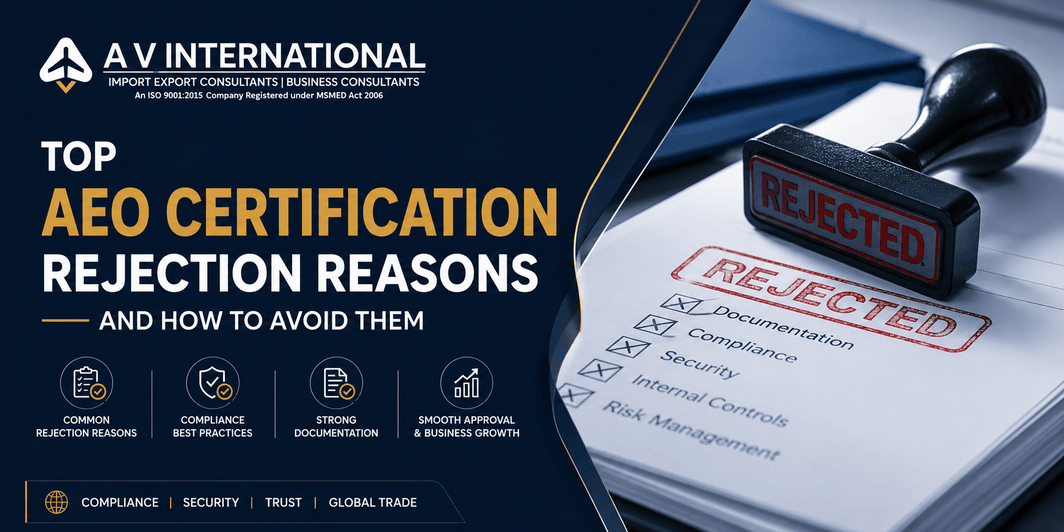
Top AEO Certification Rejection Reasons and How to Avoid Them

Top AEO Certification Rejection Reasons and How to Avoid Them

Key Takeaways

  • Most AEO Certification rejections are caused by compliance gaps rather than eligibility issues.
  • Incomplete documentation and poor record management frequently delay approvals.
  • Strong internal controls, financial stability, and supply chain security improve approval chances.
  • Regular compliance audits help identify deficiencies before application.
  • Professional guidance can significantly reduce rejection risks.

Introduction

Obtaining an Authorized Economic Operator (AEO) Certification is a significant milestone for businesses engaged in international trade. The certification demonstrates that an organization follows secure, compliant, and reliable supply chain practices while benefiting from faster customs clearance, reduced inspections, and improved global credibility.

However, many applications are delayed or rejected because businesses underestimate the level of compliance expected by Indian Customs. Understanding the most common rejection reasons can help importers, exporters, manufacturers, and logistics companies prepare effectively and maximize their chances of approval.

This guide explains the top AEO Certification rejection reasons and practical ways to avoid them in 2026.

Why AEO Certification Applications Get Rejected

Indian Customs evaluates applicants across multiple compliance parameters rather than relying only on submitted documents. The assessment includes operational controls, customs compliance history, financial health, internal procedures, and supply chain security.

Even businesses with substantial import-export operations may face rejection if these requirements are not adequately met.

Top AEO Certification Rejection Reasons

1. Poor Customs Compliance History

One of the primary reasons for rejection is a history of customs violations.

Examples include:

  • Frequent customs penalties
  • Misclassification of goods
  • Incorrect declarations
  • Repeated duty disputes
  • Non-compliance with import-export regulations

How to avoid it:

Maintain consistent customs compliance and resolve any pending disputes before applying.


2. Incomplete Documentation

Missing or inaccurate documentation is another common reason applications are returned or rejected.

Typical issues include:

  • Missing SOPs
  • Incomplete compliance records
  • Incorrect organizational details
  • Outdated licenses
  • Missing supporting evidence

How to avoid it:

Prepare a complete documentation checklist and verify every document before submission.


3. Weak Internal Control Systems

Indian Customs expects businesses to demonstrate effective internal compliance procedures.

Weak controls such as:

  • Lack of documented processes
  • No internal audit mechanism
  • Poor inventory controls
  • Inadequate risk management

may negatively affect the application.

How to avoid it:

Develop written Standard Operating Procedures (SOPs) and implement periodic compliance reviews.


4. Inadequate Supply Chain Security

AEO Certification focuses heavily on supply chain security.

Common shortcomings include:

  • Poor warehouse security
  • Unrestricted access
  • Inadequate visitor management
  • Weak cargo handling procedures
  • Lack of employee verification

How to avoid it:

Implement physical security measures, access controls, surveillance systems, and employee awareness programs.


5. Poor Financial Stability

Applicants should demonstrate sound financial standing.

Concerns may arise due to:

  • Continuous business losses
  • Outstanding government dues
  • Poor financial records
  • Insolvency-related issues

How to avoid it:

Maintain updated financial statements and ensure statutory dues are paid on time.


6. Inadequate Record Keeping

Businesses should be able to retrieve customs and trade records whenever requested.

Problems include:

  • Missing invoices
  • Poor inventory records
  • Unorganized import documentation
  • Lack of digital record management

How to avoid it:

Adopt an organized record management system with proper retention policies.


7. Lack of Employee Awareness

Employees handling imports, exports, logistics, and customs documentation should understand compliance requirements.

Without adequate training, operational mistakes become more likely.

How to avoid it:

Conduct regular compliance training for relevant departments.


8. Failure During Customs Validation

Indian Customs may conduct onsite verification before granting certification.

Common observations include:

  • Actual practices differing from documented procedures
  • Incomplete implementation of security controls
  • Poor documentation management
  • Non-functional compliance systems

How to avoid it:

Conduct an internal mock audit before the official verification.

Best Practices for Successful AEO Certification

Businesses can improve approval chances by following these practices:

  • Conduct a pre-application compliance audit.
  • Update customs and statutory registrations.
  • Maintain organized digital records.
  • Implement robust internal controls.
  • Strengthen warehouse and cargo security.
  • Train employees on customs compliance.
  • Resolve pending notices or disputes before applying.
  • Engage experienced compliance professionals for application review.
Featured Snippet Answer

The most common reasons for AEO Certification rejection include poor customs compliance history, incomplete documentation, weak internal controls, inadequate supply chain security, poor financial stability, insufficient record keeping, lack of employee training, and failure during customs validation. Businesses can avoid rejection by conducting internal audits, maintaining accurate records, strengthening compliance systems, and ensuring full readiness before submitting their application.


Frequently Asked Questions (FAQs)

1. Can an AEO Certification application be rejected?

Yes. Indian Customs may reject or seek additional clarification if an applicant fails to meet compliance, documentation, financial, or security requirements.

2. Does previous customs litigation affect AEO approval?

Yes. Frequent customs disputes or compliance violations may impact the assessment depending on their nature and resolution.

3. Is supply chain security mandatory?

Yes. Supply chain security is one of the core evaluation criteria under the AEO Programme.

4. Can businesses reapply after rejection?

Yes. Businesses can generally reapply after addressing the deficiencies identified during the previous assessment.

5. How long should records be maintained?

Businesses should maintain customs and trade records as required under applicable laws and ensure they are readily available during audits or inspections.

6. Should businesses conduct an internal audit before applying?

Yes. A pre-assessment audit helps identify compliance gaps and significantly improves the likelihood of approval.Internal Linking Suggestions

Conclusion

AEO Certification offers significant advantages for businesses involved in international trade, but achieving approval requires more than simply submitting an application. Indian Customs evaluates operational integrity, compliance culture, financial stability, documentation quality, and supply chain security.

By understanding the common reasons for rejection and proactively addressing compliance gaps, businesses can improve approval timelines, strengthen regulatory compliance, and build greater trust within the global supply chain.


Need Expert Assistance with AEO Certification?

A V International has over 35 years of experience in import-export consulting, DGFT compliance, customs advisory, and regulatory approvals.

Our experts provide end-to-end support for AEO Certification, including eligibility assessment, compliance gap analysis, documentation preparation, internal audit assistance, application filing, and post-submission support to help businesses achieve certification efficiently.

Written By

Akash Bhangare

Having more than 10 years of experience in EPR Compliance, Legal Metrology, DGFT Regulations, and Import Export Consulting Services in India.

Associated with A V International, a company with over 35 years of expertise in Environmental Compliance, EPR Registrations, Licensing, DGFT Consultancy, and Regulatory Approvals.

FeATURED ARTICLES

Foreign Trade 1
SARAL SIMS for Steel Imports in India – Complete Guide

SARAL SIMS for Steel Imports in India – Complete Guide The Government of India has introduced SARAL SIMS (Simplified Steel…

Mistakes
Top Export Compliance Mistakes: DGFT Advance  Authorization, EPCG & CPCB (2025 Guide)

Top Export Compliance Mistakes: DGFT Advance Authorization, EPCG & CPCB (2025 Guide) Exporting in India can feel like a legal…

Clean Environment
Environmental Clearance CPCB Quick Guide for Exporters

Environmental Clearance CPCB: Quick Guide for Exporters If you’re an Indian exporter or manufacturer working under schemes like the Advanced…

DGFT License
DGFT e-BRC Rule 2025: Key Update for Advance Authorization & EPCG Holders

DGFT e-BRC Rule 2025: Key Update for Advance Authorization & EPCG Holders The Directorate General of Foreign Trade (DGFT) has…