
India's Leading DGFT Consultants
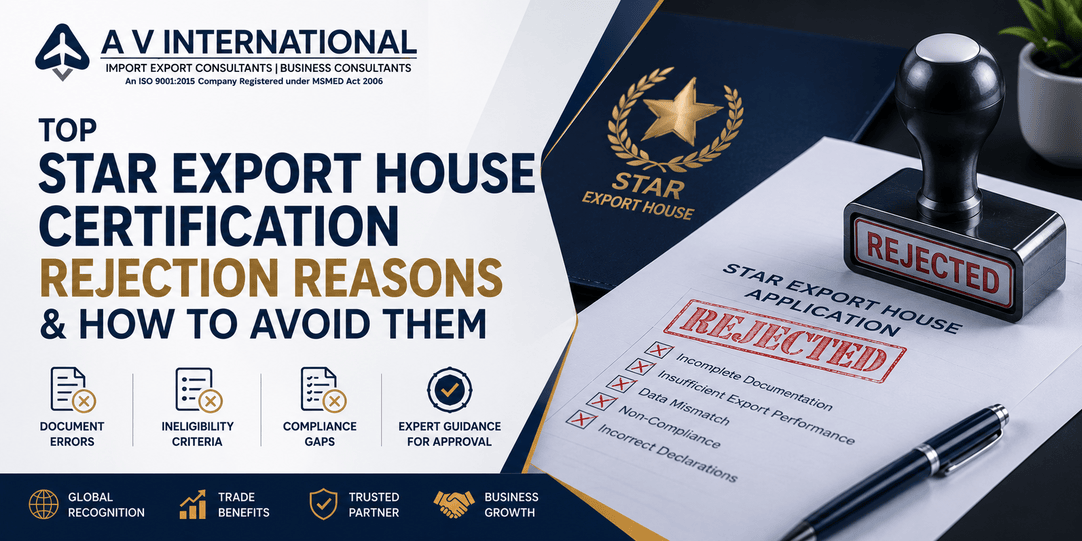
Top Star Export House Certification Rejection Reasons & How to Avoid Them

Top Star Export House Certification Rejection Reasons & How to Avoid Them

Key Takeaways

  • Most Star Export House applications are delayed or rejected due to documentation and eligibility issues.
  • Accurate export performance data is critical for successful approval.
  • DGFT carefully verifies export turnover, statutory registrations, and supporting documents.
  • Timely responses to deficiency letters help prevent prolonged delays.
  • Conducting a pre-submission review significantly improves approval chances.

Introduction

Obtaining Star Export House Certification is a major achievement for exporters seeking greater recognition under India’s Foreign Trade Policy (FTP). The certification enhances business credibility, offers trade facilitation benefits, and strengthens an exporter’s reputation in international markets.

However, many businesses face delays or rejection because of avoidable errors during the application process. From incorrect export performance calculations to incomplete documentation, even minor mistakes can result in objections from the Directorate General of Foreign Trade (DGFT).

In this guide, we discuss the top Star Export House Certification rejection reasons and practical steps businesses can take to avoid them in 2026.


What is Star Export House Certification?

Star Export House Certification is granted by the Directorate General of Foreign Trade (DGFT) to exporters who achieve the prescribed export performance under the Foreign Trade Policy.

The recognition is awarded in different categories based on export performance and provides several operational and procedural benefits to eligible exporters.


Why Do Star Export House Applications Get Rejected?

DGFT carefully evaluates each application to ensure that applicants meet all eligibility criteria and provide complete, accurate information.

Applications may be rejected or delayed due to inconsistencies in export data, missing documentation, or failure to satisfy the prescribed requirements.

Top Star Export House Certification Rejection Reasons

1. Incorrect Export Performance Calculation

One of the most common reasons for rejection is incorrect calculation of export performance.

Common mistakes include:

  • Including ineligible exports
  • Incorrect FOB value calculations
  • Data mismatch with DGFT records
  • Misreporting export turnover

How to avoid it:

Verify export figures using official shipping bills, e-BRCs, and DGFT records before submission.

2. Incomplete Supporting Documents

Applications often face objections because mandatory documents are missing.

Examples include:

  • IEC details
  • Export performance statements
  • Chartered Accountant certificates (where applicable)
  • Authorization letters
  • Additional declarations requested by DGFT

How to avoid it:

Prepare a comprehensive document checklist before filing the application.

3. Mismatch in IEC, GST or Business Details

DGFT validates applicant information across multiple government databases.

Differences in:

  • Company name
  • Business address
  • IEC details
  • GST information

may result in clarification requests or rejection.

How to avoid it:

Ensure all registrations are updated and consistent across government records.


4. Deficiency Letter Not Responded To

DGFT may issue a deficiency letter requesting additional information.

Ignoring or delaying the response may lead to application rejection.

How to avoid it:

Monitor the DGFT portal regularly and respond within the prescribed timeline.


5. Incorrect Document Uploads

Applicants sometimes upload:

  • Blurred documents
  • Expired certificates
  • Wrong attachments
  • Incomplete files

These errors delay verification.

How to avoid it:

Review every uploaded document before final submission.


6. Eligibility Criteria Not Properly Met

Some businesses apply before satisfying the prescribed export performance requirements.

Submitting an ineligible application often results in rejection.

How to avoid it:

Carefully evaluate eligibility under the applicable Foreign Trade Policy before applying.


7. Technical Errors During Online Filing

Portal-related mistakes such as incomplete application forms or incorrect selections can create processing issues.

How to avoid it:

Review the online application carefully before final submission.


Best Practices for Successful Approval

Businesses can improve approval chances by following these practices:

  • Verify export performance records.
  • Maintain updated IEC and GST information.
  • Upload high-quality scanned documents.
  • Keep export documentation organized.
  • Monitor DGFT communications regularly.
  • Respond quickly to clarification requests.
  • Conduct an internal compliance review before submission.
  • Seek professional guidance for complex cases.

Featured Snippet Answer

The most common Star Export House Certification rejection reasons include incorrect export performance calculations, incomplete documentation, mismatched IEC or GST details, failure to respond to DGFT deficiency letters, incorrect document uploads, eligibility issues, and online filing errors. Careful document verification and proactive compliance significantly improve approval chances.


Frequently Asked Questions (FAQs)

1. Can a Star Export House application be rejected?

Yes. DGFT may reject an application if eligibility criteria are not met or if documentation is incomplete or inaccurate.

2. Does a deficiency letter mean rejection?

No. A deficiency letter provides an opportunity to submit additional information or correct deficiencies before DGFT makes a final decision.

3. Can businesses reapply after rejection?

Yes. After resolving the identified issues, businesses can generally submit a fresh application, subject to the applicable DGFT guidelines.

4. What documents are most important?

Export performance records, IEC details, GST information, supporting declarations, and other prescribed documents play a crucial role in the verification process.

5. How can exporters reduce rejection risk?

By verifying all documents, ensuring data consistency, maintaining accurate export records, and conducting a thorough compliance review before filing.

6. Should exporters hire a DGFT consultant?

Professional consultants can help verify eligibility, review documentation, respond to DGFT queries, and minimize the risk of application rejection.

Conclusion

Star Export House Certification offers valuable recognition and benefits for exporters, but obtaining approval requires careful preparation and strict compliance with DGFT requirements. Most rejections result from preventable errors such as incomplete documentation, incorrect export data, or delayed responses to deficiency notices.

By reviewing every aspect of the application before submission and maintaining accurate statutory records, businesses can significantly improve their chances of timely approval.

Need Expert Assistance with Star Export House Certification?

With over 35 years of experience in DGFT consultancy and import-export compliance, A V International provides complete support for Star Export House Certification.

Our services include eligibility assessment, export performance verification, documentation review, application filing, deficiency response, DGFT follow-up, and end-to-end compliance assistance to help exporters obtain recognition with confidence.

Written By

Akash Bhangare

Having more than 10 years of experience in EPR Compliance, Legal Metrology, DGFT Regulations, and Import Export Consulting Services in India.

Associated with A V International, a company with over 35 years of expertise in Environmental Compliance, EPR Registrations, Licensing, DGFT Consultancy, and Regulatory Approvals.

FeATURED ARTICLES