

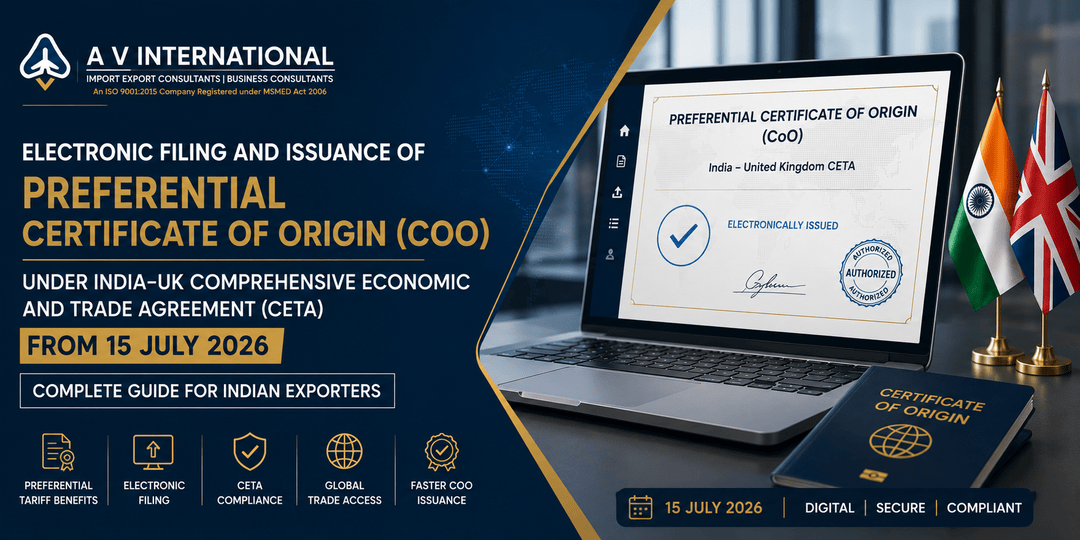
India–UK CETA Electronic Certificate of Origin (eCoO) Complete Guide 2026
Key Takeaways
- India–UK Comprehensive Economic and Trade Agreement (CETA) became effective from 15 July 2026.
- Preferential Certificates of Origin (CoO) for exports to the United Kingdom are now issued electronically through the Trade Connect ePlatform.
- Exporters can obtain the eCoO through either Self-Declaration or an Authorised Agency, depending on the applicable option under the agreement.
- Digital Signature Certificate (DSC) is mandatory for generating Self-Declaration based eCoO.
- Trade Connect serves as the unified digital platform for issuance of electronic Certificates of Origin for Indian exports.
Introduction
The Directorate General of Foreign Trade (DGFT), Ministry of Commerce & Industry, has issued Trade Notice No. 11/2026-2027 dated 13 July 2026 regarding the Electronic Filing and Issuance of Preferential Certificate of Origin (CoO) under the India–United Kingdom Comprehensive Economic and Trade Agreement (CETA). The Trade Notice confirms that the electronic Certificate of Origin (eCoO) system became operational with the implementation of the Agreement from 15 July 2026.
This development marks an important step towards digitising India’s export documentation and simplifying preferential trade procedures. Exporters shipping eligible goods to the United Kingdom can now apply for and obtain Preferential Certificates of Origin electronically through the Trade Connect ePlatform, eliminating several manual processes while improving transparency, authentication, and verification.
For Indian exporters, manufacturers, merchant exporters, MSMEs, and export houses claiming preferential tariff benefits under the India–UK CETA, understanding the new electronic CoO process is essential to ensure smooth customs clearance and compliance with DGFT requirements.
What is the Preferential Certificate of Origin (CoO)?
A Preferential Certificate of Origin is an official trade document certifying that exported goods qualify as originating goods under a Free Trade Agreement (FTA) or Comprehensive Economic and Trade Agreement (CETA). It enables importers in the partner country to claim preferential customs duty benefits, provided the goods satisfy the applicable Rules of Origin.
Under the India–UK CETA, DGFT has introduced a fully electronic issuance mechanism through the Trade Connect ePlatform, making the application and certification process faster, secure, and digitally verifiable.
What is the Trade Connect ePlatform?
Trade Connect is DGFT’s unified digital platform for the application and issuance of electronic Certificates of Origin (eCoO) for Indian exports. As notified in Trade Notice No. 11/2026-2027, exporters seeking preferential Certificates of Origin under the India–UK CETA must use the Certificate of Origin service available on the Trade Connect ePlatform.
The platform enables:
- Electronic filing of applications
- Digital issuance of Preferential Certificates of Origin
- QR code-enabled certificate generation
- Digital signature integration
- Online verification of issued certificates
- Unified access for exporters across India
Modes of Issuance under India–UK CETA
According to the Trade Notice, Preferential eCoO under the India–UK CETA can be issued through two different mechanisms:
1. Self-Declaration Based eCoO
Eligible exporters can generate their own Preferential Certificate of Origin using the Trade Connect platform, subject to compliance with mandatory Digital Signature and profile requirements.
2. Authorised Agency Issued eCoO
Exporters may also obtain the Preferential Certificate of Origin through authorised issuing agencies notified under the Agreement. These agencies examine the application and issue the certificate electronically after approval.
Self-Declaration eCoO: Eligibility and Mandatory Requirements
The Trade Notice specifies several mandatory conditions that exporters must satisfy before generating a Self-Declaration based Certificate of Origin.
Digital Signature Certificate (DSC)
A valid Digital Signature Certificate linked with the Import Export Code (IEC) is mandatory. Only users whose Trade Connect profile is linked with the IEC through a valid DSC can generate the certificate.
Upload of Applicant’s Signature
Applicants must upload a scanned copy of their ink-signed signature. This is a mandatory requirement and can be uploaded during the certificate generation process if it has not already been uploaded earlier.
Correct Agreement Selection
While filing the application, exporters must select:
India UK CETA (Self-Declaration)
as the applicable agreement on the Trade Connect platform.
Featured Snippet
From 15 July 2026, exporters claiming preferential tariff benefits under the India–UK Comprehensive Economic and Trade Agreement (CETA) must obtain electronic Certificates of Origin (eCoO) through the DGFT Trade Connect ePlatform. Certificates may be issued through Self-Declaration or Authorised Agencies, subject to mandatory Digital Signature, IEC linkage, and prescribed application procedures.
Step-by-Step Process for Self-Declaration Based eCoO under India–UK CETA
The DGFT Trade Notice provides a structured workflow for exporters opting for the Self-Declaration mechanism. Following the prescribed process correctly is essential to ensure successful generation of the electronic Certificate of Origin (eCoO).
Step 1: Complete the Online Application
The exporter should log in to the Trade Connect ePlatform and select “India UK CETA (Self-Declaration)” as the applicable agreement. All required information must be entered in the prescribed online application form.
Step 2: Submit the Application
Once all mandatory details are filled, the application may be submitted using either:
- Digital Signature Certificate (DSC), or
- Aadhaar Authentication
Importantly, no application fee is payable for submitting the Self-Declaration based eCoO application.
Step 3: Select the Appropriate Branch Address
During the application process, the exporter must select the relevant branch address from the addresses available under the corresponding IEC profile.
Based on the selected branch, the system automatically maps the application to the appropriate:
- DGFT Regional Authority, or
- Jurisdictional Special Economic Zone (SEZ)
This mapped authority will undertake verification activities whenever concerns are raised by the partner country under the provisions of the India–UK CETA.
Step 4: Auto Approval Status
After successful submission, the application status changes to:
“Auto Approved Pending Issuance”
This indicates that the exporter can proceed with the generation of the electronic Certificate of Origin.
Step 5: Generate the Self-Declared Certificate
The exporter must click on:
“Generate Self-Declared CoO”
If the scanned copy of the applicant’s signature has not been uploaded previously, the system prompts the applicant to upload and save the signature before certificate generation.
Step 6: Generate the eCoO Using DSC
The final generation of the Self-Declaration based eCoO requires mandatory use of the applicant’s linked Digital Signature Certificate.
Without a valid DSC linked to the IEC profile, the certificate cannot be generated.
Electronic Copies Generated
After successful generation, the system creates two separate copies of the Preferential Certificate of Origin.
Electronic Copy
The Electronic Copy contains:
- QR Code
- Digital Signature
- Scanned Signature of the Applicant
This copy can be downloaded immediately and used wherever accepted by the importing country’s authorities.
Physical Copy
The Physical Copy also contains:
- QR Code
- Digital Signature
- Blank signature space
After downloading and printing, the applicant may physically sign the designated space before submission wherever a signed hard copy is required.
Submission to the Importing Country
The Trade Notice clarifies that the generated copies may be submitted to the recipient country according to the requirements of the concerned authorities. Exporters should therefore verify the documentary requirements of the importing authority before dispatching the certificate.
Authorised Agency Issued eCoO
Apart from Self-Declaration, exporters may choose to obtain the Preferential Certificate of Origin through an Authorised Issuing Agency notified under the India–UK CETA.
The Trade Notice specifies the following procedure:
Select the Appropriate Agreement
Choose:
“India–UK CETA (Agency Issued)”
while submitting the application.
Choose the Authorised Agency
The system provides the list of authorised agencies notified under the Agreement for selection by the applicant.
Approval by the Issuing Agency
After examination and approval of the application by the authorised agency, the system generates an Electronic Copy of the Preferential Certificate of Origin.
This certificate contains:
- QR Code
- Digital Signature
- Signature image of the issuing officer
- Official stamp of the issuing agency
The exporter can download and utilise this electronic certificate for export documentation.
Common Guidelines for All IEC Holders
The Trade Notice also prescribes several common compliance requirements applicable to all exporters and users.
Existing DGFT Credentials
Exporters can use their existing DGFT website login credentials to access the Trade Connect ePlatform. There is no requirement to create a new user account solely for this purpose.
Additional User Accounts
Where multiple users are required under the same IEC, additional user accounts may be created and linked using a Digital Signature Certificate through the DGFT portal. These credentials can then be used for Trade Connect login and eCoO filing.
IEC Profile Management
DGFT has advised exporters to review the available guidance documents and videos under the IEC Profile Management section on the DGFT website to understand:
- Accepted Digital Signature types
- DSC linking process
- User profile management
This helps ensure successful application processing.
Ensure Name Consistency
The applicant’s name appearing in the DGFT/Trade Connect user profile should exactly match the name contained in the linked Digital Signature Certificate.
Any mismatch may lead to processing issues.
Keep IEC Details Updated
Exporters should ensure that all IEC-related information available in the DGFT system is updated so that correct details are automatically available while applying for the Preferential Certificate of Origin.
Verification Mechanism
To strengthen the authenticity and acceptance of electronically issued Preferential Certificates of Origin (eCoO), DGFT has introduced an online verification mechanism through the Trade Connect ePlatform.
Whenever an overseas customs authority or any authorised authority needs to verify the genuineness of a Certificate of Origin issued under the India–UK CETA, they can use the online verification facility available on the platform.
The verification process requires the authority to:
- Visit the Trade Connect ePlatform
- Navigate to Certificate of Origin → Verify Certificate
- Enter the relevant Certificate of Origin (CoO) Number
The system will display the details of the electronically issued Certificate of Origin corresponding to the entered CoO number, enabling quick and transparent verification.
This digital verification mechanism enhances trust between trading partners, reduces the possibility of fraudulent certificates, and facilitates smoother customs clearance under the India–UK Comprehensive Economic and Trade Agreement.
DGFT Helpdesk & Support Channels
Recognising that exporters may require technical or procedural assistance while using the new eCoO module, DGFT has advised exporters and stakeholders to contact the official Helpdesk for queries, suggestions, or feedback.
Support is available through:
- DGFT Toll-Free Helpdesk
- Official Email Support: coo-dgft@gov.in
Exporters should use these official channels whenever they encounter issues related to:
- Trade Connect login
- eCoO application
- Digital Signature integration
- IEC profile
- Certificate generation
- Technical errors
- General clarification regarding the eCoO module
Best Practices for Exporters
To ensure a smooth and error-free Certificate of Origin application process under the India–UK CETA, exporters should adopt the following best practices:
- Verify that the IEC profile is complete and updated before filing the application.
- Ensure the applicant’s name exactly matches the linked Digital Signature Certificate (DSC).
- Link a valid DSC with the IEC well in advance.
- Keep a scanned copy of the applicant’s ink signature ready for upload.
- Select the correct agreement type—India–UK CETA (Self-Declaration) or India–UK CETA (Agency Issued)—based on the applicable route.
- Carefully verify all application details before submission.
- Retain downloaded electronic certificates for future reference.
- Check importing country requirements before submitting the Electronic Copy or Physical Copy.
- Use only the official DGFT Trade Connect portal for filing and certificate generation.
These practices can help minimise delays, avoid application errors, and support faster export documentation.
Common Mistakes to Avoid
Many exporters may experience avoidable issues due to incomplete preparation. Common mistakes include:
- Using an expired or unlinked Digital Signature Certificate.
- Incorrect or outdated IEC profile information.
- Mismatch between the applicant’s name in the DGFT profile and the DSC.
- Selecting the wrong agreement type while filing the application.
- Forgetting to upload the scanned signature when required.
- Delaying the application until the shipment date.
- Ignoring Trade Connect notifications or DGFT updates.
Avoiding these issues can significantly improve the efficiency of the Certificate of Origin issuance process.
Why This Trade Notice is Important
The introduction of electronic filing and issuance of Preferential Certificates of Origin under the India–UK CETA represents another major milestone in India’s digital trade facilitation initiatives.
The new system offers several advantages:
- Completely digital application workflow
- Reduced paperwork
- Faster certificate issuance
- QR Code-enabled verification
- Enhanced authenticity through Digital Signature
- Online verification by overseas authorities
- Greater transparency
- Improved ease of doing business for exporters
For Indian exporters seeking preferential tariff benefits in the United Kingdom, understanding and complying with this electronic system is now an essential part of export documentation.
Frequently Asked Questions (FAQs)
1. When did the electronic Certificate of Origin system under the India–UK CETA become effective?
The electronic filing and issuance of Preferential Certificates of Origin under the India–UK Comprehensive Economic and Trade Agreement became effective from 15 July 2026.
2. Which platform should exporters use for applying for the Preferential Certificate of Origin?
Applications must be submitted through the Trade Connect ePlatform, which serves as DGFT’s unified digital platform for electronic Certificates of Origin.
3. Is a Digital Signature Certificate (DSC) mandatory?
Yes. A valid Digital Signature Certificate linked with the Import Export Code (IEC) is mandatory for generating Self-Declaration based electronic Certificates of Origin.
4. Can exporters apply without paying any application fee?
Yes. The Trade Notice states that applications under the Self-Declaration process may be submitted using DSC or Aadhaar authentication without payment of any fee.
5. What copies of the Certificate of Origin are generated?
The system generates:
- Electronic Copy containing QR Code, Digital Signature, and scanned signature.
- Physical Copy containing QR Code, Digital Signature, and a blank space for physical signature after printing.
6. How can foreign customs authorities verify the Certificate of Origin?
The Certificate of Origin can be verified online through the Trade Connect ePlatform using the Verify Certificate facility by entering the CoO Number.
7. Where can exporters seek assistance regarding the eCoO module?
Exporters may contact the DGFT Helpdesk through its toll-free support or email coo-dgft@gov.in for queries and technical assistance.
Conclusion
The DGFT’s introduction of the electronic filing and issuance of Preferential Certificates of Origin under the India–UK Comprehensive Economic and Trade Agreement marks a significant advancement in India’s export documentation ecosystem.
By enabling both Self-Declaration and Authorised Agency-issued eCoO through the Trade Connect ePlatform, DGFT has streamlined the certification process while strengthening transparency, security, and international verification. Exporters intending to claim preferential tariff benefits under the India–UK CETA should familiarise themselves with the prescribed workflow, maintain updated IEC and DSC records, and follow the notified procedures to ensure seamless certificate generation and acceptance.
Need Expert Assistance with DGFT Compliance?
A V International has over 35 years of experience in DGFT consultancy, Import Export Code (IEC) services, Certificates of Origin, Export Documentation, Customs Compliance, Foreign Trade Policy (FTP) advisory, and regulatory approvals.
Whether you require assistance with:
- India–UK CETA compliance
- Certificate of Origin (CoO)
- DGFT registrations
- IEC modifications
- Digital Signature integration
- Export documentation
- Foreign Trade Policy compliance
- International trade advisory
our experienced professionals can help you navigate the process efficiently and compliantly.
Contact A V International today for reliable DGFT and international trade compliance solutions tailored to your business.
Written By
Akash Bhangare
Having more than 10 years of experience in EPR Compliance, Legal Metrology, DGFT Regulations, Import Export Consulting, and Environmental Compliance in India.
Associated with A V International, a company with over 35 years of expertise in Environmental Compliance, EPR Registrations, Licensing, DGFT Consultancy, and Regulatory Approvals.
Recent Posts
- SCOMET License Application Process on DGFT Portal: Step-by-Step 2026 Guide
- Eligible Products Under RoSCTL Scheme: Complete 2026 Guide
- CBIC Simplifies EMI Scheme Documentation: What Manufacturer-Importers Need to Know
- PIMS Registration Validity & Renewal Rules 2026: What Every Paper Importer Must Know
- NFMIMS Login Problem? Complete 2026 Troubleshooting Guide for Importers
FeATURED ARTICLES

SARAL SIMS for Steel Imports in India – Complete Guide The Government of India has introduced SARAL SIMS (Simplified Steel…

Top Export Compliance Mistakes: DGFT Advance Authorization, EPCG & CPCB (2025 Guide) Exporting in India can feel like a legal…

Environmental Clearance CPCB: Quick Guide for Exporters If you’re an Indian exporter or manufacturer working under schemes like the Advanced…

DGFT e-BRC Rule 2025: Key Update for Advance Authorization & EPCG Holders The Directorate General of Foreign Trade (DGFT) has…
