
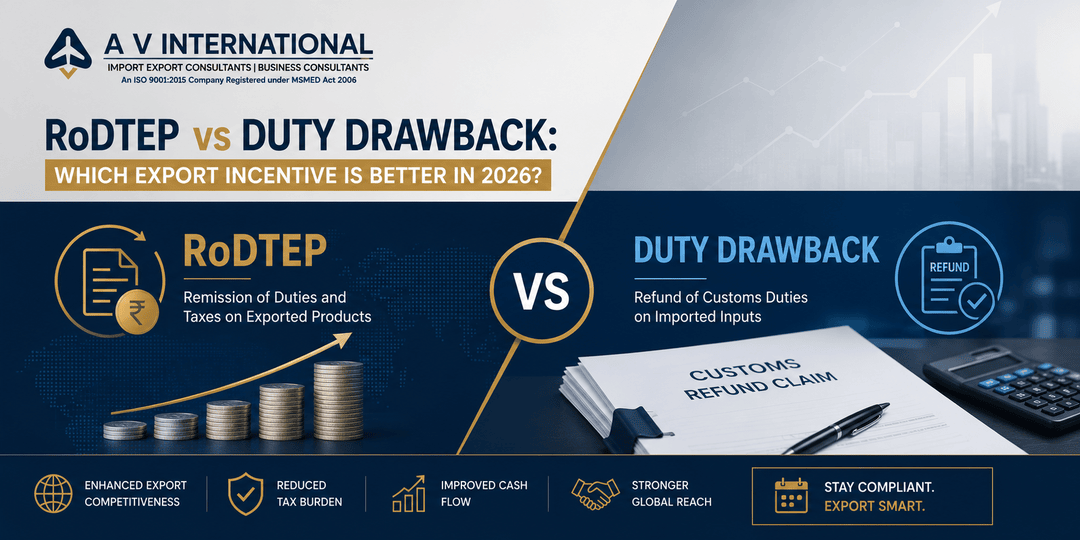

RoDTEP vs Duty Drawback: Which Export Incentive Is Better in 2026?
Key Takeaways
- RoDTEP and Duty Drawback are distinct export incentive schemes with different objectives.
- RoDTEP reimburses certain embedded taxes and duties that are not refunded through other mechanisms.
- Duty Drawback primarily refunds eligible customs duties paid on imported inputs used in exported goods.
- Exporters should understand product eligibility and applicable rates before claiming benefits.
- Proper documentation and customs compliance are essential for successful claims.
Introduction
Government export incentive schemes play an important role in improving the global competitiveness of Indian exporters. Among the most widely used incentives are the Remission of Duties and Taxes on Exported Products (RoDTEP) Scheme and the Duty Drawback Scheme.
Although both schemes aim to reduce the tax burden on exports, they operate differently and provide benefits under separate policy frameworks. Many exporters often wonder which scheme is more beneficial for their business.
This guide compares RoDTEP vs Duty Drawback in 2026, helping exporters understand the key differences, eligibility, benefits, claim process, and factors to consider before choosing the appropriate incentive.
What is RoDTEP?
The RoDTEP (Remission of Duties and Taxes on Exported Products) Scheme provides remission of certain taxes, duties, and levies incurred during the manufacturing and distribution process that are not refunded through any other mechanism.
The objective is to make Indian exports more competitive in international markets by reducing hidden costs.
What is Duty Drawback?
The Duty Drawback Scheme allows eligible exporters to claim a refund of specified customs duties paid on imported inputs used in the manufacture of exported goods.
The scheme helps reduce production costs by reimbursing eligible import duties associated with exported products.
RoDTEP vs Duty Drawback: Key Comparison
| Parameter | RoDTEP | Duty Drawback |
|---|---|---|
| Objective | Remission of eligible embedded taxes and duties | Refund of eligible customs duties on imported inputs |
| Coverage | Certain non-creditable taxes and levies | Eligible customs duties |
| Applicable To | Eligible export products notified under the scheme | Eligible exports using imported inputs |
| Benefit Type | Remission through transferable duty credit mechanism as applicable | Duty refund based on notified rates |
| Processing Authority | Customs/DGFT framework | Customs Authorities |
| Documentation | Shipping Bill, export documents, applicable declarations | Shipping Bill, import records, export documentation |
Which Scheme Is Better in 2026?
There is no universal answer.
The better option depends on several business factors, including:
- Nature of exported products
- Source of raw materials
- Import content in production
- Applicable government notifications
- Eligibility under the respective schemes
- Customs declarations and compliance
Businesses should evaluate their export model before claiming incentives.
Benefits of RoDTEP
- Reduces embedded tax costs.
- Improves export competitiveness.
- Supports exporters across various sectors.
- Encourages global market expansion.
- Simplified digital claim process through customs declarations.
Benefits of Duty Drawback
- Refunds eligible customs duties.
- Reduces import-related production costs.
- Improves exporter cash flow.
- Supports manufacturing industries using imported inputs.
- Encourages export growth.
Common Mistakes Exporters Should Avoid
Many claims are delayed due to avoidable errors such as:
- Incorrect Shipping Bill declarations
- Wrong scheme selection
- Product classification errors
- Missing export documentation
- Incorrect HSN codes
- Failure to review applicable notifications
- Inaccurate customs filings
Best Practices for Exporters
To maximize export incentives:
- Verify product eligibility before export.
- Maintain accurate shipping documentation.
- Keep import and export records organized.
- Review customs notifications regularly.
- File claims within the prescribed timelines.
- Consult experienced DGFT and customs professionals for complex cases.
Featured Snippet Answer
RoDTEP and Duty Drawback serve different purposes. RoDTEP remits certain embedded taxes and duties not refunded through other mechanisms, while Duty Drawback refunds eligible customs duties paid on imported inputs used in exported goods. The better scheme depends on the export product, input sourcing, eligibility, and applicable government notifications.
Frequently Asked Questions (FAQs)
1. Can exporters claim both RoDTEP and Duty Drawback?
Eligibility depends on the applicable government notifications, scheme provisions, and the nature of the export. Exporters should verify current regulatory requirements before claiming benefits.
2. Which scheme offers higher benefits?
There is no fixed answer. The benefit varies depending on product classification, applicable rates, and eligibility.
3. Is RoDTEP available for all export products?
No. Only notified products that satisfy the applicable conditions are eligible.
4. Is Duty Drawback applicable to all exporters?
Duty Drawback generally applies where eligible customs duties have been paid on imported inputs used in exported goods, subject to the scheme conditions.
5. What documents are required?
Common documents include Shipping Bills, export invoices, packing lists, customs documentation, import records (where applicable), and prescribed declarations.
6. How can exporters avoid claim rejection?
Maintain accurate records, ensure correct customs declarations, verify product eligibility, and comply with all applicable export regulations.
Conclusion
Both RoDTEP and Duty Drawback remain valuable export incentive schemes in 2026, but they address different types of duties and taxes. Rather than determining which scheme is universally better, exporters should assess their business model, imported inputs, product eligibility, and applicable notifications before making a claim.
Careful planning, proper documentation, and compliance with customs procedures can help businesses maximize available export benefits while avoiding unnecessary delays or claim rejections.
Need Expert Assistance with Export Incentive Claims?
With over 35 years of experience in DGFT consultancy, customs compliance, and import-export advisory, A V International assists exporters with RoDTEP eligibility assessment, Duty Drawback claims, export documentation, DGFT compliance, customs advisory, and end-to-end export incentive support.
Our experts help businesses identify the most suitable incentive scheme while ensuring accurate documentation and regulatory compliance.
Written By
Akash Bhangare
Having more than 10 years of experience in EPR Compliance, Legal Metrology, DGFT Regulations, and Import Export Consulting Services in India.
Associated with A V International, a company with over 35 years of expertise in Environmental Compliance, EPR Registrations, Licensing, DGFT Consultancy, Import Export Advisory, and Regulatory Approvals.
Recent Posts
- India–Oman CEPA Opens New Opportunities: Complete DGFT TRQ Procedure Guide (2026)
- How Long Does RoDTEP Credit Take After Export? 2026 Timeline Explained
- RoDTEP vs Duty Drawback: Which Export Incentive Is Better?
- India–UK CETA eCoO Registration & Certificate of Origin Guide 2026
- India–UK CETA TRQ Applications 2026 Guide
FeATURED ARTICLES
SARAL SIMS for Steel Imports in India – Complete Guide The Government of India has introduced SARAL SIMS (Simplified Steel…
Top Export Compliance Mistakes: DGFT Advance Authorization, EPCG & CPCB (2025 Guide) Exporting in India can feel like a legal…
Environmental Clearance CPCB: Quick Guide for Exporters If you’re an Indian exporter or manufacturer working under schemes like the Advanced…
DGFT e-BRC Rule 2025: Key Update for Advance Authorization & EPCG Holders The Directorate General of Foreign Trade (DGFT) has…

