
How Long Does RoDTEP Credit Take After Export? 2026 Timeline Explained
Key Takeaways
- RoDTEP credit is not generated immediately after export.
- Multiple verification stages are completed before credit issuance.
- Correct Shipping Bill declarations significantly reduce delays.
- ICEGATE and Customs validations play a crucial role.
- Documentation accuracy helps exporters receive benefits faster.
- Professional guidance minimizes rejection and processing issues.
Introduction
The Remission of Duties and Taxes on Exported Products (RoDTEP) Scheme continues to be one of India’s most important export incentive schemes in 2026. However, one of the most common questions exporters ask is:
“How long does RoDTEP credit take after export?“
The answer depends on several factors, including Shipping Bill accuracy, Customs processing, ICEGATE validations, and RoDTEP scroll generation.
Understanding the complete timeline helps exporters plan cash flow, avoid unnecessary follow-ups, and identify delays before they become serious compliance issues.
What is RoDTEP Credit?
RoDTEP credit reimburses certain embedded duties, taxes, and levies that are not otherwise refunded under existing schemes.
Instead of receiving cash directly, eligible exporters receive electronic duty credit that can generally be utilized or transferred as permitted under applicable regulations.
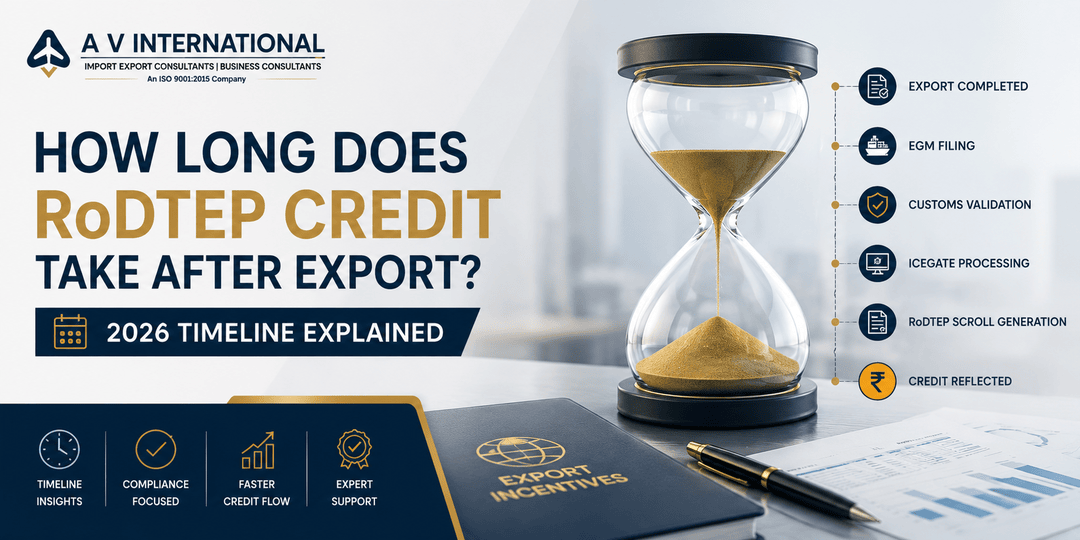
Typical RoDTEP Credit Timeline After Export (2026)
Although timelines vary depending on Customs processing, a typical RoDTEP workflow looks like this:
| Stage | Estimated Timeline |
|---|---|
| Export completed & Shipping Bill filed | Day 0 |
| EGM Filing & Customs validation | Within a few days |
| Shipping Bill processing | 1–3 weeks |
| ICEGATE validation | 2–6 weeks |
| RoDTEP scroll generation | 1–3 months (varies) |
| Credit reflected in ICEGATE ledger | After successful processing |
Actual timelines may differ depending on port workload, system updates, document verification, and government processing schedules.
Featured Snippet Answer
RoDTEP credit is generally issued after successful Customs processing, Export General Manifest (EGM) filing, ICEGATE validation, and RoDTEP scroll generation. While timelines vary by port and application accuracy, many exporters receive credit within several weeks to a few months after export, provided all declarations and documentation are correct.
Factors That Affect RoDTEP Credit Timeline
Several factors influence how quickly your RoDTEP credit is generated.
Correct Shipping Bill Declaration
Failure to select RoDTEP at the time of export may delay or affect eligibility.
Export General Manifest (EGM)
The shipping line must file the EGM correctly before further processing.
Customs Verification
Customs authorities validate export details before forwarding data.
ICEGATE System Processing
ICEGATE performs multiple automated validations before generating eligible credit.
Policy Updates
System maintenance or procedural changes may occasionally increase processing time.
Common Reasons for RoDTEP Credit Delays
Exporters often experience delays due to avoidable mistakes such as:
- Incorrect Shipping Bill declarations
- IEC or GST mismatch
- Errors in product classification
- Pending Customs verification
- EGM filing issues
- Technical ICEGATE processing delays
- Incomplete exporter information
- Amendments after export
How to Check RoDTEP Credit Status
Exporters can monitor progress by reviewing:
- ICEGATE account
- Shipping Bill status
- Scroll generation status
- Customs communications
- Export documentation records
Regular monitoring helps identify issues before they delay credit generation further.
Best Practices for Faster RoDTEP Credit
Businesses should follow these best practices:
- Verify Shipping Bill details before filing.
- Ensure RoDTEP declaration is correctly selected.
- Confirm EGM filing with the shipping line.
- Match GST, IEC, and exporter details accurately.
- Maintain complete export documentation.
- Respond promptly to Customs queries.
- Periodically review ICEGATE status.
Industry Insight
Many RoDTEP delays are caused by documentation mismatches rather than policy restrictions. Businesses that establish strong internal export compliance processes generally experience fewer delays and smoother credit processing.
FAQs
1. How long does RoDTEP credit usually take after export?
Timelines vary, but credit is generally issued after successful Customs processing, EGM filing, ICEGATE validation, and scroll generation.
2. Why has my RoDTEP credit not been generated?
Possible reasons include incorrect declarations, pending EGM, document mismatches, Customs verification, or system processing delays.
3. Can incorrect Shipping Bill details delay RoDTEP?
Yes. Incorrect declarations are among the most common reasons for delayed or rejected benefits.
4. How can I check my RoDTEP status?
Exporters can review their ICEGATE account, Shipping Bill status, scroll generation details, and Customs communications.
5. Does every exporter receive RoDTEP automatically?
No. Exporters must satisfy eligibility conditions and ensure all required declarations and documentation are correctly filed.
6. Can RoDTEP credit be delayed because of ICEGATE?
Yes. Technical validations, maintenance, or pending data synchronization may occasionally increase processing time.
Conclusion
RoDTEP remains an important export incentive for Indian exporters in 2026. Although the credit is not issued immediately after export, understanding the processing stages helps businesses set realistic expectations and minimize delays.
By ensuring accurate Shipping Bill declarations, timely EGM filing, proper documentation, and regular status monitoring, exporters can significantly improve the chances of receiving RoDTEP credit without unnecessary complications.
Need Help with RoDTEP Claims?
A V International has over 35 years of experience assisting exporters with DGFT and Customs compliance.
Our experts help businesses with:
- RoDTEP claim assistance
- Shipping Bill review
- DGFT advisory
- ICEGATE compliance
- Export documentation
- Customs consultancy
- Import Export licensing
Contact A V International for professional assistance in managing your export incentive claims efficiently.
Written By
Akash Bhangare
Having more than 10 years of experience in EPR Compliance, Legal Metrology, DGFT Regulations, and Import Export Consulting Services in India.
Associated with A V International, a company with over 35 years of expertise in Environmental Compliance, EPR Registrations, Licensing, and Regulatory Approvals.
Recent Posts
- India–Oman CEPA Opens New Opportunities: Complete DGFT TRQ Procedure Guide (2026)
- How Long Does RoDTEP Credit Take After Export? 2026 Timeline Explained
- RoDTEP vs Duty Drawback: Which Export Incentive Is Better?
- India–UK CETA eCoO Registration & Certificate of Origin Guide 2026
- India–UK CETA TRQ Applications 2026 Guide
FeATURED ARTICLES
SARAL SIMS for Steel Imports in India – Complete Guide The Government of India has introduced SARAL SIMS (Simplified Steel…
Top Export Compliance Mistakes: DGFT Advance Authorization, EPCG & CPCB (2025 Guide) Exporting in India can feel like a legal…
Environmental Clearance CPCB: Quick Guide for Exporters If you’re an Indian exporter or manufacturer working under schemes like the Advanced…
DGFT e-BRC Rule 2025: Key Update for Advance Authorization & EPCG Holders The Directorate General of Foreign Trade (DGFT) has…

