

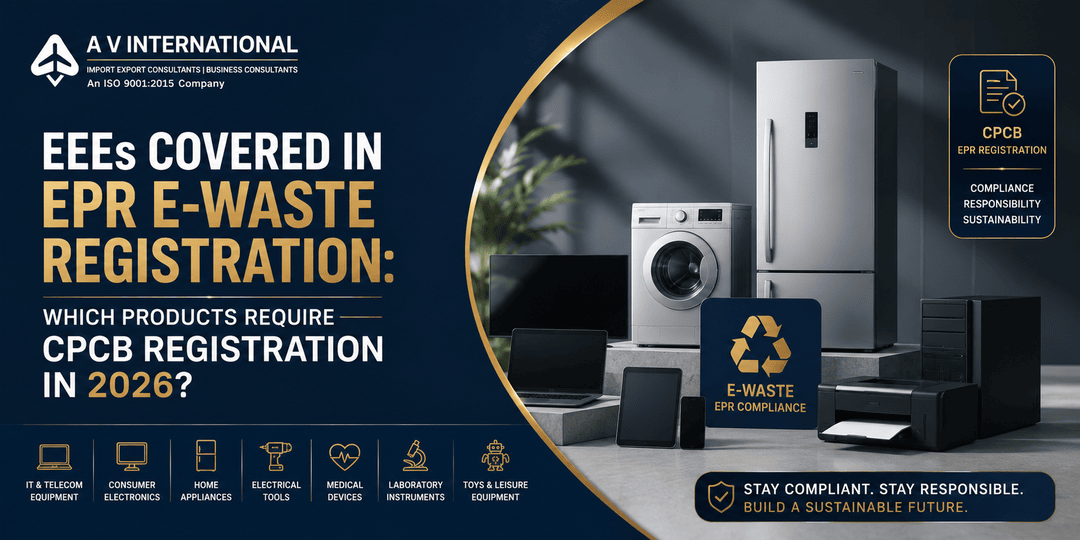
EEEs Covered in EPR E-Waste Registration: Which Products Require CPCB Registration in 2026?
Key Takeaways
- The E-Waste (Management) Rules, 2022 cover 106 Electrical and Electronic Equipment (EEE) items under seven broad categories.
- Imported electrical and electronic equipment can fall under E-Waste EPR when offered for sale in India.
- CPCB EPR registration is required for producers covered by the rules.
- Product classification should be checked against Schedule I before applying.
- Components, consumables, parts and spares that make covered EEE operational can also fall within the framework.
- Solar photovoltaic modules, panels and cells are covered, but their treatment has specific provisions.
- Correct EEE code selection is important for registration, reporting and EPR obligation management.
Introduction
The rapid growth of electronics imports and manufacturing in India has made E-Waste Extended Producer Responsibility (EPR) an important compliance requirement for businesses.
Importers, manufacturers, brand owners and other businesses dealing with electrical and electronic equipment need to determine whether their products fall within the E-Waste (Management) Rules, 2022.
A common compliance question is: Which electrical and electronic products require CPCB EPR registration in 2026?
The answer depends primarily on whether the product is covered under Schedule I of the E-Waste (Management) Rules, 2022 and whether the business falls within the definition of a Producer or another regulated entity.
The rules became effective from 1 April 2023 and cover 106 EEE items across seven categories.
What Are EEEs Under E-Waste EPR?
Electrical and Electronic Equipment (EEE) refers to equipment that depends on electric current or an electromagnetic field to function, as well as equipment used for generating, transferring or measuring electricity.
Under the E-Waste (Management) Rules, 2022, Schedule I identifies the electrical and electronic equipment covered by the EPR framework.
The coverage also extends to relevant components, consumables, parts and spares that make the equipment operational.
Featured Snippet Answer
CPCB E-Waste EPR registration applies to producers dealing with electrical and electronic equipment listed in Schedule I of the E-Waste (Management) Rules, 2022. The schedule covers 106 EEE items across seven categories, including IT equipment, consumer electronics, electrical equipment, tools, toys, medical devices and laboratory instruments.
Which EEE Products Are Covered in 2026?
Schedule I covers 106 EEE items grouped into seven broad categories. Businesses should check the specific product and corresponding EEE code rather than relying only on a general product description.
1. Information Technology and Telecommunication Equipment
This category covers many commonly imported and sold electronic products, including:
- Desktop computers
- Laptop computers
- Notebook and notepad computers
- Printers and cartridges
- Copying equipment
- Telephones
- Mobile/cellular phones
- Facsimile equipment
- User terminals and systems
- Other specified IT and telecommunication equipment
CPCB’s Schedule I assigns specific EEE codes to individual products.
2. Consumer Electrical and Electronics
This category includes consumer-facing electronic and electrical products such as:
- Television sets
- Refrigerators
- Washing machines
- Air conditioners
- Certain mercury-containing lamps
- Other specified consumer electrical and electronic equipment
Solar photovoltaic modules, panels and cells are also covered under the framework, subject to their specific provisions.
3. Large and Small Electrical and Electronic Equipment
This broad category covers various electrical and electronic products used in commercial, industrial and household applications.
Because the category contains numerous individual products, importers should verify the exact product description and EEE code before registration rather than assuming that every electrically operated product automatically falls under one category.
4. Electrical and Electronic Tools
Specified electrical and electronic tools are also covered, except equipment falling within the exclusions specified by the rules.
Examples may include certain powered tools and related equipment covered by Schedule I.
5. Toys, Leisure and Sports Equipment
Electrical and electronic products used for:
- Toys
- Leisure activities
- Sports
- Entertainment-related applications
may fall under the applicable Schedule I entries when they meet the prescribed product descriptions.
6. Medical Devices
Specified electrical and electronic medical devices are covered under the E-Waste EPR framework, subject to the exclusions provided in the rules.
Businesses importing medical equipment should therefore check the exact product classification and applicable EEE code before determining registration requirements.
7. Laboratory Instruments
Specified laboratory and testing instruments are also included in Schedule I.
Importers of laboratory equipment should verify the equipment’s technical description against the applicable Schedule I entry before deciding whether EPR registration is required.
CPCB states that the 2022 framework covers 106 EEEs across seven categories.
Does Importing EEE Automatically Mean EPR Registration Is Required?
Not necessarily based solely on the fact that a company imports an electrical product.
The important question is whether the business falls within the regulatory definition of Producer.
Under the rules, a Producer includes a person who:
- Manufactures and sells EEE under its own brand.
- Sells assembled EEE under its own brand where the equipment is produced by another manufacturer.
- Offers imported EEE for sale.
- Imports used EEE.
Therefore, businesses importing covered electrical and electronic equipment for sale in India need to carefully assess their EPR responsibilities.
Who Must Register on the E-Waste EPR Portal?
CPCB’s FAQ states that the following entities are required to register on the E-Waste EPR Portal:
- Manufacturer
- Producer
- Refurbisher
- Recycler
For producers, registration applies to covered EEE listed in Schedule I.
A bulk consumer, on the other hand, does not require registration under the E-Waste EPR Portal merely because it uses covered equipment.
Products That Are Not Covered Under These Rules
Businesses should also understand the exclusions.
According to CPCB’s FAQ, the E-Waste (Management) Rules, 2022 do not apply to:
- Waste batteries covered under the Battery Waste Management Rules, 2022
- Packaging plastics covered under the Plastic Waste Management Rules, 2016
- Micro enterprises as defined under the MSMED framework
- Radioactive waste covered under the Atomic Energy Act and applicable rules
This means that a business may have obligations under different EPR frameworks depending on the products and materials it handles.
Why Correct EEE Classification Matters
One of the most important steps before CPCB registration is identifying the correct EEE category and code.
Incorrect classification can create problems with:
- EPR registration
- Product declarations
- Sales data
- EPR obligation calculation
- EPR certificate procurement
- Quarterly and annual returns
- Future compliance audits
CPCB’s registration process specifically uses EEE information and codes, making accurate product mapping an important compliance step.
E-Waste EPR Compliance for 2026
E-Waste EPR is not limited to obtaining a registration certificate.
Producers are also responsible for fulfilling applicable recycling obligations through the prescribed EPR mechanism. CPCB states that producers fulfil EPR obligations through EPR certificates obtained from registered recyclers, while the rules also provide for refurbishing certificates.
CPCB’s FAQ further states that recycling targets increase over time, reaching 70% for FY 2025–26 and FY 2026–27, subject to the applicable provisions and calculation methodology.
Practical Checklist for Importers
Before importing or selling electrical and electronic products in India, businesses should check:
- Is the product electrical or electronic equipment?
- Is it listed in Schedule I?
- What is the applicable EEE code?
- Does the importer fall within the definition of Producer?
- Are components, parts or spares also covered?
- Is CPCB EPR registration required?
- Are product and sales records maintained?
- Is the business also covered under another EPR framework?
- Are applicable RoHS requirements being addressed?
CPCB also requires producers to comply with applicable restrictions on specified hazardous substances under the RoHS provisions.
Frequently Asked Questions (FAQs)
1. How many EEE products are covered under E-Waste EPR?
The E-Waste (Management) Rules, 2022 cover 106 EEE items across seven categories under Schedule I.
2. Do importers of electronic products need CPCB EPR registration?
Importers offering covered EEE for sale in India can fall within the definition of Producer and may require CPCB EPR registration.
3. Are laptop and desktop computers covered?
Yes. Personal computers, laptops, notebooks and other specified IT equipment are included in Schedule I.
4. Are mobile phones covered under E-Waste EPR?
Specified cellular/mobile telephone equipment is included under the IT and telecommunication category in Schedule I.
5. Are solar panels covered?
Yes. Solar photovoltaic modules, panels and cells are covered under the E-Waste framework, but they have specific management provisions and do not follow the ordinary recycling-target treatment in the same way as other EEE.
6. Is CPCB registration required for every electrical product?
No. Businesses should verify whether the specific product is listed in Schedule I and whether the entity falls within the applicable registration category.
7. Can one product fall under another EPR framework?
Yes. Different waste streams are governed by different regulations. Businesses should separately assess plastic packaging, batteries and other applicable waste categories rather than assuming that one EPR registration covers everything.
Conclusion
Understanding which EEEs require CPCB EPR registration in 2026 is essential for importers, manufacturers, brand owners and businesses selling electronic products in India.
The E-Waste (Management) Rules, 2022 cover 106 EEE items under seven categories. However, determining compliance requires more than simply identifying a product as “electronic.”
Businesses should verify the exact Schedule I entry, EEE code, business role, product records and applicable EPR obligations before placing products on the Indian market.
Need Help with E-Waste EPR Registration?
A V International has more than 35 years of experience in import-export compliance, EPR registrations, DGFT licensing and regulatory consulting.
Our team can assist businesses with:
- CPCB E-Waste EPR Registration
- EEE Product & Code Classification
- EPR Compliance Documentation
- EPR Return Support
- Importer Compliance
- Regulatory Advisory
- End-to-End EPR Compliance Support
Professional compliance review can help businesses identify applicable EPR obligations before registration and avoid classification or documentation errors.
Written By
Akash Bhangare
Having more than 10 years of experience in EPR Compliance, Legal Metrology, DGFT Regulations, and Import Export Consulting Services in India.
Associated with A V International, a company with over 35 years of expertise in Environmental Compliance, EPR Registrations, Licensing, and Regulatory Approvals.
Recent Posts
- EPCG Compliance Audit Checklist Every Exporter & Manufacturer Needs in 2026
- TRACE Scheme DGFT: How MSME Exporters Can Get Certification Costs Reimbursed
- DGFT TRACE Scheme Update 2026: Higher Reimbursement for MSMEs Explained
- How to Apply for Star Export House Certificate in India: Complete 2026 Guide
- Fast Approval Tips to Reduce CDSCO Dual Use NOC Processing Time in 2026
FeATURED ARTICLES

SARAL SIMS for Steel Imports in India – Complete Guide The Government of India has introduced SARAL SIMS (Simplified Steel…

Top Export Compliance Mistakes: DGFT Advance Authorization, EPCG & CPCB (2025 Guide) Exporting in India can feel like a legal…

Environmental Clearance CPCB: Quick Guide for Exporters If you’re an Indian exporter or manufacturer working under schemes like the Advanced…

DGFT e-BRC Rule 2025: Key Update for Advance Authorization & EPCG Holders The Directorate General of Foreign Trade (DGFT) has…
