

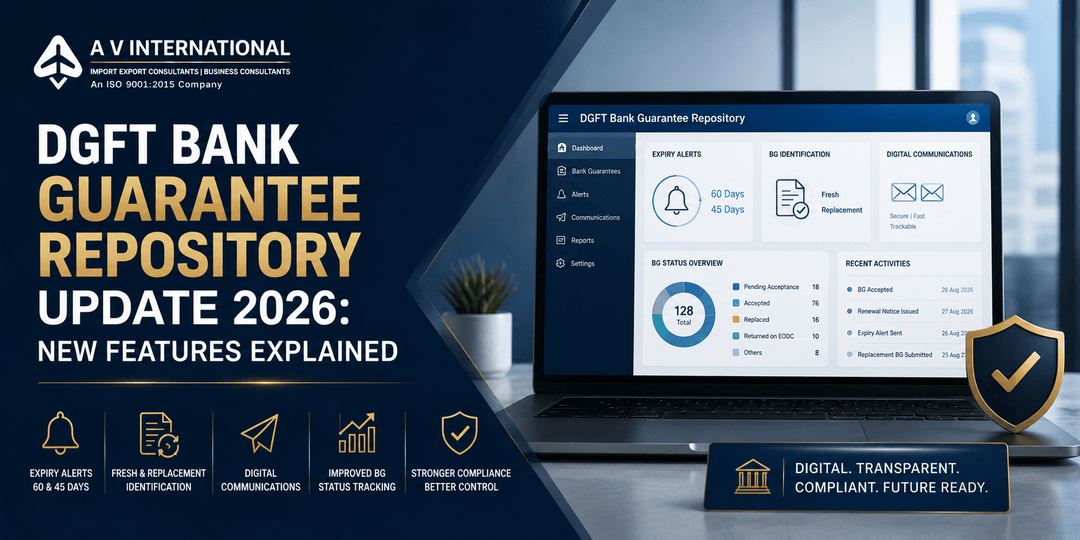
DGFT Bank Guarantee Repository Update 2026: New Features Explained
For exporters using Advance Authorisation, EPCG or other DGFT processes involving Bank Guarantees, tracking the validity of a BG is not just an administrative task.
A missed renewal date can create unnecessary compliance problems. A replacement Bank Guarantee can require coordination between the exporter, bank and DGFT Regional Authority. And when BG information is being tracked through multiple documents or manual records, it becomes easier for important actions to be delayed.
DGFT has now introduced new functionality designed to make this process more systematic.
Through Trade Notice No. 23/2026-2027 dated 28 August 2026, the Directorate General of Foreign Trade has announced enhanced functionalities in its Bank Guarantee (BG) Repository Module on the DGFT Portal. The enhancements cover both the Customer Portal (CP) and Back Office (BO) interfaces.
The objective is straightforward: improve BG processing, provide better visibility of BG status, reduce paper-based tracking and allow more proactive monitoring of guarantees approaching expiry.
For exporters, this means the DGFT portal is becoming more structured around the complete BG lifecycle — from submission and acceptance to replacement, renewal, return or possible encashment.
Let’s understand what has actually changed and what exporters should do differently.
Quick Take: What Exporters Need to Know
- DGFT issued Trade Notice No. 23/2026-2027 on 28 August 2026.
- The update concerns the Bank Guarantee (BG) Repository Module on the DGFT Portal.
- The enhanced functionality applies to both the Customer Portal and Back Office interfaces.
- A new Purpose field identifies whether a BG is a fresh submission or a replacement of an existing BG.
- Exporters will receive system-generated email alerts 60 days and 45 days before BG expiry.
- Regional Authorities can digitally sign communications relating to BG renewal, replacement, notices to banks and return of BGs.
- Exporters and DGFT officials can track BGs through structured statuses such as Pending Acceptance, Accepted, Replaced and Returned on EODC.
- BGs declared under the Bills Repository remain in Pending Acceptance until accepted by the concerned Regional Authority.
- Where a BG is linked to an invalidation file under Advance Authorisation/EPCG, its status can automatically move to Accepted once the invalidation file is approved.
- The overall objective is to reduce paper-based tracking and make BG monitoring more proactive and digitally coordinated.
What Does DGFT Trade Notice 23/2026-2027 Actually Say?
The Trade Notice was issued by the Government of India, Ministry of Commerce and Industry, Department of Commerce, Directorate General of Foreign Trade.
It is dated:
28 August 2026
and is identified as:
Trade Notice No. 23/2026-2027
The subject is:
Introduction of new features in the Bank Guarantee (BG) Repository Module on DGFT Portal.
DGFT explains that enhanced functionality has been deployed in the BG Repository Module covering:
- Customer Portal (CP); and
- Back Office (BO).
The stated purpose is to:
- streamline BG processing; and
- facilitate proactive monitoring of Bank Guarantees.
Importantly, this Trade Notice is primarily a portal and workflow enhancement.
It does not announce a new percentage of Bank Guarantee, introduce a new export obligation or change the commercial terms of a Bank Guarantee.
The focus is on how Bank Guarantees are submitted, tracked, renewed, replaced, accepted and communicated through the DGFT system.
What Has Changed in the DGFT BG Repository?
There are four major functional enhancements specifically identified by DGFT.
1. New “Purpose” Field for Bank Guarantees
One of the most important changes is the introduction of a Purpose field.
The field indicates whether the Bank Guarantee being submitted is:
- a fresh submission, or
- a replacement of an existing BG.
This may sound like a small portal change, but it is useful from a compliance and tracking perspective.
Previously, where an exporter was replacing an existing guarantee, the relationship between the old BG and replacement BG could require additional manual tracking.
The new field gives the system a structured way to identify the nature of the submission.
What this means for exporters
When submitting a BG, the exporter needs to ensure that the purpose is correctly identified.
A replacement BG should not be treated like an unrelated fresh BG.
Correct classification can help maintain a clearer record of the BG lifecycle.
Exporter Tip
Before submitting a replacement Bank Guarantee, verify the existing BG details and make sure the submission is correctly identified as a replacement.
2. Automatic BG Expiry Alerts at 60 and 45 Days
This is probably the most immediately useful change for exporters.
DGFT states that system-triggered email alerts will be sent to exporters 60 days and 45 days before the expiry of a Bank Guarantee.
That creates two advance reminders.
Why does this matter?
A Bank Guarantee should not be allowed to expire accidentally where a valid BG is still required.
A typical exporter may have several guarantees at different stages of different DGFT authorisations.
Manual monitoring can become difficult when:
- multiple BGs are outstanding;
- different BGs have different expiry dates;
- the export/compliance team changes;
- a replacement BG is under process;
- the underlying authorisation has not yet been fully closed; or
- EODC/redemption is still pending.
The new alerts are intended to give exporters advance visibility.
The alert timeline
| Alert | What It Means |
|---|---|
| 60 days before expiry | Early warning to review the BG |
| 45 days before expiry | Further reminder to take required action |
| Expiry date | BG reaches its stated validity date |
What exporters should do when they receive an alert
Do not simply treat the email as an informational notification.
Use the alert as a trigger to check:
- Is the underlying DGFT authorisation still open?
- Is the BG still required?
- Is renewal necessary?
- Is a replacement BG being submitted?
- Has EODC/redemption been completed?
- Is the BG eligible for return?
- Is any action pending with the Regional Authority or bank?
Exporter Tip
Do not wait for the 45-day alert before starting the process. The 60-day alert should ideally trigger your internal BG review.
3. Digital Communication for Renewal, Replacement and Other BG Actions
DGFT has also provided Regional Authorities with the ability to generate and digitally sign communications through the portal.
These communications may relate to:
- renewal/replacement of BG;
- renewal notice to the bank;
- encashment notice to the bank; and
- return of BG to the exporter.
This is important because the BG lifecycle involves several parties.
For example:
Exporter → DGFT Regional Authority → Bank
If communication is dependent on physical letters or manual follow-up, the process can become slower and harder to track.
The new workflow is designed to make these communications more standardized and digitally traceable.
4. Structured BG Status Tracking
DGFT has introduced a structured mechanism for tracking the status of Bank Guarantees.
The Trade Notice specifically identifies the following statuses:
- Pending Acceptance
- Accepted
- Replaced
- Returned on EODC
- Encashment Notice to Bank Issued
- Renewal Notice to Exporter Issued
- Renewal Notice to Bank Issued
This is a major improvement from the perspective of visibility.
Instead of treating the BG as simply “submitted” or “not submitted,” the repository can reflect different stages of the BG lifecycle.
Understanding the New BG Statuses
Pending Acceptance
A BG declared under the Bills Repository will remain in Pending Acceptance until it is accepted by the concerned Regional Authority.
This is important because:
Submission does not necessarily mean acceptance.
An exporter should therefore not assume that a BG is fully processed merely because it has been uploaded or declared.
Accepted
Once the concerned Regional Authority accepts the BG, the system can reflect the Accepted status.
The Trade Notice also provides a specific automated mechanism for BGs linked to invalidation files under Advance Authorisation or EPCG.
Where such a BG is linked to an invalidation file, its status will automatically be updated to Accepted upon approval of the invalidation file.
Replaced
This status helps identify a BG that has been replaced by another BG.
The new Purpose field is particularly relevant here because the portal can identify a submission as a replacement rather than simply treating it as a fresh guarantee.
Returned on EODC
This status indicates that the BG has been returned in connection with EODC.
For exporters completing their authorisation obligations, this provides a structured status in the repository rather than relying entirely on manual tracking.
Encashment Notice to Bank Issued
This status indicates that the relevant communication regarding encashment has been issued to the bank.
This is an important compliance status and should not be ignored.
If an exporter sees such a status, it should be treated as requiring immediate review of the underlying authorisation and BG position.
Renewal Notice to Exporter Issued
This indicates that a renewal-related communication has been issued to the exporter.
It reinforces the importance of monitoring the portal and registered email address.
Renewal Notice to Bank Issued
This indicates that the relevant renewal communication has been issued to the bank.
The exporter should coordinate with its bank where renewal/replacement action is required.
Before vs Now: What Has Changed?
| Particular | Earlier / Existing Tracking Approach | Enhanced DGFT Repository |
|---|---|---|
| BG identification | Less structured | Purpose field introduced |
| Fresh vs replacement BG | Manual/context-based identification could be required | Purpose specifically identifies fresh or replacement |
| Expiry monitoring | Exporter had to monitor expiry dates | System email alerts at 60 and 45 days |
| BG status | Tracking could require separate follow-up | Structured status mechanism |
| Renewal communication | Manual/paper-based processes could be involved | Portal-based digitally signed communication |
| Bank communication | Separate communication process | Digital renewal/encashment communication functionality |
| BG acceptance | Acceptance tracking | Pending Acceptance / Accepted statuses |
| Replacement tracking | Manual coordination | Replaced status |
| EODC-related return | Manual tracking | Returned on EODC status |
The Trade Notice itself states that the enhancements are intended to reduce paper-based tracking, enable proactive monitoring of expiring BGs, streamline linking of replacement BGs and facilitate uniform, digitally signed communications across Regional Authorities.
How Does This Affect Advance Authorisation?
The Trade Notice does not amend the substantive Advance Authorisation scheme.
However, it specifically refers to BGs linked to invalidation files under Advance Authorisation.
This is therefore particularly relevant for exporters using Advance Authorisation where Bank Guarantees are part of the applicable process.
The key system-level change is:
BG linked to an invalidation file → invalidation file approved → BG status automatically updated to “Accepted.”
This mechanism is expressly stated in the Trade Notice.
What this means for Advance Authorisation users
If you have an Advance Authorisation-related BG:
- monitor its status in the repository;
- verify whether it is linked to the relevant invalidation file;
- monitor the approval of the invalidation file;
- check whether the BG status changes appropriately;
- respond promptly to renewal alerts where the BG is approaching expiry.
Important distinction
The Trade Notice does not say that Advance Authorisation users are automatically exempt from Bank Guarantees.
It also does not change the underlying Advance Authorisation eligibility, import entitlement or Export Obligation.
It primarily improves the digital tracking and workflow around BGs.
How Does This Affect EPCG?
The Trade Notice also specifically mentions EPCG in relation to invalidation files.
Where a BG declared under the Bills Repository is linked to an invalidation file under AA/EPCG, the system can automatically update the BG to Accepted once the invalidation file is approved.
Therefore, EPCG users should pay particular attention to:
- BG submission;
- BG acceptance;
- invalidation-file linkage;
- invalidation approval;
- BG expiry;
- renewal/replacement requirements; and
- final BG return status.
Again, the Trade Notice is a repository/workflow enhancement. It does not itself amend the EPCG Export Obligation or create a new EPCG duty benefit.
What Does This Mean for Exporters in Practical Terms?
The biggest practical change is that Bank Guarantee monitoring is becoming more system-driven.
Earlier, exporters could rely heavily on:
- internal Excel sheets;
- compliance calendars;
- emails;
- bank records;
- physical documents; and
- manual follow-ups.
Those tools can still be useful internally.
But exporters now have additional system functionality on the DGFT Portal.
The practical workflow becomes more structured:
BG submission
↓
Purpose identified as fresh/replacement
↓
BG appears in repository
↓
Pending Acceptance
↓
Acceptance by RA / applicable system update
↓
Monitoring of validity
↓
60-day alert
↓
45-day alert
↓
Renew / replace / complete EODC as applicable
↓
Returned / Replaced / other applicable status
This makes it easier for compliance teams to identify where a BG stands.
Example: Exporter With an Expiring BG
Suppose an exporter has a Bank Guarantee that expires on 30 November 2026.
Under the new alert mechanism, the exporter can expect system-generated alerts approximately:
- 1 October 2026 — 60 days before expiry
- 16 October 2026 — 45 days before expiry
The exporter should use the first alert to review whether the BG still needs to remain valid.
If the underlying requirement continues, the exporter can initiate the appropriate renewal/replacement process rather than waiting until the final days.
These dates are only an illustrative calculation based on the 60-day and 45-day alert periods stated in the Trade Notice; they are not additional statutory deadlines announced by DGFT.
Example: Replacement Bank Guarantee
Suppose ABC Exports has an existing BG and its bank issues a replacement BG.
Under the enhanced repository functionality, the exporter can identify the purpose of the new submission as a replacement of an existing BG.
This provides a more structured connection between the replacement submission and the existing guarantee.
Practical benefit
The exporter should have better visibility over:
- which BG is being replaced;
- whether the replacement has been accepted;
- whether the old BG has been appropriately dealt with; and
- what status is currently shown in the repository.
Example: Advance Authorisation Invalidation File
Suppose XYZ Manufacturing has a BG linked to an Advance Authorisation invalidation file.
The BG may initially remain in:
Pending Acceptance
Once the linked invalidation file is approved, the Trade Notice provides that the BG status can automatically update to:
Accepted
This reduces the need for separate manual status updating in the particular workflow covered by the Trade Notice.
What Exporters Should Do Now
The new functionality is useful only if exporters actually monitor and use it.
Recommended Action Checklist
Review all active DGFT-related Bank Guarantees.
Prepare an internal list of BG numbers and expiry dates.
Confirm that the correct email address is registered with DGFT.
Monitor the new 60-day and 45-day expiry alerts.
Check the BG status shown in the DGFT Repository.
Understand whether each BG is fresh or a replacement.
Check whether any replacement BG needs to be linked correctly.
Review BGs connected with Advance Authorisation.
Review BGs connected with EPCG.
Check invalidation-file status wherever relevant.
Monitor Pending Acceptance BGs.
Follow up where acceptance remains pending.
Check renewal communications issued to exporters or banks.
Coordinate with your bank well before expiry.
Review BGs approaching EODC/redemption.
Retain copies of digitally issued communications and relevant records.
Check the DGFT User Manual for the detailed workflow.
DGFT has specifically stated that a User Manual covering the relevant workflows is available on the DGFT Website for guidance and effective adoption.
Common Mistakes Exporters Should Avoid
1. Waiting until the BG is about to expire
The new 60-day and 45-day alerts are designed to encourage proactive action.
Do not treat the alert as a last-minute reminder.
2. Assuming an uploaded BG is automatically accepted
A BG declared under the Bills Repository remains in Pending Acceptance until accepted by the concerned Regional Authority, subject to the specific automated mechanism described for linked invalidation files.
3. Ignoring the Purpose field
If a BG is a replacement, ensure that it is correctly identified as a replacement.
4. Monitoring only the bank’s records
The bank’s records and the DGFT Repository serve different purposes.
Exporters should monitor the DGFT portal as well as their bank’s communication.
5. Ignoring portal status changes
Statuses such as:
- Pending Acceptance;
- Renewal Notice to Exporter Issued;
- Renewal Notice to Bank Issued; and
- Encashment Notice to Bank Issued
can indicate that action is required.
6. Assuming the new feature changes substantive DGFT scheme rules
The Trade Notice is about BG Repository functionality and workflow enhancement.
It does not, by itself, amend the underlying Advance Authorisation or EPCG scheme conditions.
7. Relying only on email alerts
The Trade Notice provides system-triggered alerts at 60 and 45 days before expiry, but exporters should maintain their own compliance calendar as a backup.
A portal alert should supplement — not replace — internal compliance controls.
FAQs: DGFT Bank Guarantee Repository Update 2026
1. What is DGFT Trade Notice No. 23/2026-2027?
DGFT Trade Notice No. 23/2026-2027 dated 28 August 2026 introduces enhanced functionalities in the Bank Guarantee Repository Module on the DGFT Portal.
2. What is the DGFT Bank Guarantee Repository?
It is the DGFT Portal functionality used for managing and tracking Bank Guarantee-related information and workflows. The latest enhancement introduces more structured tracking, expiry alerts and digital communication features.
3. What is the new Purpose field in the BG Repository?
The Purpose field identifies whether a submitted Bank Guarantee is a fresh submission or a replacement of an existing BG.
4. Will DGFT send reminders before a Bank Guarantee expires?
Yes. The Trade Notice states that system-triggered email alerts will be sent to exporters 60 days and 45 days before BG expiry.
5. What happens when a BG is declared under the Bills Repository?
The BG remains in Pending Acceptance until it is accepted by the concerned Regional Authority.
6. What does “Pending Acceptance” mean for a DGFT Bank Guarantee?
It means that the BG has been declared in the repository but has not yet been accepted by the concerned Regional Authority.
Exporters should monitor such BGs rather than assuming that submission means final acceptance.
7. What happens if a BG is linked to an Advance Authorisation or EPCG invalidation file?
Where such a BG is linked to an invalidation file under AA/EPCG, its status is automatically updated to Accepted upon approval of the invalidation file, according to the Trade Notice.
8. Can DGFT issue digital communications for BG renewal?
Yes. Regional Authorities may generate and digitally sign communications for BG renewal/replacement, renewal notices to banks, encashment notices to banks and return of BGs, as applicable.
9. What BG statuses can exporters track?
The Trade Notice lists statuses including Pending Acceptance, Accepted, Replaced, Returned on EODC, Encashment Notice to Bank Issued, Renewal Notice to Exporter Issued and Renewal Notice to Bank Issued.
10. Does this Trade Notice change Advance Authorisation eligibility?
No such change is stated in the Trade Notice. Its relevance to Advance Authorisation is primarily through the BG repository workflow and the specific reference to invalidation files.
11. Does this Trade Notice change EPCG Export Obligation?
No. The Trade Notice does not announce a change to EPCG Export Obligation. Its EPCG reference concerns the automated BG status update where a BG is linked to an approved invalidation file.
12. Where can exporters find guidance on the new BG workflow?
DGFT states that a User Manual detailing the relevant workflows is available on the DGFT Website.
Final Takeaway
The latest DGFT Bank Guarantee update is less about changing the substance of a Bank Guarantee and more about improving how the guarantee is managed through the DGFT Portal.
The most important features are:
Purpose identification → 60/45-day expiry alerts → structured BG statuses → digital renewal/replacement communications → better linkage with relevant workflows.
For exporters, the practical message is simple:
Do not wait for a Bank Guarantee to become an urgent problem.
Use the new DGFT repository functionality to monitor your guarantees, review approaching expiry dates, check acceptance status and coordinate renewal or replacement well in advance.
This is particularly relevant for businesses handling Advance Authorisation and EPCG, where BG-related processes can be connected with invalidation and other DGFT workflows.
The Trade Notice itself states that these enhancements are intended to reduce paper-based tracking, improve proactive monitoring of expiring BGs, streamline replacement-BG linking and support uniform digitally signed communications across Regional Authorities.
Need Help With DGFT Bank Guarantee, Advance Authorisation or EPCG Compliance?
Bank Guarantee management can become complicated when multiple authorisations, banks, Regional Authorities, renewals, replacements and EODC-related processes are involved.
A V International can assist exporters with:
- Advance Authorisation
- EPCG Licence
- Bank Guarantee-related DGFT compliance
- Advance Authorisation Redemption / EODC
- EPCG Redemption
- DGFT licensing and amendments
- Invalidation-related DGFT procedures
- DGFT portal compliance and troubleshooting
- Export-import regulatory advisory
With 35+ years of experience assisting Indian exporters, A V International helps businesses understand not only the regulatory requirement but also the practical documentation and compliance steps involved.
If your Bank Guarantee is approaching expiry, showing an unexpected status, awaiting acceptance, or connected with an Advance Authorisation/EPCG process, it is advisable to review the position before the issue becomes time-sensitive.
Important: This article is based primarily on DGFT Trade Notice No. 23/2026-2027 dated 28 August 2026 supplied for this article. The Trade Notice announces portal/workflow enhancements; it should not be interpreted as independently changing the substantive eligibility, Export Obligation or Bank Guarantee requirements of Advance Authorisation, EPCG or any other DGFT scheme unless another applicable provision specifically provides so. Case-specific requirements should be verified against the applicable DGFT/HBP provisions and portal workflow.
Recent Posts
- EPCG Compliance Audit Checklist Every Exporter & Manufacturer Needs in 2026
- TRACE Scheme DGFT: How MSME Exporters Can Get Certification Costs Reimbursed
- DGFT TRACE Scheme Update 2026: Higher Reimbursement for MSMEs Explained
- How to Apply for Star Export House Certificate in India: Complete 2026 Guide
- Fast Approval Tips to Reduce CDSCO Dual Use NOC Processing Time in 2026
FeATURED ARTICLES

SARAL SIMS for Steel Imports in India – Complete Guide The Government of India has introduced SARAL SIMS (Simplified Steel…

Top Export Compliance Mistakes: DGFT Advance Authorization, EPCG & CPCB (2025 Guide) Exporting in India can feel like a legal…

Environmental Clearance CPCB: Quick Guide for Exporters If you’re an Indian exporter or manufacturer working under schemes like the Advanced…

DGFT e-BRC Rule 2025: Key Update for Advance Authorization & EPCG Holders The Directorate General of Foreign Trade (DGFT) has…
