
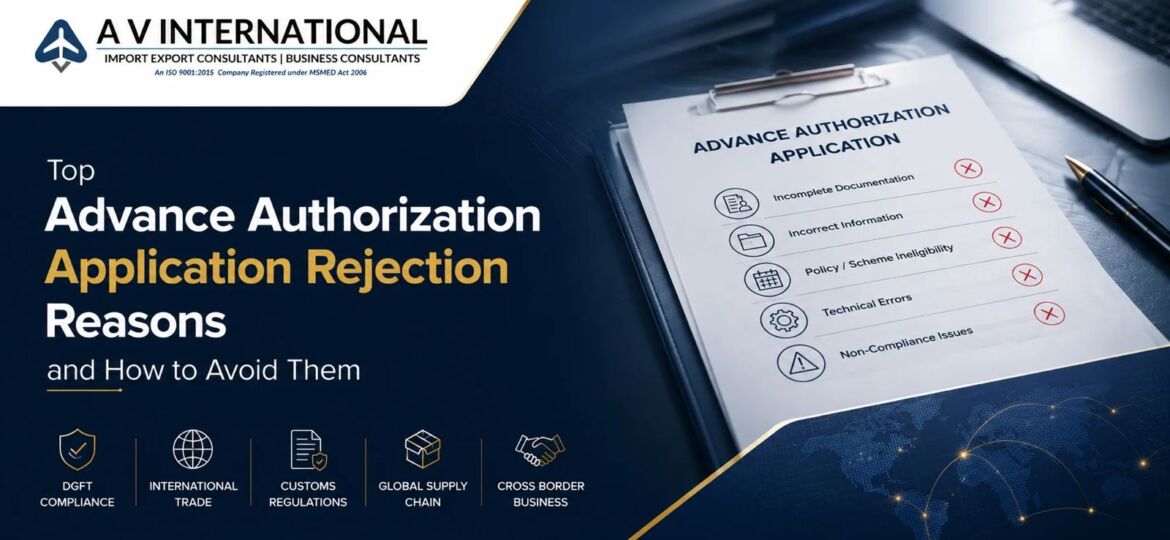

Top Advance Authorization Application Rejection Reasons and How to Avoid Them
Key Takeaways
- Advance Authorization applications are often rejected due to documentation errors, incorrect input-output norms, and inconsistencies in business information.
- Mismatched IEC, GST, PAN, and export product details can trigger DGFT scrutiny and rejection.
- Incorrect quantity calculations and unrealistic wastage norms are common reasons for application objections.
- Proper documentation and accurate export planning significantly improve approval chances.
- Responding quickly to DGFT deficiency letters helps avoid prolonged delays.
- Maintaining complete records and compliance documentation reduces rejection risks.
- A structured review process can improve Advance Authorization approval success rates in 2026.
Introduction
The Advance Authorization Scheme remains one of the most valuable export promotion schemes available to Indian exporters. It allows duty-free import of raw materials, components, consumables, and inputs used in manufacturing export products.
However, many businesses face unexpected delays and application rejections due to avoidable mistakes in documentation, input-output calculations, export product descriptions, and compliance requirements.
If your Advance Authorization application has been rejected or you want to improve approval chances in 2026, understanding the common rejection reasons is essential.
This guide explains the most frequent Advance Authorization application rejection reasons and practical strategies to avoid them.
What Is Advance Authorization?
Advance Authorization is a duty exemption scheme administered by DGFT that allows exporters to import inputs required for manufacturing export products without paying customs duties.
The scheme helps exporters reduce production costs and improve international competitiveness.
Why Advance Authorization Approval Is Important
A successful Advance Authorization approval provides:
- Duty-free import benefits
- Lower manufacturing costs
- Improved export competitiveness
- Better cash flow management
- Reduced customs duty burden
- Enhanced global market access
Delays or rejection can affect production schedules and export commitments.
Top Advance Authorization Application Rejection Reasons
1. Incorrect Input-Output Norms (SION)
One of the most common reasons for rejection is incorrect declaration of input-output ratios.
Examples include:
- Excessive raw material consumption
- Incorrect wastage calculations
- Unsupported manufacturing norms
Solution
Verify applicable Standard Input Output Norms (SION) before filing.
2. Mismatch in IEC Details
DGFT may reject applications when:
- IEC details are outdated
- Business name differs across records
- Address inconsistencies exist
Solution
Ensure IEC records are updated and match all supporting documents.
3. Incorrect Export Product Description
Vague or inaccurate product descriptions often trigger objections.
Solution
Provide detailed product descriptions aligned with export invoices and technical specifications.
4. Incomplete Documentation
Applications frequently face rejection due to missing documents.
Common omissions include:
- IEC Certificate
- GST Registration
- Manufacturing Process Details
- Chartered Engineer Certificate
- Technical Specifications
Solution
Prepare a comprehensive document checklist before submission.
5. Incorrect Quantity Calculations
Many applicants incorrectly calculate:
- Input quantities
- Wastage percentages
- Export obligations
Solution
Review all quantity calculations carefully before filing.
6. Unsupported Wastage Claims
Excessive wastage percentages often attract scrutiny.
Solution
Provide technical justification supported by manufacturing records.
7. Product Classification Errors
Incorrect ITC HS Code classification may result in rejection.
Solution
Verify classification under the latest DGFT and customs schedules.
8. Failure to Respond to DGFT Deficiency Letters
Many applications are rejected simply because businesses fail to respond within the prescribed time.
Solution
Monitor DGFT communications regularly and respond promptly.
9. Manufacturing Process Inconsistencies
DGFT may seek clarification when:
- Manufacturing processes appear unrealistic
- Input-output relationships are unclear
Solution
Submit detailed manufacturing flowcharts and process descriptions.
10. Export Obligation Feasibility Issues
Applications may face objections when proposed export commitments appear unrealistic.
Solution
Submit practical projections based on actual export capacity.
Documents Required for Advance Authorization Application
Before applying, keep the following documents ready:
- IEC Certificate
- GST Registration Certificate
- PAN Card
- Manufacturing Process Flow Chart
- Product Technical Specifications
- Chartered Engineer Certificate
- Export Performance Details
- Input Consumption Statement
- Factory License (if applicable)
- Authorization Letter
- Digital Signature Certificate
Important Tip
Ensure consistency across all business and product-related documents.
How to Avoid Advance Authorization Rejection
Step 1: Verify Business Information
Cross-check:
- IEC
- GST
- PAN
- Company Address
Step 2: Validate Product Classification
Confirm correct ITC HS Codes.
Step 3: Review Input-Output Norms
Use applicable SION or provide technical justification.
Step 4: Audit Documentation
Ensure all mandatory documents are complete and current.
Step 5: Conduct Internal Review
Verify calculations, descriptions, and export obligations.
Step 6: Submit Accurate Application
Avoid assumptions and unsupported claims.
Practical Compliance Tips for Exporters in 2026
- Keep IEC details updated.
- Maintain production and consumption records.
- Review SION requirements carefully.
- Use accurate product classifications.
- Respond quickly to DGFT communications.
- Conduct pre-submission audits.
- Maintain complete export documentation.
Frequently Asked Questions (FAQs)
Why was my Advance Authorization application rejected?
Most rejections occur due to documentation errors, incorrect norms, classification mistakes, or unaddressed DGFT queries.
Can I reapply after rejection?
Yes. Businesses can correct deficiencies and submit a revised application.
What is the most common rejection reason?
Incorrect input-output norms and incomplete documentation are among the most common causes.
Does incorrect IEC information affect approval?
Yes. Mismatched IEC records frequently trigger DGFT objections.
How long does DGFT take to process applications?
Processing timelines vary depending on application complexity and verification requirements.
Can consultants help improve approval chances?
Yes. Experienced DGFT consultants can identify deficiencies before submission.
Are SION norms mandatory?
Where applicable, SION norms should be followed unless justified alternative norms are approved.
Can wrong HS Codes lead to rejection?
Yes. Incorrect classification can delay or prevent approval.
Conclusion
Advance Authorization application rejection can delay exports, increase costs, and disrupt production planning. Fortunately, most rejections occur because of avoidable documentation errors, incorrect norms, classification issues, or incomplete information.
By understanding the most common rejection reasons and implementing proper compliance procedures, exporters can significantly improve approval chances and maximize the benefits available under the Advance Authorization Scheme in 2026.
Need Help with Advance Authorization Approval?
A V International has more than 35 years of experience assisting exporters with:
- Advance Authorization Applications
- DGFT Licensing Services
- Export Compliance
- SION Norm Advisory
- Duty Exemption Schemes
- Customs Documentation
- Import-Export Licensing
Our experts help businesses prepare accurate applications, avoid rejection, and achieve faster DGFT approvals.
Written By
Akash Bhangare
Having more than 10 years of experience in DGFT compliance, Advance Authorization, export-import regulations, and export incentive schemes in India.
Associated with A V International, a company with over 35 years of expertise in DGFT licensing, export-import compliance, customs advisory, and international trade consulting services.
Recent Posts
- Top Advance Authorization Application Rejection Reasons and How to Avoid Them
- Battery Waste EPR Portal Errors: Complete Troubleshooting Guide for Businesses
- How to Calculate E-Waste EPR Targets and Compliance Obligations
- EPR Registration vs EPR Compliance: What PIBOs Must Know in 2026
- Battery Waste EPR Registration for Importers in India: Complete 2026 Compliance Guide
FeATURED ARTICLES
SARAL SIMS for Steel Imports in India – Complete Guide The Government of India has introduced SARAL SIMS (Simplified Steel…
Top Export Compliance Mistakes: DGFT Advance Authorization, EPCG & CPCB (2025 Guide) Exporting in India can feel like a legal…
Environmental Clearance CPCB: Quick Guide for Exporters If you’re an Indian exporter or manufacturer working under schemes like the Advanced…
DGFT e-BRC Rule 2025: Key Update for Advance Authorization & EPCG Holders The Directorate General of Foreign Trade (DGFT) has…

