

India's Leading DGFT Consultants
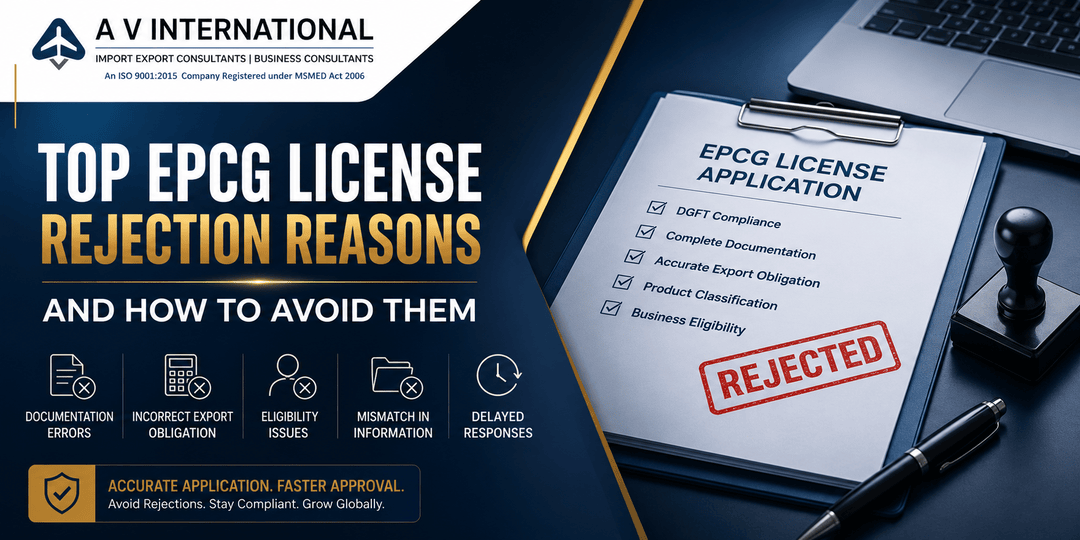
Top EPCG License Rejection Reasons and How to Avoid Them

Top EPCG License Rejection Reasons and How to Avoid Them

Key Takeaways

  • Incorrect or incomplete documentation is one of the leading causes of EPCG License rejection.
  • Businesses must meet DGFT eligibility requirements before applying.
  • Errors in export obligation details and product classification can delay approvals.
  • Timely responses to DGFT queries improve approval chances.
  • Proper planning and expert review help avoid unnecessary delays and rejections.

Introduction

The Export Promotion Capital Goods (EPCG) Scheme is one of India’s most valuable export promotion initiatives under the Directorate General of Foreign Trade (DGFT). It enables manufacturers and exporters to import capital goods at concessional customs duty by fulfilling prescribed export obligations.

Although the scheme offers significant financial benefits, many businesses face delays or rejection because of avoidable application errors. Even small mistakes in documentation, eligibility assessment, or export obligation calculations can lead to additional clarification requests or rejection by the licensing authority.

This guide explains the most common EPCG License rejection reasons, practical solutions to avoid them, and best practices for obtaining faster approval in 2026.

What Is an EPCG License?

An EPCG (Export Promotion Capital Goods) License is an authorization issued by DGFT that allows eligible businesses to import capital goods at concessional customs duty, subject to fulfilling specified export obligations within the prescribed period.

The scheme supports manufacturing competitiveness by reducing capital investment costs while encouraging export growth.

Featured Snippet Answer

EPCG License applications are commonly rejected due to incomplete documentation, incorrect export obligation calculations, eligibility issues, inaccurate product details, or non-compliance with DGFT guidelines. Businesses can improve approval chances by preparing accurate documents, verifying application details, responding promptly to DGFT queries, and ensuring compliance with the latest Foreign Trade Policy requirements.

Top EPCG License Rejection Reasons

1. Incomplete Documentation

Many applications are rejected because mandatory supporting documents are missing or uploaded incorrectly.

Common missing documents include:

  • IEC Certificate
  • GST Registration
  • Manufacturer details
  • Chartered Engineer Certificate (where applicable)
  • Digital Signature Certificate (DSC)
  • Supporting declarations

Always verify document completeness before submission.


2. Incorrect Export Obligation Details

Export obligation is one of the most critical aspects of the EPCG Scheme.

Errors often include:

  • Incorrect FOB values
  • Wrong export calculations
  • Inaccurate product descriptions
  • Miscalculated export commitments

Incorrect figures frequently result in DGFT clarification requests or rejection.


3. Eligibility Issues

Some applicants fail to verify whether they satisfy the EPCG Scheme eligibility conditions before filing.

Businesses should confirm:

  • Valid IEC Registration
  • Eligible business activities
  • Product eligibility
  • Compliance with current Foreign Trade Policy provisions

Applying without meeting eligibility requirements may lead to immediate rejection.


4. Incorrect Product Classification

Providing incorrect HS Codes or inaccurate descriptions of imported capital goods can delay processing.

Ensure that:

  • Capital goods are properly classified.
  • Technical specifications match supporting documents.
  • Product descriptions are complete and accurate.

5. Mismatch in Business Information

Differences between DGFT records and submitted application details often trigger verification.

Common mismatches include:

  • Company name
  • GST information
  • PAN details
  • Registered office address
  • IEC information

Maintain consistency across all government registrations.


6. Poor Quality Document Uploads

Blurred or unreadable documents frequently delay application processing.

Before uploading:

  • Scan documents in high resolution.
  • Ensure all pages are legible.
  • Upload files in the prescribed format.
  • Verify document orientation.

7. Delayed Response to DGFT Queries

DGFT authorities may seek additional clarification during application review.

Ignoring or responding late to these queries can significantly delay approval or result in rejection.

Regularly monitor your DGFT dashboard and registered email for updates.

Best Practices to Avoid EPCG License Rejection

Businesses can significantly improve approval success by following these practices:

  • Verify eligibility before applying.
  • Prepare a complete documentation checklist.
  • Review export obligation calculations carefully.
  • Use accurate HS Codes and product descriptions.
  • Cross-check IEC, GST, and PAN details.
  • Upload clear and properly scanned documents.
  • Respond promptly to DGFT clarification requests.
  • Keep digital records of all submissions.

Practical Tips for Faster Approval

To reduce processing delays:

  • Review every application before final submission.
  • Stay updated with the latest DGFT notifications.
  • Ensure supporting declarations are properly signed.
  • Maintain organized compliance records.
  • Seek professional guidance for complex applications.

Proper planning can prevent unnecessary delays and improve approval timelines.

Common Mistakes Businesses Should Avoid

Avoid these frequent errors:

  • Applying without checking eligibility
  • Incorrect export turnover calculations
  • Incomplete supporting documents
  • Wrong HS Code selection
  • Mismatch in IEC and GST information
  • Ignoring DGFT notices
  • Last-minute application submission

Most EPCG License rejections are preventable with careful preparation.

Frequently Asked Questions (FAQs)

1. Why is my EPCG License application rejected?

Applications are generally rejected due to incomplete documents, eligibility issues, incorrect export obligation calculations, mismatched business information, or non-compliance with DGFT guidelines.

2. How can I avoid EPCG License rejection?

Ensure accurate documentation, verify eligibility, calculate export obligations correctly, submit complete applications, and respond promptly to DGFT queries.

3. Does DGFT ask for clarification after application submission?

Yes. DGFT may request additional documents or clarification before approving the application.

4. Can incorrect HS Codes delay approval?

Yes. Incorrect classification of imported capital goods may result in processing delays or rejection.

5. Can professional consultants assist with EPCG applications?

Yes. Experienced DGFT consultants help businesses prepare accurate documentation, verify eligibility, complete applications, and improve approval success.

6. How long does EPCG License approval usually take?

Approval timelines vary depending on document verification, application accuracy, DGFT workload, and whether additional clarification is required.

Conclusion

The EPCG Scheme offers valuable benefits to exporters and manufacturers by reducing the cost of importing capital goods. However, many applications are delayed or rejected because of avoidable mistakes such as incomplete documentation, incorrect export obligation calculations, or inconsistencies in business information.

By understanding the common rejection reasons, maintaining accurate records, and following DGFT guidelines, businesses can significantly improve their chances of obtaining faster EPCG License approval in 2026.

Need Help with EPCG License Application?

A V International has over 35 years of experience in DGFT Licensing, EPCG Authorization, Advance Authorisation, IEC Registration, and Import-Export Compliance.

Our experts provide complete assistance with:

  • EPCG License Application
  • Documentation Review
  • DGFT Compliance
  • Export Obligation Guidance
  • DGFT Query Resolution
  • End-to-End Licensing Support

Partner with A V International to simplify your EPCG application process and improve your approval success.

Written By

Akash Bhangare

Having more than 10 years of experience in EPR Compliance, Legal Metrology, DGFT Regulations, and Import Export Consulting Services in India.

Associated with A V International, a company with over 35 years of expertise in Environmental Compliance, EPR Registrations, Licensing, and Regulatory Approvals.

FeATURED ARTICLES