
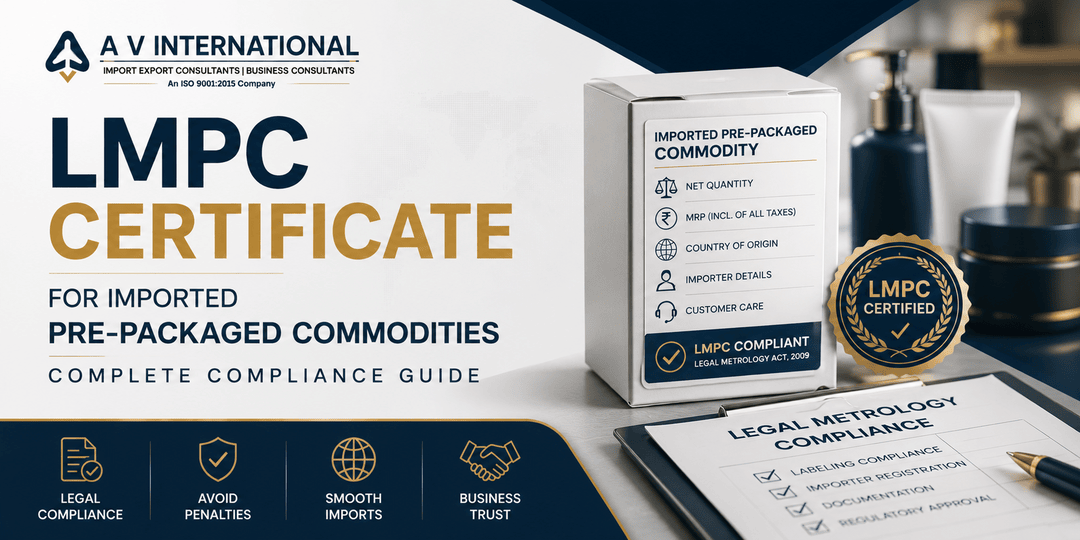

LMPC Certificate for Imported Pre-Packaged Commodities: Complete Compliance Guide (2026)
Key Takeaways
- LMPC Certificate is mandatory for many imported pre-packaged commodities sold in India.
- Registration helps ensure compliance with the Legal Metrology Act and Packaged Commodities Rules.
- Proper labeling is as important as obtaining the certificate.
- Incorrect or incomplete documentation can delay registration.
- Non-compliance may result in penalties, product detention, or legal action.
- Professional guidance helps businesses complete the process faster and avoid costly mistakes.
Introduction
Importing pre-packaged commodities into India involves more than customs clearance and DGFT compliance. Businesses must also comply with the Legal Metrology Act, 2009 and the Legal Metrology (Packaged Commodities) Rules, 2011, which regulate labeling and declarations on imported packaged goods.
If your company imports products such as consumer goods, electronics, cosmetics, food items, medical devices, industrial products, or household products in packaged form, obtaining an LMPC Certificate may be a mandatory requirement before selling them in the Indian market.
This guide explains everything importers need to know about LMPC registration, required documents, compliance requirements, and best practices.
What is an LMPC Certificate?
An LMPC (Legal Metrology Packaged Commodities) Certificate is a registration issued to importers dealing with pre-packaged commodities intended for sale or distribution in India.
The registration confirms that the importer complies with the labeling and packaging requirements prescribed under Indian Legal Metrology regulations.
Why is LMPC Registration Important?
An LMPC Certificate offers several compliance advantages:
- Ensures compliance with Legal Metrology regulations
- Helps avoid customs clearance issues
- Enables legal sale of imported packaged products
- Builds consumer trust through proper labeling
- Reduces the risk of penalties and product seizures
- Supports smooth business operations
Featured Snippet Answer
An LMPC Certificate is required for importers bringing pre-packaged commodities into India that fall under the Legal Metrology (Packaged Commodities) Rules. It ensures products carry mandatory declarations such as importer details, MRP, quantity, country of origin, and manufacturing information before being sold in the Indian market.
Who Needs an LMPC Certificate?
Generally, LMPC registration may be required for:
- Importers of packaged consumer goods
- Electronics importers
- Cosmetic importers
- Food product importers
- Medical device importers
- Household goods importers
- Industrial packaged products
- E-commerce sellers importing packaged goods
- Brand owners importing finished products
Documents Required for LMPC Certificate
Although requirements may vary depending on the authority, businesses commonly need:
- Import Export Code (IEC)
- GST Registration Certificate
- PAN Card
- Company Incorporation Certificate
- Partnership Deed or LLP Agreement (if applicable)
- Identity proof of authorized signatory
- Address proof of business premises
- Authorization Letter
- Product details
- Packaging and label artwork
- List of imported commodities
- Signature of authorized person
- Passport-size photograph (where applicable)
Keeping all documents updated helps avoid unnecessary delays.
Step-by-Step LMPC Registration Process
Step 1: Verify Applicability
Determine whether your imported products require LMPC registration.
Step 2: Collect Required Documents
Prepare all statutory and business documents.
Step 3: Prepare Product Label
Ensure the packaging contains mandatory declarations.
Step 4: Submit Application
File the LMPC registration application with the appropriate Legal Metrology authority.
Step 5: Document Verification
Authorities verify submitted documents and may request clarifications.
Step 6: Registration Approval
Upon successful verification, the LMPC Certificate is issued.
Mandatory Labeling Requirements
Imported pre-packaged commodities generally require declarations such as:
- Name and address of importer
- Country of Origin
- Generic product name
- Net quantity
- Maximum Retail Price (MRP)
- Month and Year of Import (where applicable)
- Customer care details
- Manufacturing details (where required)
Incorrect labeling is one of the most common reasons for compliance issues.
Common Mistakes Importers Should Avoid
- Applying with incomplete documents
- Incorrect product labeling
- Missing importer declarations
- Wrong MRP declaration
- Using outdated packaging artwork
- Ignoring Legal Metrology requirements before import
- Delaying registration until after shipment arrival
These mistakes can lead to shipment delays and regulatory complications.
Best Practices for Smooth Compliance
- Review product labels before shipment.
- Maintain updated statutory documents.
- Keep records of all imported products.
- Monitor changes in Legal Metrology regulations.
- Conduct periodic compliance audits.
- Seek professional assistance for registration and renewals.
Timeline and Cost
The processing timeline depends on the completeness of the application, document verification, and the concerned Legal Metrology authority. Delays are commonly caused by missing documents or incorrect labeling.
Businesses should also account for applicable government fees and any professional consultancy charges, where relevant.
FAQs
1. Is LMPC Certificate mandatory for every importer?
It depends on the nature of the imported products. Many pre-packaged commodities intended for retail sale require LMPC registration.
2. Can products be imported without LMPC registration?
Non-compliance may result in customs objections, regulatory issues, or restrictions on selling the products in India.
3. How long does LMPC registration take?
The timeline varies depending on document verification and the processing authority.
4. Can one LMPC Certificate cover multiple products?
Generally, the registration covers the importer, but compliance requirements should be reviewed for each product category.
5. What happens if product labels are incorrect?
Incorrect labeling may lead to penalties, product detention, or directions to rectify labeling before sale.
6. Does LMPC registration require renewal?
Businesses should monitor applicable validity and renewal requirements as prescribed by the issuing authority.
Conclusion
Obtaining an LMPC Certificate for imported pre-packaged commodities is an essential compliance requirement for many businesses importing goods into India. Proper registration, accurate labeling, and timely compliance help ensure hassle-free customs clearance, uninterrupted sales, and reduced regulatory risks.
By preparing complete documentation and following Legal Metrology requirements, importers can strengthen their compliance framework while protecting their business from avoidable penalties.
Need Assistance with LMPC Registration?
A V International has over 35 years of experience in regulatory approvals, DGFT compliance, Legal Metrology registrations, import-export consulting, and licensing services.
Our experts assist businesses with:
- LMPC Certificate Registration
- Legal Metrology Compliance
- Product Label Verification
- DGFT & IEC Consultancy
- Import Export Compliance
- Documentation Support
- Regulatory Advisory
Contact A V International today for end-to-end assistance with your LMPC registration requirements.
Written By
Akash Bhangare
Having more than 10 years of experience in EPR Compliance, Legal Metrology, DGFT Regulations, and Import Export Consulting Services in India.
Associated with A V International, a company with over 35 years of expertise in Environmental Compliance, EPR Registrations, Licensing, and Regulatory Approvals.
Recent Posts
- LMPC Certificate for Imported Pre-Packaged Commodities | Complete Guide 2026
- Exporting to Oman? DGFT Makes eCoO Mandatory Under India–Oman CEPA – Complete Guide (2026)
- India–Oman CEPA Opens New Opportunities: Complete DGFT TRQ Procedure Guide (2026)
- How Long Does RoDTEP Credit Take After Export? 2026 Timeline Explained
- RoDTEP vs Duty Drawback: Which Export Incentive Is Better?
FeATURED ARTICLES
SARAL SIMS for Steel Imports in India – Complete Guide The Government of India has introduced SARAL SIMS (Simplified Steel…
Top Export Compliance Mistakes: DGFT Advance Authorization, EPCG & CPCB (2025 Guide) Exporting in India can feel like a legal…
Environmental Clearance CPCB: Quick Guide for Exporters If you’re an Indian exporter or manufacturer working under schemes like the Advanced…
DGFT e-BRC Rule 2025: Key Update for Advance Authorization & EPCG Holders The Directorate General of Foreign Trade (DGFT) has…

