
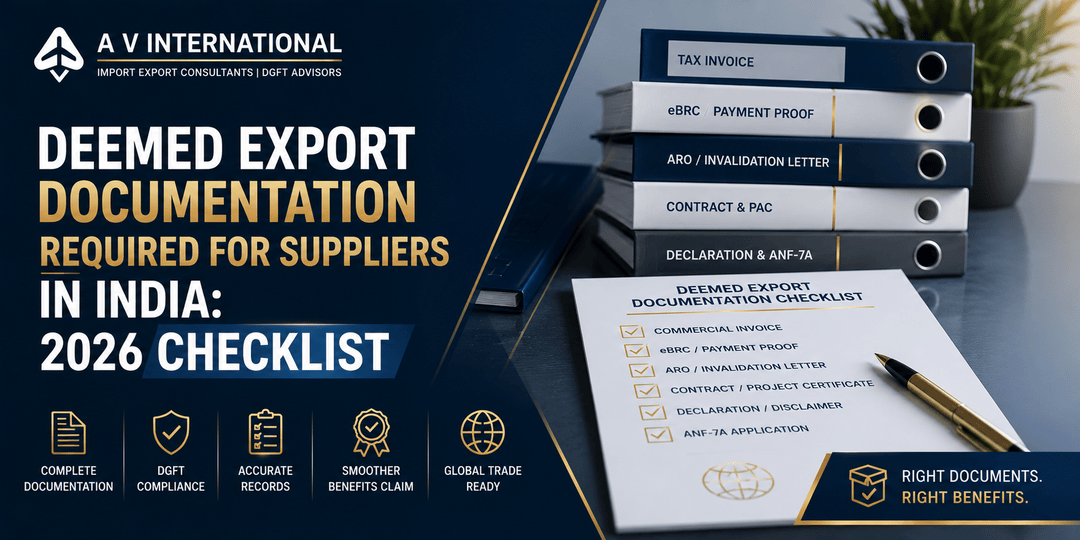

Deemed Export Documentation Required for Suppliers in India: 2026 Checklist
Key Takeaways
- Deemed exports are domestic supplies that qualify under specified categories of the Foreign Trade Policy.
- Suppliers must maintain complete commercial, payment and authorization records to support a deemed export benefit claim.
- ANF-7A is used for claiming applicable deemed export benefits.
- Depending on the transaction, documents can include tax invoices, eBRC, ARO, Invalidation Letter, contracts, Project Authority Certificates and declarations.
- Since December 2025, the DGFT procedure requires applications to be filed with the jurisdictional Regional Authority, subject to specific provisions for supplies to EOUs.
- The eBRC format was updated from 13 January 2026 to include GSTIN, GST Invoice Number and GST Invoice Date.
- Documentation should be prepared according to the exact deemed export category and benefit being claimed.
Introduction
A supply made within India can still qualify as a deemed export when it meets the specific conditions prescribed under the Foreign Trade Policy.
For Indian manufacturers and suppliers, deemed export transactions can provide access to benefits such as Advance Authorisation, Deemed Export Drawback and eligible Terminal Excise Duty benefits, subject to applicable conditions.
However, many suppliers face difficulty when claiming benefits because invoices, payment evidence, authorization documents or recipient declarations are incomplete.
This Deemed Export Documentation Required for Suppliers in India: 2026 Checklist explains the important documents suppliers should maintain and the practical checks that should be completed before filing a claim.
What Is a Deemed Export?
Under FTP 2023, deemed exports generally refer to specified supplies where the goods do not leave India and payment is received in Indian rupees or freely convertible foreign exchange.
Only supplies falling within the categories specifically covered by the policy qualify. Therefore, a domestic sale should not automatically be treated as a deemed export simply because the buyer is connected with an export-oriented project or authorization.
The eligibility of the transaction must first be established under Chapter 7 of FTP 2023.
Which Suppliers Can Claim Deemed Export Benefits?
Specified categories include supplies such as:
- Intermediate goods supplied to Advance Authorisation or DFIA holders against an Invalidation Letter.
- Supplies to Advance Authorisation/DFIA holders against an ARO.
- Supplies to EOUs, EHTPs, STPs and BTPs.
- Supplies of capital goods against EPCG authorization.
- Supplies to specified projects or agencies covered under FTP 2023.
- Eligible supplies to certain UN/international organization projects.
- Supplies to qualifying nuclear power projects subject to prescribed conditions.
The exact documentation depends on which category applies.
Deemed Export Documentation Checklist for Suppliers in 2026
1. Commercial Invoice / Tax Invoice
The invoice is one of the most important documents supporting the transaction.
The supplier should ensure that invoice details are consistent with the actual supply, including:
- Supplier name and GST details
- Recipient name and address
- Invoice number and date
- Product description
- Quantity
- Value
- Applicable GST details
- Relevant authorization or project references, wherever applicable
For non-excisable supplies, the revised ANF-7A checklist refers to system-generated GST e-invoices and corresponding e-way bills, subject to the prescribed alternatives.
2. Proof of Payment / eBRC
Payment realization is an important part of the deemed export claim.
Suppliers should maintain appropriate proof of payment through eBRC/Bank Realisation Certificate, as applicable.
A significant 2026 update is that DGFT revised Appendix 2U, with the updated eBRC format operationalised from 13 January 2026. The revised format includes GSTIN, GST Invoice Number and GST Invoice Date.
Therefore, suppliers should verify that their payment documentation is consistent with the invoice and GST records.
3. ARO or Invalidation Letter
Where the deemed export supply is made against an Advance Authorisation or DFIA, the relevant authorization document is critical.
Depending on the transaction, keep:
- Original/digitally signed ARO
- Invalidation Letter
- Authorization number and date
- Details of the authorized holder
- Quantity and product details
The applicable document should correspond with the actual supply.
4. Contract / Purchase Order
Where the supply is connected with an eligible project or Project Authority, maintain the relevant contract or purchase order.
The document should clearly establish:
- Buyer/Project Authority
- Nature of supply
- Product details
- Contract value
- Delivery requirements
- Relevant project information
ANF-7A specifically requires a copy of the contract in applicable Project Authority cases.
5. Project Authority Certificate
For applicable project-based deemed exports, a Project Authority Certificate (PAC) may be required.
Where applicable, suppliers should maintain the prescribed PAC and related file/reference details.
This becomes particularly important where the deemed export benefit depends upon the eligibility of the underlying project.
6. Declaration / Disclaimer Certificate
The supplier should also check whether a declaration or disclaimer certificate is required.
Where either the supplier or recipient is claiming the benefit, the prescribed declaration helps establish that the other party is not simultaneously claiming the same deemed export benefit.
ANF-7A provides for the prescribed declaration/disclaimer documentation.
7. GST and E-Way Bill Records
GST documentation should be reconciled with the deemed export claim.
Keep copies of relevant:
- GST invoices
- E-invoices
- E-way bills
- GST return records
- Payment records
- Recipient confirmations
The invoice, payment and supply information should tell the same story across the records.
2026 ANF-7A Filing Requirement
For claiming deemed export benefits, the supplier or recipient submits ANF-7A along with the prescribed documents.
Following Public Notice No. 35/2025-26, applications are submitted to the jurisdictional Regional Authority as specified in the revised procedure. For supplies to EOUs, separate provisions apply to the DTA supplier and recipient EOU.
The revised procedure also provides for online filing and uploading of prescribed documents, making proper digital documentation increasingly important.
Common Documentation Mistakes
Suppliers should avoid:
- Invoice and eBRC details not matching
- Incorrect authorization number
- Missing ARO or Invalidation Letter
- Incomplete Project Authority documentation
- Missing recipient disclaimer
- Incorrect GST invoice information
- Claiming benefits without establishing eligibility
- Mixing different deemed export categories inappropriately
A key procedural point is that an ANF-7A application should relate to one category of supply under the applicable FTP provision.
Practical 2026 Supplier Checklist
Before submitting a deemed export benefit claim, verify:
☐ Eligibility under FTP 2023 Chapter 7
☐ Correct deemed export category
☐ Valid GST/tax invoice
☐ E-invoice and e-way bill, wherever applicable
☐ Payment realization evidence/eBRC
☐ ARO or Invalidation Letter, where applicable
☐ Contract/Purchase Order
☐ Project Authority Certificate, where applicable
☐ Required declarations/disclaimers
☐ Correct ANF-7A
☐ Correct jurisdictional authority
☐ Consistency between invoice, GST and payment records
Featured Snippet Answer
Suppliers claiming deemed export benefits in India should maintain invoices, GST/e-invoice and e-way bill records, payment proof or eBRC, ARO or Invalidation Letter where applicable, contracts, Project Authority Certificates and prescribed declarations. The exact documents depend on the deemed export category and benefit claimed, so suppliers should verify ANF-7A requirements before filing.
FAQs
1. What documents are required for deemed exports in India?
Common documents include invoices, GST/e-invoice records, e-way bills, eBRC/payment proof, ARO or Invalidation Letter, contracts, Project Authority Certificates and prescribed declarations, depending on the transaction.
2. Is ANF-7A required for deemed export benefits?
Yes. Suppliers or recipients claiming applicable deemed export benefits are required to submit ANF-7A with the prescribed supporting documents.
3. Is eBRC required for deemed export claims?
Where applicable, proof of payment through eBRC/Bank Realisation Certificate is prescribed. The eBRC format was updated with additional GST fields from January 2026.
4. What is an Invalidation Letter in deemed exports?
An Invalidation Letter is relevant to specified supplies to an Advance Authorisation or DFIA holder and supports the applicable deemed export procedure.
5. Can a supplier claim deemed export benefits for every domestic supply?
No. Only supplies falling within the specified categories and satisfying the conditions under FTP 2023 can qualify as deemed exports.
6. Where should the deemed export claim be filed?
Under the revised procedure, the application is generally submitted to the jurisdictional Regional Authority. Special provisions apply to supplies involving EOUs.
Conclusion
Proper documentation is the foundation of a successful deemed export benefit claim.
For suppliers in India, maintaining accurate invoices, payment evidence, authorization documents, project records and declarations can significantly reduce the risk of objections or delays.
The 2026 documentation environment also requires greater attention to digital records, particularly following the revised ANF-7A procedure and updated eBRC format.
Before filing a claim, suppliers should verify both eligibility and document requirements for the specific deemed export category rather than relying on a generic checklist.
Need Professional Help With Deemed Export Documentation?
A V International provides professional support for businesses involved in deemed exports and Indian trade compliance.
Our services include:
- Deemed Export Documentation
- ANF-7A Filing Support
- DGFT Compliance
- Advance Authorisation & DFIA Advisory
- ARO/Invalidation Letter Documentation
- Export-Import Compliance
- Regulatory Documentation Review
With more than 35 years of experience, A V International helps suppliers and businesses manage DGFT requirements and reduce documentation-related compliance risks.
Written By
Akash Bhangare
Having more than 10 years of experience in EPR Compliance, Legal Metrology, DGFT Regulations, and Import Export Consulting Services in India.
Associated with A V International, a company with over 35 years of expertise in Environmental Compliance, EPR Registrations, Licensing, and Regulatory Approvals.
Recent Posts
- Deemed Export Documentation Required for Suppliers in India: 2026 Checklist
- PIMS Registration Customs Clearance Delay? 7 Solutions to Release Paper Imports in 2026
- NFMIMS Registration Before Customs Clearance 2026: New Rules After the June Amendment
- DGFT Bank Guarantee Repository Update 2026: New Features Explained
- Deemed Export Benefits for Indian Suppliers Under FTP 2023: Complete 2026 Guide
FeATURED ARTICLES
SARAL SIMS for Steel Imports in India – Complete Guide The Government of India has introduced SARAL SIMS (Simplified Steel…
Top Export Compliance Mistakes: DGFT Advance Authorization, EPCG & CPCB (2025 Guide) Exporting in India can feel like a legal…
Environmental Clearance CPCB: Quick Guide for Exporters If you’re an Indian exporter or manufacturer working under schemes like the Advanced…
DGFT e-BRC Rule 2025: Key Update for Advance Authorization & EPCG Holders The Directorate General of Foreign Trade (DGFT) has…

