

India's Leading DGFT Consultants
SCOMET export licence documents required for DGFT application 2026 checklist

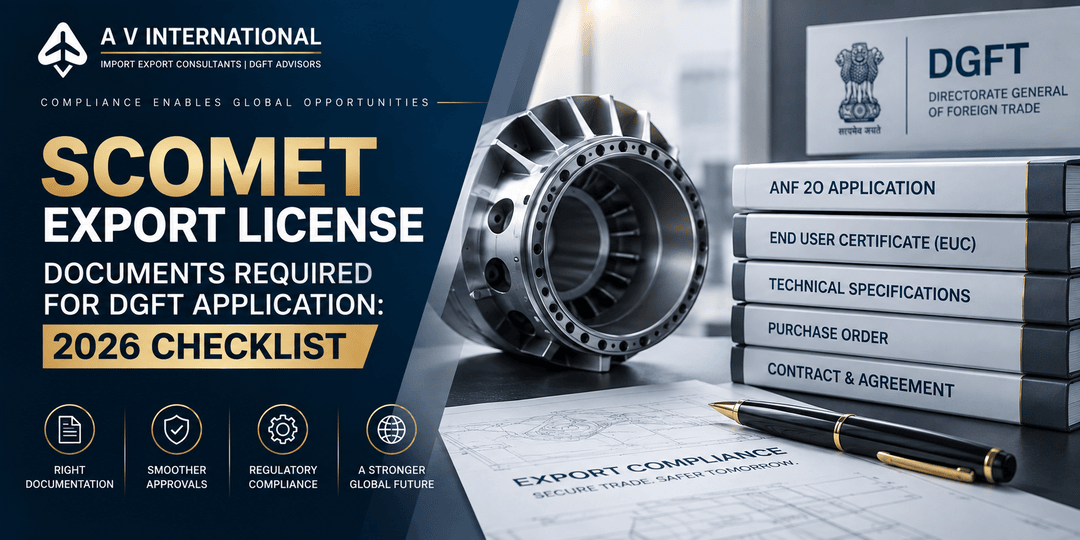
SCOMET Export License Documents Required for DGFT Application: 2026 Checklist

Key Takeaways

  • SCOMET exports require specific authorization from DGFT unless an applicable exemption or exception applies.
  • The standard application for SCOMET export authorization is made through ANF 2O.
  • End Use-cum-End User Certificates (EUCs) are among the most important documents for a SCOMET application.
  • Purchase orders, technical specifications and supply contracts should be consistent with the proposed export.
  • Original EUCs from relevant entities in the supply chain may also need to be submitted to DGFT Headquarters.
  • Exporters should verify the correct SCOMET category/sub-category before preparing the application.
  • Documents and declarations must clearly establish the end user, end use and complete supply-chain structure.

Introduction

Exporting a product, software or technology covered under the SCOMET (Special Chemicals, Organisms, Materials, Equipment and Technologies) list requires careful export-control compliance.

A common reason for delays in SCOMET applications is not the application form itself, but incomplete or inconsistent supporting documents.

The Directorate General of Foreign Trade (DGFT) examines SCOMET applications based on factors such as the credentials of the end user, proposed end use, supply-chain integrity, destination-country controls and national security considerations.

Therefore, exporters should prepare the complete documentation package before filing the application.

What Is a SCOMET Export Licence?

SCOMET is India’s export-control framework covering specified sensitive goods, materials, chemicals, equipment, software and technologies.

For SCOMET items listed in Appendix 3 to Schedule 2 of ITC (HS), an export authorization application is made to DGFT Headquarters in ANF 2O through the online system.

The application is assessed through the applicable DGFT process, including consideration by the Inter-Ministerial Working Group (IMWG), wherever required.

SCOMET Export Licence Documents Required in 2026

1. ANF 2O Application

The first document is the prescribed ANF 2O application for SCOMET export authorization.

The application should contain accurate information about:

  • Exporter and IEC
  • SCOMET category and sub-category
  • Export product
  • Quantity and value
  • Foreign buyer
  • Consignee
  • End user
  • Country of export
  • Country of final destination
  • Proposed end use

The DGFT online SCOMET system captures information across sections covering general information, SCOMET items, shipment details, foreign buyer/consignee, banking information, producer/manufacturer details, attachments and declarations.

2. End Use-cum-End User Certificate (EUC)

The End Use-cum-End User Certificate is one of the most important SCOMET documents.

EUCs should establish:

  • Identity of the end user
  • Complete address and contact details
  • Product being exported
  • Technical specifications
  • Intended end use
  • Final destination
  • Supply-chain details

Where the foreign buyer, consignee/intermediary and end user are different entities, the applicable EUCs must cover the relevant entities in the supply chain.

DGFT requires original EUCs in the prescribed Appendix 2S format in addition to their electronic submission in the application process.

3. Purchase Order

A copy of the Purchase Order (PO) should be maintained for the proposed SCOMET export.

The PO should correspond with the application in terms of:

  • Product description
  • Model/part number
  • Quantity
  • Value
  • Buyer
  • End user
  • Destination

Any major mismatch between the PO and EUC can create clarification requirements.

4. Detailed Technical Specifications

Technical specifications are particularly important for controlled products because DGFT needs to understand exactly what is being exported.

Depending on the product, technical documents may include:

  • Product datasheet
  • Model number
  • Part number
  • Technical parameters
  • Material composition
  • Performance specifications
  • Product catalogue
  • Software/technology specifications, where applicable

DGFT’s SCOMET guidance specifically requires elaborate technical specifications relating to the item of export.

5. Supply Contract / Export Agreement

Where applicable, submit the relevant supply contract or agreement.

The document should identify the contracting parties and provide sufficient information about:

  • Product
  • Quantity
  • Contract reference
  • Delivery
  • End-use arrangement
  • Buyer/end-user relationship

Where a contract is lengthy, DGFT guidance allows relevant portions containing the contract reference, parties and items/quantities to be uploaded within the specified limits.

6. ANF-1 / Exporter Profile Information

The exporter profile and IEC-related information should be complete and updated.

The SCOMET application is linked to the exporter’s DGFT profile, so exporters should ensure that:

  • IEC is active
  • Company name is correct
  • Registered address is updated
  • Contact details are current
  • Authorized signatory information is accurate
7. Previous DGFT Authorization, Where Applicable

For a repeat application involving the same product, exporters should keep copies/details of any earlier DGFT authorization.

The SCOMET guidelines specifically provide for submission of a copy of the DGFT authorization for the same product where applicable in repeat applications.

8. Destination-Country Import Documents, Where Applicable

For certain applications and reporting requirements, exporters may need to provide Bills of Entry into the destination country relating to previous exports.

DGFT’s SCOMET guidelines provide for destination-country Bills of Entry for relevant previous exports, with specific submission requirements.

SCOMET Document Matching Checklist

Before submitting the application, compare all documents carefully.

Information Should Match Across Documents
Product description ANF 2O, PO, EUC, technical documents
Model/Part Number Application, PO, technical specification
Quantity Application, PO, EUC
End User Application and EUC
Buyer/Consignee Application, PO and EUC
Country Application, PO and EUC
End Use Application and EUC
Technical parameters Application, EUC and product documents

A mismatch does not necessarily mean the application will be rejected, but it can lead to clarification requests and additional processing.

SCOMET Application Process in 2026

The practical process is:

  1. Identify the SCOMET category and sub-category.
  2. Determine whether an export authorization is required.
  3. Collect buyer, consignee and end-user information.
  4. Obtain the required EUCs.
  5. Collect the PO and supply contract.
  6. Prepare detailed technical specifications.
  7. Complete ANF 2O online through DGFT.
  8. Upload supporting documents in PDF format.
  9. Submit the required original EUCs to DGFT wherever prescribed.
  10. Respond promptly to DGFT/IMWG queries, if raised.

DGFT’s current SCOMET user manual confirms that the online application includes dedicated sections for item details, shipment information, foreign buyer/consignee, bank details, producer/manufacturer details, attachments and declarations.

Common SCOMET Documentation Mistakes

Exporters should avoid:

  • Using the wrong SCOMET category.
  • Submitting an incomplete EUC.
  • Different product descriptions across documents.
  • Missing technical specifications.
  • Incorrect end-user details.
  • PO and EUC quantity mismatch.
  • Missing intermediary/consignee EUC where applicable.
  • Uploading unclear or incomplete PDFs.
  • Failing to provide original EUCs where prescribed.
  • Ignoring DGFT clarification requests.
Featured Snippet Answer

For a SCOMET export licence application in India, exporters generally need ANF 2O, End Use-cum-End User Certificates, purchase orders, detailed technical specifications, relevant supply contracts, exporter profile information and other documents applicable to the transaction. Additional documents may be required depending on the SCOMET category, supply chain, destination and previous export history.

FAQs

1. Which form is used for a SCOMET export licence?

The standard application for SCOMET export authorization is ANF 2O, submitted through the DGFT online system.

2. Is an End User Certificate mandatory for SCOMET applications?

An EUC is a key requirement for SCOMET authorization applications. The applicable EUCs should cover the relevant entities in the supply chain and follow the prescribed format.

3. What is Appendix 2S?

Appendix 2S contains the prescribed End Use-cum-End User Certificate formats used for SCOMET applications.

4. Is a Purchase Order required for SCOMET authorization?

A copy of the purchase order from the relevant entities involved in the supply chain is among the documents prescribed in DGFT’s SCOMET application guidance.

5. Why are technical specifications important?

Technical specifications help DGFT identify and evaluate the exact product proposed for export and determine its relationship with the applicable SCOMET classification.

6. Can a SCOMET application be filed online?

Yes. SCOMET applications are submitted through DGFT’s online system, with supporting documents uploaded electronically. Original EUCs may also be required in hard copy as prescribed.

7. How long should SCOMET records be maintained?

SCOMET authorization holders are required to maintain specified records, including application documents, correspondence, contracts, books of account and financial records, for five years from the applicable date.

Conclusion

A successful SCOMET export licence application depends on much more than completing ANF 2O.

The exporter must establish a clear connection between the SCOMET classification, product specifications, purchase order, end user, intended end use and supply chain.

Preparing the EUCs, technical documents and commercial records carefully before filing can reduce clarification requests and improve the overall quality of the application.

For sensitive exports, exporters should also maintain proper records after authorization and ensure that post-export compliance requirements are followed.

Need Professional Help With SCOMET Export Licensing?

A V International provides professional support for businesses dealing with SCOMET export authorization and DGFT compliance.

Our services include:

  • SCOMET Classification Review
  • SCOMET Export Licence Application
  • ANF 2O Preparation & Filing
  • End User Certificate Documentation
  • Technical Documentation Review
  • DGFT Query & Clarification Support
  • Export Control Compliance
  • Post-Authorization Compliance

With more than 35 years of experience, A V International helps exporters manage complex DGFT licensing and regulatory requirements efficiently.

Written By

Akash Bhangare

Having more than 10 years of experience in EPR Compliance, Legal Metrology, DGFT Regulations, and Import Export Consulting Services in India.

Associated with A V International, a company with over 35 years of expertise in Environmental Compliance, EPR Registrations, Licensing, and Regulatory Approvals.

FeATURED ARTICLES