

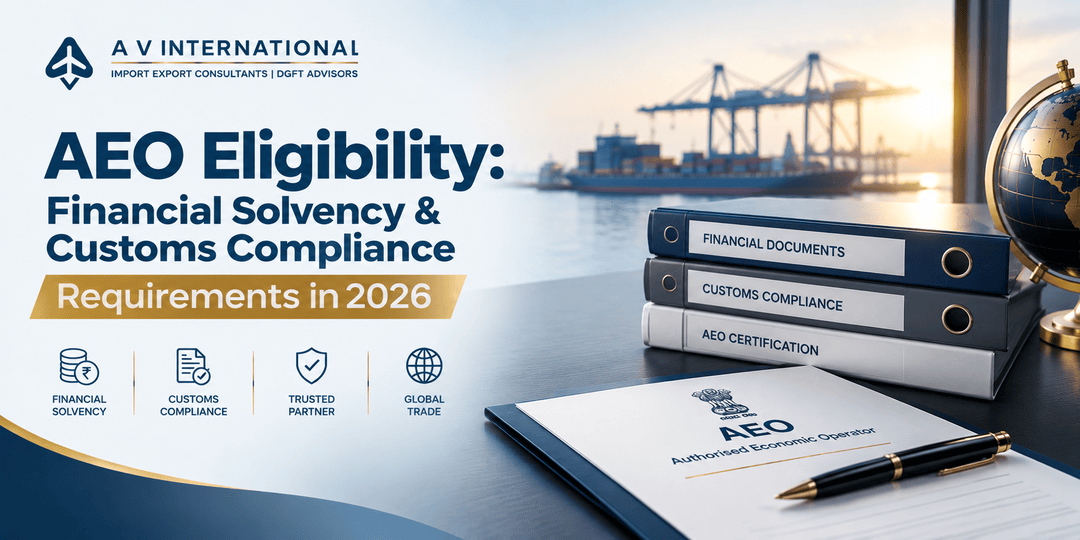
Key Takeaways
- Financial solvency and Customs compliance are important parts of AEO eligibility assessment in India.
- AEO applicants must demonstrate good financial standing and the ability to meet business commitments, including Customs duty obligations.
- Financial assessment includes areas such as audited financial statements, net current assets, contingent liabilities, tax payment history and insolvency status.
- Customs compliance review covers Customs-law compliance, notices, prosecution matters, declaration accuracy and corrective actions.
- Standard applicants generally have a three-financial-year qualifying period for legal and financial compliance.
- Eligible MSMEs receive a reduced qualifying period of two financial years.
- AEO-T2 and higher applications involve more extensive verification of records, controls and applicable security systems.
Introduction
The Authorised Economic Operator (AEO) Programme is designed for businesses involved in India’s international supply chain that can demonstrate reliable Customs compliance, auditable records and appropriate internal controls.
For importers and exporters, obtaining AEO status is not simply a matter of completing an online application. Customs evaluates whether the applicant has adequate systems, financial strength and a consistent compliance record.
Among the most important areas are financial solvency and Customs compliance. These requirements help Customs assess whether the business can meet its financial obligations and whether its import-export operations are managed in a controlled and compliant manner. The current AEO India portal continues to identify legal compliance, record management and financial solvency as core eligibility requirements.
What Does Financial Solvency Mean for AEO?
For AEO purposes, financial solvency generally means that the applicant has sufficient financial standing to fulfil its commitments, including the ability to pay Customs duties.
The AEO financial-solvency framework examines several aspects of the applicant’s financial position rather than relying on a single financial ratio.
The prescribed financial-solvency checklist includes areas such as:
- Financial position during the applicable qualifying period
- Audited balance sheets
- Net current assets
- Contingent liabilities
- Payment of applicable taxes
- Going-concern comments or qualifications in audited accounts
- Insolvency, liquidation or bankruptcy proceedings
- Solvency certificate from the statutory auditor, where applicable
Financial Documents Required for AEO Assessment
Businesses should prepare their financial records before starting the AEO application.
Important supporting documents may include:
Audited Financial Statements
Balance sheets and other audited financial statements provide evidence of the applicant’s financial position.
Net Current Assets
The AEO framework specifically examines net current assets. Where the position is negative, the applicant should be prepared to explain the reasons and provide supporting evidence.
Contingent Liabilities
The applicant may need to provide details of contingent liabilities, particularly those relating to Customs or GST matters.
Tax Payment Record
The financial-solvency assessment also considers whether the entity has defaulted in payment of taxes during the applicable period.
Solvency Certificate
Where applicable, a solvency certificate issued by the statutory auditor should be maintained as part of the supporting documentation.
Customs Compliance Requirements for AEO
Financial strength alone does not establish AEO eligibility. The applicant must also demonstrate a satisfactory compliance framework.
Customs compliance assessment can cover:
- Previous Customs-law infringements
- Customs notices and proceedings
- Prosecution matters
- Accuracy of Customs declarations
- Customs valuation procedures
- Tariff classification controls
- Import and export authorisations
- Record-keeping procedures
- Corrective action for previous Customs errors
- Procedures followed by Customs brokers and other business partners
The AEO verification framework specifically allows Customs to examine previous Customs matters and the remedial action taken for earlier errors.
This means businesses should not only identify historical issues but also maintain evidence showing how errors were investigated, corrected and prevented from recurring.
Customs Declaration Accuracy Is Important
AEO applicants should have documented procedures for checking the accuracy of Customs declarations.
These controls should address:
- Correct HS classification
- Customs valuation
- Product description
- Quantity and unit of measurement
- Country of origin
- Import or export licence requirements
- Applicable duties and exemptions
- Supporting commercial documents
For businesses using Customs brokers or other representatives, responsibilities should be clearly defined and documented.
Financial Solvency and Customs Compliance Period
For standard AEO applicants, the framework generally considers the preceding three financial years for relevant legal and financial compliance requirements.
However, eligible MSMEs receive important relaxations.
Under CBIC Circular No. 54/2020-Customs, the qualifying period for legal and financial compliance for eligible MSMEs was reduced from three financial years to two financial years. The same circular also reduced the general Customs-document threshold from 25 to 10 documents for qualifying MSMEs, subject to at least five documents in each half-year period.
What Changes for AEO-T2?
AEO-T1 is the entry tier and requires the prescribed general, legal, record-management and financial-solvency criteria.
For AEO-T2, Customs conducts more extensive verification. The current AEO portal states that detailed safety and security controls apply to AEO-T2 and higher applicable tiers.
During verification, the AEO team may examine:
- Accounting and logistics systems
- Internal controls
- Cargo movement
- IT and document security
- Financial solvency
- Premises and cargo security
- Logistics processes
- Storage arrangements
- Customs-related activities
The applicant should therefore ensure that the information submitted in the application can be supported by actual records and operating procedures.
40–60 Word Featured Snippet Answer
AEO financial solvency and Customs compliance requirements in 2026 require applicants to demonstrate adequate financial standing, proper financial records, Customs compliance, accurate declarations and documented internal controls. Customs may review financial statements, net current assets, contingent liabilities, tax payment history, Customs proceedings and corrective actions. Eligible MSMEs receive a reduced two-year compliance period.
AEO Financial & Customs Compliance Checklist
Before applying, businesses should review:
 Audited financial statements
- Net current asset position
- Contingent liability details
- Tax payment records
- Solvency certificate, where applicable
- Customs compliance history
- Customs notices and adjudication records
- Prosecution-related information, where applicable
- HS classification procedures
- Customs valuation procedures
- Import-export authorisation controls
- Customs broker responsibilities
- Corrective-action records
- Documented SOPs and supporting evidence
Common Problems That Can Delay AEO Applications
Businesses may face deficiencies when financial or compliance information is incomplete or inconsistent.
Common issues include:
- Differences between financial statements and submitted information
- Unexplained contingent liabilities
- Negative net current assets without adequate explanation
- Missing Customs proceeding details
- Incomplete corrective-action records
- SOPs that exist on paper but lack implementation evidence
- Inconsistent company, IEC or address information
- Inadequate documentation supporting compliance claims
The AEO India portal specifically advises applicants to ensure that documents are complete and consistent and that SOPs are supported by evidence such as records, approvals and logs.
Practical Preparation Tips for 2026
Before filing an AEO application, businesses should conduct an internal compliance review.
Check financial records for the relevant period, reconcile Customs and GST-related liabilities, review past Customs notices and ensure that corrective actions are documented.
For AEO-T2 applications, conduct an additional review of premises, cargo, IT, personnel and supply-chain security controls.
The objective should be to ensure that the application, SOPs, financial records and actual business practices tell the same story.
FAQs
Is financial solvency mandatory for AEO certification?
Yes. Financial solvency is one of the prescribed AEO eligibility areas, including for AEO-T1, T2 and T3 applicants.
What financial documents are required for AEO?
Depending on the applicable requirements, businesses may need audited financial statements, balance sheets, net current asset information, contingent liability details and a solvency certificate where applicable.
Does AEO require positive net current assets?
The AEO financial-solvency checklist specifically asks whether net current assets are positive. Where the position is negative, the applicant should provide an explanation and supporting evidence.
Can an MSME apply with only two years of financial and compliance history?
Eligible MSMEs receive a relaxation reducing the qualifying legal and financial compliance period from three financial years to two financial years.
Does a previous Customs error automatically prevent AEO certification?
The AEO framework considers Customs compliance and remedial action. Applicants should disclose relevant matters and demonstrate corrective measures rather than assuming that every historical error automatically prevents certification.
Is financial solvency checked during AEO-T2 verification?
Yes. Financial solvency is among the areas that may be examined during the AEO physical verification process.
Conclusion
Financial solvency and Customs compliance are two critical pillars of AEO eligibility in 2026. Importers and exporters should be prepared to demonstrate sound financial standing, proper records, accurate Customs declarations and effective compliance controls.
Businesses should review audited financial statements, net current assets, contingent liabilities, tax records and Customs history before submitting their application. They should also maintain evidence of corrective actions for previous errors.
Eligible MSMEs benefit from important relaxations, including a two-year qualifying period for legal and financial compliance.
Need Professional Help with AEO Certification?
A V International assists importers, exporters, manufacturers and businesses with AEO certification and Customs compliance preparation.
Our services include:
- AEO-T1 & AEO-T2 Application Support
- AEO Financial Solvency Documentation
- Customs Compliance Review
- AEO SOP & Process Documentation
- MSME AEO Compliance
- Financial & Legal Compliance Review
- AEO Verification Preparation
- Customs Regulatory Advisory
Professional preparation can help businesses identify financial and Customs compliance gaps before filing their AEO application.
Written By
Akash Bhangare
Having more than 10 years of experience in EPR Compliance, Legal Metrology, DGFT Regulations, and Import Export Consulting Services in India.
Associated with A V International, a company with over 35 years of expertise in Environmental Compliance, EPR Registrations, Licensing, and Regulatory Approvals.
SARAL SIMS for Steel Imports in India – Complete Guide The Government of India has introduced SARAL SIMS (Simplified Steel…

Top Export Compliance Mistakes: DGFT Advance Authorization, EPCG & CPCB (2025 Guide) Exporting in India can feel like a legal…

Environmental Clearance CPCB: Quick Guide for Exporters If you’re an Indian exporter or manufacturer working under schemes like the Advanced…

DGFT e-BRC Rule 2025: Key Update for Advance Authorization & EPCG Holders The Directorate General of Foreign Trade (DGFT) has…
