
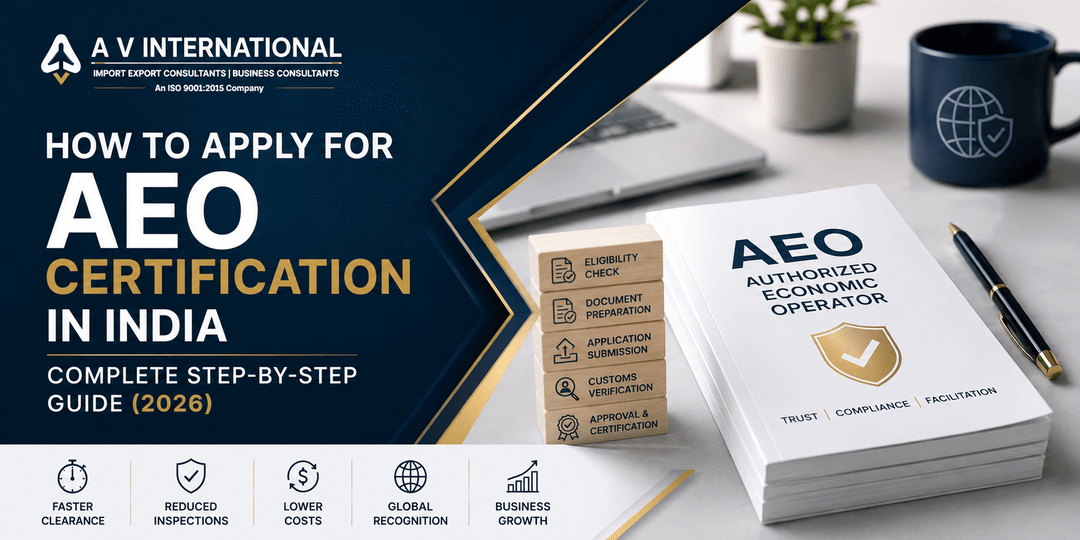

How to Apply for AEO Certification in India: Complete Step-by-Step Guide (2026)
Key Takeaways
- Understand what AEO Certification is and why it matters.
- Learn the eligibility requirements before applying.
- Know the complete list of required documents.
- Follow the step-by-step AEO application process.
- Understand the approval timeline.
- Avoid common application mistakes.
- Improve your chances of faster certification.
Introduction
Businesses involved in international trade are increasingly looking for ways to reduce customs delays, improve supply chain security, and gain global recognition. One of the most valuable certifications offered by Indian Customs is the Authorized Economic Operator (AEO) Certification.
An AEO-certified business enjoys several operational benefits, including faster customs clearance, reduced inspections, simplified procedures, and enhanced credibility with global trading partners.
If you are planning to apply for AEO Certification in India in 2026, this guide explains the complete application process, eligibility requirements, required documents, approval timeline, and practical tips to help you obtain certification successfully.
What is AEO Certification?
Authorized Economic Operator (AEO) is a trade facilitation program administered by the Central Board of Indirect Taxes and Customs (CBIC).
It recognizes businesses that maintain high standards of:
- Customs compliance
- Financial solvency
- Supply chain security
- Internal control systems
- Record management
- Legal compliance
The certification is available for:
- Importers
- Exporters
- Customs Brokers
- Logistics Service Providers
- Warehouse Operators
- Freight Forwarders
- Terminal Operators
Why Should Businesses Apply for AEO Certification?
AEO Certification provides several operational and commercial advantages.
Major benefits include:
- Faster customs clearance
- Reduced cargo examination
- Priority processing at ports
- Lower transaction costs
- Improved global credibility
- Better supply chain efficiency
- Recognition under Mutual Recognition Agreements (MRAs)
- Reduced compliance burden
For businesses handling frequent imports or exports, these benefits can significantly improve operational efficiency.
Eligibility Criteria
Before applying, businesses should generally ensure they:
- Have a valid IEC.
- Demonstrate a satisfactory compliance history.
- Maintain proper accounting and internal controls.
- Show financial solvency.
- Follow customs and tax regulations.
- Maintain secure business premises and supply chain practices.
- Keep proper business records.
Eligibility requirements may vary depending on the AEO category being applied for.
Documents Required
Prepare the following documents before submitting your application:
- IEC Certificate
- GST Registration
- PAN
- Company Incorporation Documents
- Organization Chart
- Financial Statements
- Bank Solvency Certificate (if applicable)
- Security and Safety Procedures
- Internal Control Documents
- Customs Compliance Records
- Business Process Details
- Warehouse Information (if applicable)
- Self-Assessment Questionnaire
- Supporting declarations
Having complete and accurate documentation helps reduce processing delays.
Step-by-Step AEO Application Process
Step 1: Evaluate Eligibility
Review your business operations, compliance history, and financial standing before starting the application.
Step 2: Collect Required Documents
Gather all supporting documents and verify that information is accurate and consistent.
Step 3: Complete the Application
Fill out the prescribed AEO application with complete business information and required declarations.
Step 4: Submit Supporting Documents
Attach all mandatory documents, compliance records, and security procedures.
Step 5: Customs Verification
Indian Customs reviews the submitted information and may request clarifications or additional documents.
Step 6: Site Validation (if applicable)
Officials may conduct an on-site verification to evaluate operational processes and security measures.
Step 7: Approval and Certification
Once the application satisfies all requirements, the AEO Certificate is issued.
Approval Timeline
The approval timeline depends on:
- Completeness of documentation
- Accuracy of submitted information
- Business size
- Category of application
- Verification requirements
- Response time for clarifications
Applications with complete documentation generally move faster than those requiring repeated corrections.
Featured Snippet Answer
How do you apply for AEO Certification in India?
To apply for AEO Certification in India, businesses must verify eligibility, prepare the required documents, complete the prescribed application, submit supporting compliance records, undergo Customs verification, respond to any queries, and successfully complete the assessment process. Accurate documentation and strong compliance practices improve the chances of faster approval.
Common Mistakes to Avoid
Many applications are delayed because of avoidable errors.
Common mistakes include:
- Incomplete application forms
- Missing supporting documents
- Incorrect business information
- Weak internal control documentation
- Poor record maintenance
- Delayed responses to Customs queries
- Inadequate supply chain security documentation
Reviewing the application thoroughly before submission can prevent unnecessary delays.
Best Practices for Faster Approval
Businesses should:
- Conduct an internal compliance review.
- Keep documentation updated.
- Maintain accurate financial records.
- Establish documented security procedures.
- Respond promptly to departmental communications.
- Perform a final document verification before submission.
Professional guidance can also help streamline the process.
Frequently Asked Questions
1. Who can apply for AEO Certification?
Importers, exporters, customs brokers, logistics providers, freight forwarders, warehouse operators, and other eligible supply chain participants.
2. Is AEO Certification mandatory?
No. It is a voluntary certification that provides several customs facilitation benefits.
3. How long does approval take?
The timeline depends on documentation quality, verification requirements, and Customs processing.
4. What are the biggest reasons for delays?
Incomplete documents, inaccurate information, compliance gaps, and delayed responses during verification.
5. Does AEO Certification improve international credibility?
Yes. Many overseas trading partners recognize AEO-certified businesses as trusted supply chain operators.
6. Can MSMEs apply?
Yes. Eligible MSMEs engaged in international trade may also apply.
Conclusion
AEO Certification has become an important competitive advantage for businesses involved in international trade. Besides simplifying customs procedures, it strengthens supply chain security, improves business credibility, and enhances operational efficiency.
Preparing a complete application, maintaining strong compliance practices, and ensuring accurate documentation can significantly improve the chances of successful approval.
Need Expert Assistance?
A V International has over 35 years of experience in import-export consulting, DGFT compliance, customs advisory, and regulatory approvals.
Our experts assist businesses with:
- AEO Certification
- DGFT Authorizations
- IEC & Customs Compliance
- Import Export Consulting
- Legal Metrology Registration
- EPR Compliance
- End-to-end documentation and application support
Contact A V International today to simplify your AEO Certification process with expert guidance.
Written By
Akash Bhangare
Having more than 10 years of experience in EPR Compliance, Legal Metrology, DGFT Regulations, and Import Export Consulting Services in India.
Associated with A V International, a company with over 35 years of expertise in Environmental Compliance, EPR Registrations, Licensing, DGFT Consultancy, Customs Advisory, and Regulatory Approvals.
Recent Posts
- How to Apply for AEO Certification in India: Complete Step-by-Step Guide (2026)
- Top LMPC Registration Rejection Reasons and How to Avoid Them in 2026
- LMPC Certificate for Imported Pre-Packaged Commodities | Complete Guide 2026
- Exporting to Oman? DGFT Makes eCoO Mandatory Under India–Oman CEPA – Complete Guide (2026)
- India–Oman CEPA Opens New Opportunities: Complete DGFT TRQ Procedure Guide (2026)
FeATURED ARTICLES
SARAL SIMS for Steel Imports in India – Complete Guide The Government of India has introduced SARAL SIMS (Simplified Steel…
Top Export Compliance Mistakes: DGFT Advance Authorization, EPCG & CPCB (2025 Guide) Exporting in India can feel like a legal…
Environmental Clearance CPCB: Quick Guide for Exporters If you’re an Indian exporter or manufacturer working under schemes like the Advanced…
DGFT e-BRC Rule 2025: Key Update for Advance Authorization & EPCG Holders The Directorate General of Foreign Trade (DGFT) has…

