
Eligible Products Under ROSCTL Scheme: Complete 2026 Guide
Key Takeaways
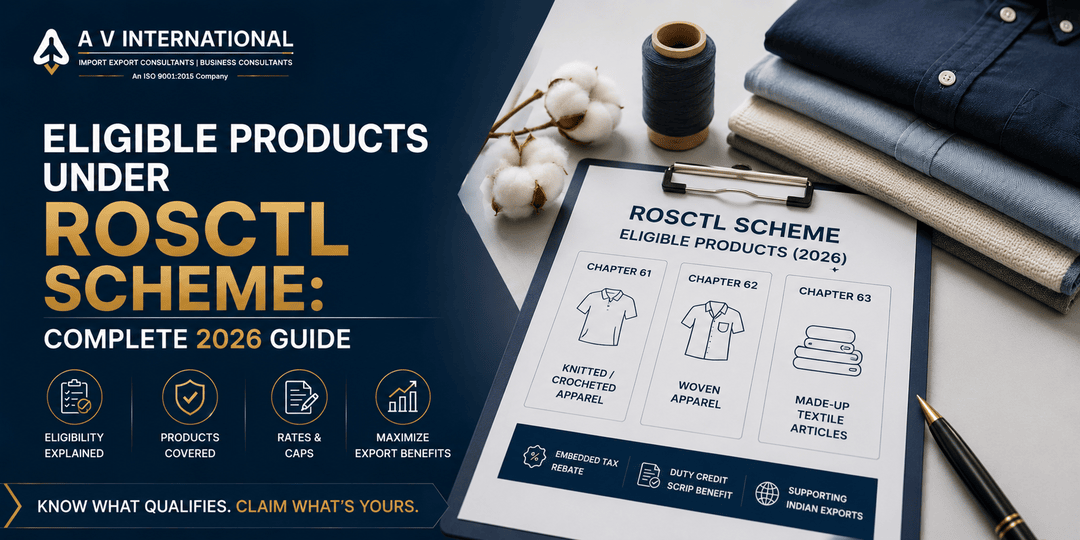
- ROSCTL primarily covers apparel/garments under HS Chapters 61 and 62 and made-ups under Chapter 63.
- The Government extended the scheme beyond 31 March 2026 up to 30 September 2026, or until approval of the scheme for the 16th Finance Commission cycle, whichever is earlier. The extension was made without changing the existing scheme guidelines.
- Products outside the ROSCTL coverage may generally be considered under RoDTEP, subject to applicable rules and rates.
- Product eligibility depends heavily on the correct HS/ITC classification.
- Existing rates and caps continued unchanged under the March 2026 extension unless separately notified.
- Exporters should verify the applicable rate, value cap and shipping bill declaration before filing the export claim.
Introduction
For textile exporters, choosing the correct export incentive can directly affect shipment profitability. One of the most important schemes for apparel, garments and made-up products is the Rebate of State and Central Taxes and Levies (ROSCTL) scheme.
However, simply exporting a textile product does not automatically mean that it is eligible for ROSCTL. The product’s HS classification, chapter, description and applicable scheme conditions must be checked carefully.
For 2026, exporters also need to consider an important policy update. The Ministry of Textiles extended ROSCTL from 31 March 2026 to 30 September 2026 or until approval under the 16th Finance Commission cycle, whichever is earlier, without changing the existing scheme guidelines.
Featured Snippet Answer
Which products are eligible under ROSCTL in 2026?
ROSCTL primarily applies to exported apparel and garments classified under HS Chapters 61 and 62 and made-ups under Chapter 63, subject to the scheme’s conditions, exclusions, applicable rates and caps. Exporters should verify the exact ITC-HS code and current ROSCTL schedule before claiming the benefit on a shipping bill.
What Products Are Covered Under the ROSCTL Scheme?
The most important starting point is the HS Chapter classification.
1. Apparel and Garments – Chapter 61
Chapter 61 broadly covers articles of apparel and clothing accessories, knitted or crocheted.
Depending on the specific HS code and applicable ROSCTL schedule, eligible products may include categories such as:
- Knitted garments
- T-shirts and similar apparel
- Sweaters and pullovers
- Babies’ garments
- Knitted clothing accessories
- Other qualifying knitted or crocheted apparel
The exact eligibility should be checked at the HS code level, rather than relying only on the product’s commercial description.
2. Apparel and Garments – Chapter 62
Chapter 62 covers articles of apparel and clothing accessories that are not knitted or crocheted.
Potential product categories include:
- Woven shirts
- Trousers and shorts
- Jackets and coats
- Dresses
- Skirts
- Suits and ensembles
- Other qualifying woven garments
Again, the exact ROSCTL treatment depends on the relevant tariff item and applicable scheme schedule.
3. Made-Ups – Chapter 63
Chapter 63 covers various made-up textile articles and related textile products.
Depending on the specific classification and exclusions, exporters may encounter products such as:
- Bed linen
- Table linen
- Kitchen linen
- Curtains
- Furnishing articles
- Textile bags and similar articles
- Other made-up textile products
Not every product within Chapter 63 should automatically be treated as ROSCTL eligible. The specific ITC-HS code and scheme conditions must be checked.
What About Textile Products Outside Chapters 61, 62 and 63?
This is an important distinction for exporters.
The ROSCTL framework is specifically focused on apparel/garments and made-ups. The Government’s 2026 continuation also states that textile products not covered under ROSCTL are supported through RoDTEP, subject to the applicable RoDTEP framework.
Therefore, exporters dealing with:
- Fabrics
- Yarn
- Fibre
- Technical textiles
- Other textile materials
- Textile products outside ROSCTL chapters
should not assume that ROSCTL applies.
Instead, they should check whether the product falls under the applicable RoDTEP schedule.
ROSCTL Eligibility: What Should Exporters Check?
Before claiming ROSCTL, businesses should verify the following:
Correct HS Code
The first and most important step is accurate ITC-HS classification. A wrong classification can result in incorrect benefit calculation or claim-related issues.
Product Description
The description in the invoice, packing list and shipping bill should properly correspond with the actual exported product and classification.
ROSCTL Rate and Cap
The applicable ROSCTL benefit is not necessarily a simple percentage of the entire export value. The relevant notified rate and applicable value cap should be considered.
Shipping Bill Declaration
The exporter must correctly indicate the applicable scheme benefit while filing the shipping bill. The ROSCTL framework provides for item-level claims and electronic duty credit mechanisms.
Scheme Restrictions
ROSCTL claims are subject to prescribed restrictions and conditions. Exporters are responsible for ensuring compliance before making the claim.
How Does the ROSCTL Benefit Work?
ROSCTL operates through duty credit scrips/e-scrips maintained electronically through the Customs system.
Under the scheme framework, the rebate is issued through an electronic duty credit mechanism, and the resulting scrip can be used in accordance with applicable Customs rules.
For businesses, this means that ROSCTL compliance is not limited to checking whether a product belongs to Chapter 61, 62 or 63. The exporter must also ensure that the shipping bill, HS code, claim declaration and supporting records are accurate.
Common Mistakes Exporters Should Avoid
Some of the most common ROSCTL problems arise from basic classification and documentation errors.
Avoid:
- Selecting an incorrect HS code.
- Assuming every Chapter 63 product qualifies.
- Using an outdated ROSCTL rate or cap.
- Failing to declare the benefit correctly in the shipping bill.
- Mismatch between invoice and shipping bill description.
- Ignoring scheme-specific exclusions or restrictions.
- Calculating the benefit without considering the applicable cap.
- Claiming ROSCTL where RoDTEP is actually applicable.
2026 ROSCTL Update: What Exporters Should Know
The March 2026 notification extended ROSCTL until 30 September 2026 or approval of the 16th Finance Commission cycle scheme, whichever is earlier. Importantly, the extension continued the existing scope, structure, coverage and other conditions without change.
The Union Government’s 2026–27 budget documents also continue to provide for ROSCTL, demonstrating that the scheme remains an important component of India’s textile export support framework.
Because the policy position can be reviewed or modified, exporters should verify the latest applicable notification before making significant commercial decisions.
ROSCTL Eligibility Checklist for Exporters
Before filing a shipping bill, check:
- Correct ITC-HS code
- Product falls within eligible ROSCTL coverage
- Applicable rate verified
- Applicable cap verified
- Invoice description matches product
- Shipping bill details are correct
- ROSCTL declaration is properly made
- Applicable restrictions are reviewed
- Supporting records are maintained
- Latest DGFT/Customs/Ministry of Textiles updates are checked
FAQs
1. Which HS Chapters are generally covered under ROSCTL?
ROSCTL primarily covers apparel/garments under Chapters 61 and 62 and made-ups under Chapter 63, subject to specific conditions and exclusions.
2. Is ROSCTL available for all textile products?
No. ROSCTL is focused on eligible apparel, garments and made-ups. Other textile products may fall under RoDTEP, depending on their classification and applicable schedule.
3. Is ROSCTL available in 2026?
Yes. The Government extended the scheme up to 30 September 2026 or until approval under the 16th Finance Commission cycle, whichever is earlier.
4. Do all Chapter 63 products qualify for ROSCTL?
Not necessarily. Eligibility must be confirmed against the specific HS code, notified coverage and applicable exclusions.
5. Can an exporter claim ROSCTL without checking the HS code?
Exporters should not rely only on the product name. Correct HS classification is essential for determining scheme eligibility and the applicable benefit.
6. What happens if the wrong ROSCTL benefit is claimed?
Incorrect claims can create reconciliation, recovery, documentation or Customs-related issues. Exporters should review the shipping bill and supporting records carefully.
7. Can a textile product outside ROSCTL receive an export incentive?
Products outside ROSCTL coverage may be considered under RoDTEP where eligible and where the applicable RoDTEP schedule permits the benefit.
Conclusion
Identifying ROSCTL eligible products in 2026 requires more than checking whether an item is a textile product. Exporters should examine the exact ITC-HS classification, product description, applicable ROSCTL schedule, rate, cap and scheme conditions before filing the shipping bill.
For apparel and garments under Chapters 61 and 62 and eligible made-ups under Chapter 63, ROSCTL remains an important export-support mechanism during the current 2026 continuation period.
A careful classification and claim review can help exporters avoid unnecessary errors and protect their eligible export benefits.
Need Professional ROSCTL Compliance Support?
A V International assists exporters with ROSCTL eligibility verification, HS classification review, export incentive compliance, shipping bill documentation and related DGFT/Customs requirements.
If your business is unsure whether a textile product qualifies for ROSCTL or whether the correct benefit has been claimed, professional compliance review can help reduce errors and improve the accuracy of your export documentation.
Written By
Akash Bhangare
Having more than 10 years of experience in EPR Compliance, Legal Metrology, DGFT Regulations, and Import Export Consulting Services in India.
Associated with A V International, a company with over 35 years of expertise in Environmental Compliance, EPR Registrations, Licensing, and Regulatory Approvals.
Recent Posts
- Eligible Products Under ROSCTL Scheme: Complete 2026 Guide
- DGFT Eases One Star Export House Eligibility: What Exporters Need to Know
- DGFT Automates EO Extension for Advance Authorisation & EPCG: What Exporters Need to Know
- Latest ROSCTL Rates for Textile Products (2026 Updated List)
- ROSCTL Pending Status on ICEGATE? Here’s the Exact Solution
FeATURED ARTICLES
SARAL SIMS for Steel Imports in India – Complete Guide The Government of India has introduced SARAL SIMS (Simplified Steel…
Top Export Compliance Mistakes: DGFT Advance Authorization, EPCG & CPCB (2025 Guide) Exporting in India can feel like a legal…
Environmental Clearance CPCB: Quick Guide for Exporters If you’re an Indian exporter or manufacturer working under schemes like the Advanced…
DGFT e-BRC Rule 2025: Key Update for Advance Authorization & EPCG Holders The Directorate General of Foreign Trade (DGFT) has…

