
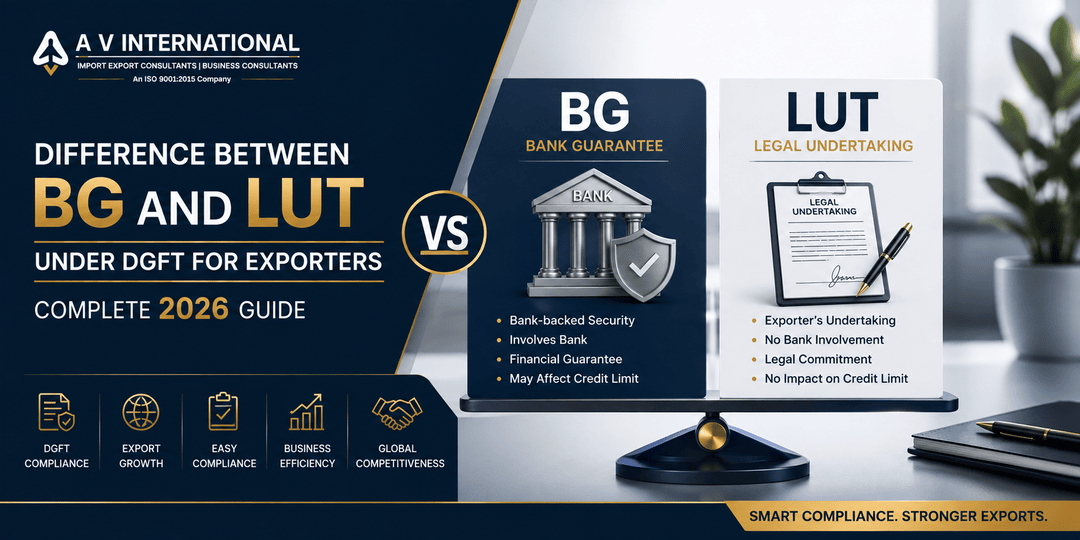

BG vs LUT Under DGFT: Key Differences for Exporters in 2026
Difference Between BG and LUT Under DGFT for Exporters: Complete 2026 Guide
Key Takeaways
- BG means Bank Guarantee, while LUT under DGFT generally means Legal Undertaking.
- DGFT’s Legal Undertaking is different from the GST Letter of Undertaking, although both are commonly abbreviated as LUT.
- BG/LUT requirements can apply to Advance Authorisation and EPCG Authorisation.
- The applicable security depends on the exporter, authorisation, sourcing arrangement and relevant Customs provisions.
- Status holders and PSUs may have additional options, including Corporate Guarantee, where permitted.
- Exporters should not assume that GST LUT automatically replaces a DGFT BG or Legal Undertaking.
Introduction
Exporters using DGFT schemes such as Advance Authorisation and EPCG often come across the terms Bank Guarantee (BG) and LUT.
This creates confusion because the same abbreviation, LUT, is also used under GST for a Letter of Undertaking used by exporters making zero-rated supplies without payment of IGST.
However, these are different compliance mechanisms.
Under DGFT procedures, LUT generally refers to a Legal Undertaking connected with the obligations of an authorisation. Under GST, LUT means a Letter of Undertaking under the GST framework.
Understanding this distinction is important before importing duty-free goods, sourcing inputs domestically or completing export obligations.
What Does BG Mean Under DGFT?
A Bank Guarantee (BG) is a financial security issued by a bank on behalf of the exporter or authorisation holder.
In the context of DGFT schemes, it may secure the government’s revenue or the exporter’s obligations associated with an authorisation.
For example, DGFT’s Handbook of Procedures provides for execution of BG/Legal Undertaking for Advance Authorisation and EPCG Authorisation before applicable customs clearance.
A BG therefore involves a bank and can have a direct impact on the company’s banking limits and financial arrangements.
What Does LUT Mean Under DGFT?
Under DGFT’s authorisation procedures, LUT means Legal Undertaking, not the GST Letter of Undertaking.
The Legal Undertaking represents the exporter’s commitment to comply with the conditions attached to the authorisation, including applicable export obligations and other prescribed requirements.
DGFT’s HBP specifically provides for execution of a BG/LUT with Customs Authorities before clearance in applicable Advance Authorisation/EPCG cases.
The important point is that DGFT LUT and GST LUT should not be treated as interchangeable documents.
BG vs LUT Under DGFT: Key Difference
| Particular | Bank Guarantee (BG) | Legal Undertaking (LUT) |
|---|---|---|
| Meaning | Bank-backed financial guarantee | Legal undertaking by the authorisation holder |
| Bank involvement | Yes | Generally no bank guarantee component |
| Purpose | Provides financial security | Provides legal/compliance commitment |
| Financial impact | May affect bank limits/margin | Generally avoids a bank-backed guarantee |
| Used in DGFT schemes | Yes, where applicable | Yes, where applicable |
| Connected with | Advance Authorisation/EPCG and Customs procedures | Advance Authorisation/EPCG and applicable DGFT procedures |
| Default assumption | Depends on applicable rules | Depends on eligibility and prescribed provisions |
The actual requirement should always be checked against the applicable DGFT, Customs and scheme-specific provisions.
When Is BG or LUT Required?
DGFT Paragraph 2.29 provides the framework for execution of BG/Legal Undertaking for Advance Authorisation and EPCG Authorisation.
For direct imports, the authorisation holder is required to execute the applicable BG/LUT with Customs authorities before clearance.
For indigenous sourcing, BG/LUT may be required with the Regional Authority in accordance with the applicable provisions. DGFT also provides that where the firm has already executed BG/LUT with Customs for the full applicable value and submits proof to the Regional Authority, a separate BG/LUT with the RA may not be required.
Therefore, exporters should examine the exact authorisation and sourcing model instead of assuming that one document applies to every case.
DGFT LUT vs GST LUT: Do Not Confuse Them
This is one of the most important compliance points for exporters.
DGFT LUT
Legal Undertaking under DGFT is associated with authorisations such as Advance Authorisation and EPCG and relates to compliance with the conditions and obligations of those schemes.
GST LUT
Letter of Undertaking under GST allows an eligible registered person to export goods or services without payment of IGST, subject to the applicable GST provisions.
CBIC confirms that exports can be made without payment of IGST under bond/LUT, subject to the prescribed conditions and procedures.
Therefore:
DGFT Legal Undertaking ≠ GST Letter of Undertaking
The documents may share the abbreviation “LUT”, but they operate under different regulatory frameworks.
Is BG Better Than LUT?
There is no universal answer.
For an eligible exporter, a Legal Undertaking may be commercially convenient because it can avoid the need for a bank-backed guarantee. However, eligibility and applicability depend on the relevant DGFT and Customs provisions.
A BG may be necessary where the applicable provisions require financial security or where the exporter does not qualify for the alternative mechanism.
Companies should therefore consider:
- Exporter status
- Type of DGFT authorisation
- Duty saved amount
- Import or indigenous sourcing
- Customs requirements
- Existing guarantees
- Banking limits
- Export obligation
- Applicable exemptions or relaxations
Special Option for Status Holders and PSUs
DGFT procedures also provide an important facility for eligible entities.
A Status Holder or Public Sector Undertaking (PSU) may submit a Corporate Guarantee in lieu of BG/LUT in accordance with the relevant Customs provisions.
However, exporters should verify whether the conditions for this facility are satisfied before relying on it.
Common Mistakes Exporters Should Avoid
- Treating GST LUT as a substitute for DGFT Legal Undertaking.
- Assuming every Advance Authorisation requires the same type of security.
- Ignoring Customs requirements at the port of registration.
- Providing incorrect authorisation or duty-saved information.
- Failing to track export obligation and redemption requirements.
- Not checking whether an existing BG/LUT can cover the relevant transaction.
- Applying outdated procedures without checking the current DGFT framework.
Featured Snippet Answer
The main difference between BG and LUT under DGFT is that a Bank Guarantee is a bank-backed financial security, while a DGFT LUT is a Legal Undertaking given by the authorisation holder. Both may be relevant to Advance Authorisation or EPCG compliance, depending on the applicable DGFT and Customs provisions.
FAQs
1. Is DGFT LUT the same as GST LUT?
No. DGFT LUT generally refers to a Legal Undertaking, while GST LUT means a Letter of Undertaking for exporting without payment of IGST.
2. Is Bank Guarantee mandatory for every Advance Authorisation?
Not necessarily. The applicable BG/LUT requirement depends on the relevant DGFT, Customs and authorisation provisions.
3. Can LUT replace Bank Guarantee under DGFT?
Where the applicable provisions permit a Legal Undertaking, it may be used instead of a Bank Guarantee. Eligibility and conditions must be checked for the specific case.
4. Does EPCG also involve BG/LUT?
Yes. DGFT Paragraph 2.29 covers BG/Legal Undertaking requirements for both Advance Authorisation and EPCG Authorisation.
5. Does GST LUT cover DGFT obligations?
No. GST LUT relates to GST export procedures and does not automatically discharge obligations under a DGFT authorisation.
6. Can a Status Holder use Corporate Guarantee?
DGFT provisions allow a Status Holder or PSU to submit Corporate Guarantee in lieu of BG/LUT subject to the applicable Customs provisions.
Conclusion
BG and LUT are important compliance instruments for exporters using DGFT schemes, but they serve different purposes. A Bank Guarantee provides bank-backed financial security, whereas a DGFT Legal Undertaking represents a direct legal commitment by the authorisation holder.
Exporters should also remember that DGFT Legal Undertaking and GST Letter of Undertaking are two different concepts despite sharing the abbreviation “LUT”.
Before applying for Advance Authorisation or EPCG benefits, businesses should evaluate their eligibility, authorisation structure, sourcing method and applicable Customs requirements to select the correct compliance mechanism.
CTA – A V International
Need assistance with Advance Authorisation, EPCG, DGFT compliance, BG/LUT requirements, export obligation management or authorisation redemption?
A V International provides professional DGFT and Import Export Compliance Consulting Services to exporters, manufacturers, importers, MSMEs and businesses across India.
Contact A V International for expert assistance with your DGFT compliance requirements.
Written By
Akash Bhangare
Having more than 10 years of experience in EPR Compliance, Legal Metrology, DGFT Regulations, and Import Export Consulting Services in India.
Associated with A V International, a company with over 35 years of expertise in Environmental Compliance, EPR Registrations, Licensing, and Regulatory Approvals.
Recent Posts
- Difference Between BG and LUT Under DGFT for Exporters: Complete 2026 Guide
- Cases Where Bank Guarantee Is Exempted for Advance Authorisation | 2026 Guide
- Advance Authorisation vs EPCG Scheme: Which Is Better for Exporters in 2026?
- How to Apply for EPCG License in India: Complete Step-by-Step Guide (2026)
- How to Apply for AEO Certification in India: Complete Step-by-Step Guide (2026)
FeATURED ARTICLES
SARAL SIMS for Steel Imports in India – Complete Guide The Government of India has introduced SARAL SIMS (Simplified Steel…
Top Export Compliance Mistakes: DGFT Advance Authorization, EPCG & CPCB (2025 Guide) Exporting in India can feel like a legal…
Environmental Clearance CPCB: Quick Guide for Exporters If you’re an Indian exporter or manufacturer working under schemes like the Advanced…
DGFT e-BRC Rule 2025: Key Update for Advance Authorization & EPCG Holders The Directorate General of Foreign Trade (DGFT) has…

