

India's Leading DGFT Consultants
Battery Waste EPR target calculation guide for producers and importers in India 2026

How to Calculate Battery Waste EPR Targets Accurately in 2026

Key Takeaways

  • Battery EPR targets are calculated primarily by weight, not simply by the number of batteries.
  • The applicable percentage depends on the battery category and compliance year.
  • The reference quantity is generally from a prescribed preceding financial year, not automatically the current year’s sales.
  • Portable, automotive, industrial and EV batteries have different target schedules.
  • Battery chemistry must also be correctly mapped within the applicable battery type.
  • Do not confuse a producer’s EPR collection obligation with the recycler’s material-recovery target.
  • Accurate import, manufacturing and sales records are essential for correct EPR calculations.

Introduction

Battery Waste EPR compliance has become increasingly important for manufacturers, importers and businesses placing batteries or equipment containing batteries in the Indian market.

Under the Battery Waste Management Rules, 2022, producers are responsible for meeting Extended Producer Responsibility obligations relating to waste batteries. The framework covers portable, automotive, industrial and electric vehicle batteries, irrespective of their chemistry, shape, volume or use.

For businesses, one of the most common compliance challenges is determining the correct EPR target quantity. Using current-year sales instead of the prescribed reference year, selecting the wrong battery category or mixing different battery chemistries can result in incorrect liability calculations.

Featured Snippet Answer

Battery Waste EPR targets in India are calculated by applying the prescribed percentage to the quantity of batteries placed on the Indian market in the applicable reference year. The calculation depends on battery type, compliance year and, where applicable, battery chemistry. Producers must then meet the resulting obligation through the prescribed collection, recycling/refurbishment and EPR certificate mechanism.

How Battery Waste EPR Target Calculation Works

A simplified calculation can be represented as:

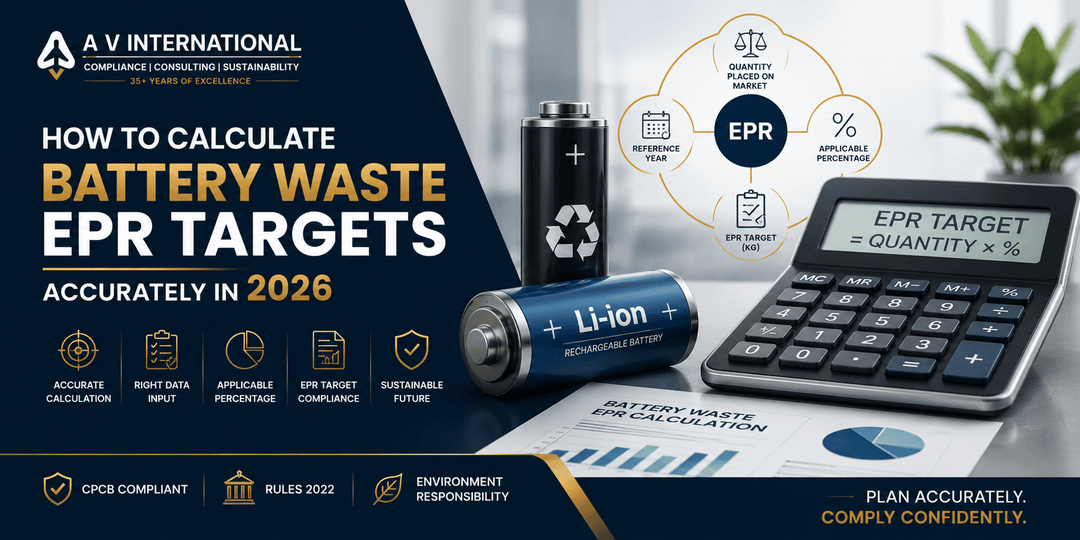
EPR Target Quantity = Applicable Reference-Year Quantity × Prescribed EPR Percentage

However, the difficult part is identifying the correct reference year and battery category.

For example, if the applicable reference-year quantity is 10,000 kg and the prescribed EPR target is 70%:

10,000 kg × 70% = 7,000 kg EPR target

The 7,000 kg is the target quantity that must be addressed under the applicable EPR mechanism.

Step 1: Identify the Battery Category

First classify the battery correctly as:

  • Portable Battery
  • Automotive Battery
  • Industrial Battery
  • Electric Vehicle Battery

EV batteries have further distinctions, including three-wheelers, two-wheelers and four-wheelers.

Step 2: Identify the Correct Reference Year

This is where many businesses make mistakes.

For example, rechargeable portable batteries used in consumer electronics are linked to the fifth preceding financial year. Certain other portable batteries use the third preceding financial year, while different EV categories have their own prescribed reference periods.

Therefore, businesses should not simply apply the EPR percentage to their 2025–26 or 2026–27 sales.

Step 3: Apply the Applicable 2026–27 Percentage

For practical planning, the 2026–27 target schedule includes:

Battery Category 2026–27 Target Reference Basis
Portable – rechargeable consumer electronics 70% 5th preceding FY
Portable – other batteries 70% 3rd preceding FY
EV – 3-wheelers 70% 5th preceding FY
EV – 2-wheelers 70% 4th preceding FY
Automotive 90% 3rd preceding FY
Industrial 70% 3rd preceding FY

The EV four-wheeler target begins from 2029–30, so it does not create the same 2026–27 collection target applicable to the other listed EV categories.

Step 4: Calculate the Target

Suppose an importer has placed 10,000 kg of automotive batteries in the applicable reference year.

If the applicable 2026–27 target is 90%:

10,000 kg × 90% = 9,000 kg

Therefore, the calculated EPR target would be 9,000 kg.

Similarly, if an industrial battery producer has an applicable reference quantity of 8,000 kg and a 70% target:

8,000 kg × 70% = 5,600 kg

These are illustrative calculations; businesses must use their actual records and the applicable category-specific rules.

Do Not Confuse Producer Targets With Recycler Recovery Targets

A major compliance mistake is confusing the producer’s EPR obligation with the material recovery target applicable to recyclers.

From 2026–27, the minimum material recovery target is 90% for portable and EV batteries and 60% for automotive and industrial batteries. This calculation concerns recovery of materials from the dry weight of batteries processed by recyclers and is different from the producer’s collection/EPR target.

Therefore, a producer should not simply use the recycler’s 90% or 60% recovery figure to calculate its own EPR liability.

EPR Certificates and Fulfilment

After determining the obligation, producers need to fulfil it through the prescribed EPR framework. EPR certificates are generated through the CPCB system based on eligible recycling or refurbishment quantities, and producers can use applicable certificates to meet their obligations.

The rules also require 100% recycling or refurbishment of the applicable collected quantity, subject to the prescribed compliance-cycle framework. Up to 60% of certain remaining quantities may be carried forward to the next compliance cycle under the applicable provisions.

Common Battery EPR Calculation Mistakes

Businesses should avoid:

  • Calculating the target using current-year sales without checking the prescribed reference year.
  • Mixing portable, automotive, industrial and EV batteries.
  • Ignoring battery chemistry when preparing category-wise data.
  • Calculating liability by number of units instead of weight.
  • Confusing producer EPR targets with recycler material-recovery targets.
  • Using incorrect import or sales data.
  • Failing to maintain category-wise supporting records.
  • Treating payment to an unregistered recycler as equivalent to a valid EPR certificate.
2026 Compliance Best Practices

For accurate Battery EPR calculations, businesses should maintain:

  • Import records and Bills of Entry
  • Sales invoices and dispatch records
  • Battery-wise product specifications
  • Battery weight and category details
  • Chemistry-wise classification
  • Year-wise quantity placed on the Indian market
  • EPR certificate records
  • Recycler/refurbisher registration details
  • Annual return working papers

The Battery Waste Management Amendment Rules, 2025 also introduced changes concerning EPR registration-number labelling and QR/barcode-based compliance, making traceability increasingly important for producers.

FAQs

1. Is Battery EPR calculated on the number of batteries?

No. The EPR target is generally determined by the weight of batteries placed on the market, multiplied by the applicable percentage and reference-year rules.

2. Can I calculate my 2026–27 target using 2026–27 sales?

Not automatically. The applicable rules prescribe different preceding financial-year reference periods depending on battery category.

3. Are portable and EV batteries calculated using the same reference year?

No. Different battery categories and EV subcategories have different reference-year requirements.

4. Is the recycler’s 90% recovery target my EPR target?

No. The producer’s EPR collection obligation and the recycler’s material-recovery target are separate regulatory calculations.

5. Does battery chemistry matter?

Yes. The EPR obligation is category-specific and the applicable requirements can also require classification according to the kind of battery, such as lithium-ion, lead-acid, nickel-cadmium or zinc-based batteries.

6. What records should businesses maintain?

Businesses should maintain accurate import, manufacturing, sales, battery weight, category, chemistry and EPR certificate records to support their calculations and filings.

7. Can a consultant help calculate Battery EPR liability?

Yes. Professional assistance can help businesses reconcile historical sales/import data, classify batteries correctly, calculate targets and prepare CPCB-related compliance documentation.

Conclusion

Accurate Battery Waste EPR target calculation is not simply a matter of applying a percentage to current sales. The correct calculation requires battery classification, historical quantity data, prescribed reference years, applicable target percentages and proper weight-based records.

For 2026–27, businesses should pay particular attention to the category-specific requirements and avoid confusing producer EPR obligations with recycler material-recovery targets.

A well-maintained EPR calculation sheet can significantly reduce errors during annual compliance and help businesses maintain reliable supporting documentation.

CTA – A V International

Need help with Battery Waste EPR Registration, EPR Target Calculation, EPR Certificate Management or Annual Return Filing?

A V International provides professional Battery EPR compliance support for importers, manufacturers, producers, brand owners, startups and MSMEs. Our team can assist with data reconciliation, target calculation, CPCB portal compliance and documentation.

Contact A V International for professional Battery Waste EPR compliance assistance in India.

Written By

Akash Bhangare

Having more than 10 years of experience in EPR Compliance, Legal Metrology, DGFT Regulations, and Import Export Consulting Services in India.

Associated with A V International, a company with over 35 years of expertise in Environmental Compliance, EPR Registrations, Licensing and Regulatory Approvals.

FeATURED ARTICLES