
India's Leading DGFT Consultants
Exporter reviewing DGFT norms fixation application documents for Advance Authorisation

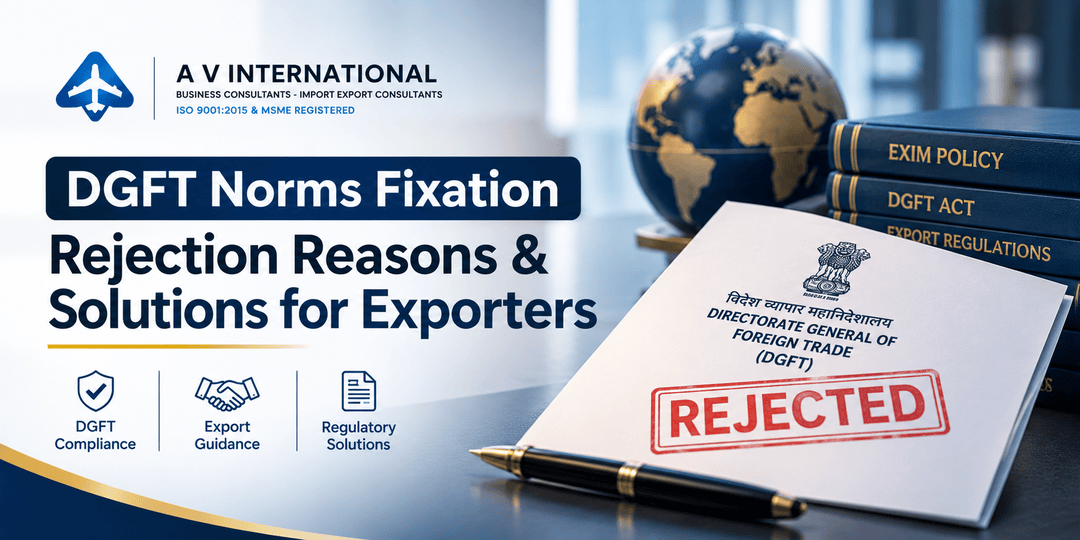
DGFT Norms Fixation Rejection: Common Reasons and Practical Solutions for Exporters

Key Takeaways

  • Most norms fixation rejections come from weak technical data, not from ineligibility.
  • A clear production process, batch-wise consumption data and a Chartered Engineer certificate are the core of a strong application.
  • Wastage claims must be realistic and backed by records.
  • Missing the deadline for a reply to a DGFT deficiency letter can close your file.
  • A well-prepared first submission saves months of back-and-forth with the Norms Committee.

Introduction

Many exporters under the Advance Authorisation scheme export products that have no Standard Input Output Norms (SION). In that case, the input-output ratio must be fixed by DGFT’s Norms Committee. This is called norms fixation or ad-hoc norms fixation.

On paper, the process looks simple. In practice, a large number of applications get deficiency letters or are rejected outright. That delays redemption of the authorisation, blocks the bank guarantee, and can lead to duty demands.

Here are the most common reasons applications fail, and how to avoid them.

What Is DGFT Norms Fixation?

Featured Snippet Answer:
DGFT norms fixation is the process in which the Norms Committee of the Directorate General of Foreign Trade fixes the quantity of inputs allowed for making a specific export product when no SION exists. Exporters apply with technical details, production data and consumption records, and the approved norms decide the duty-free inputs under Advance Authorisation.

Once norms are fixed, they are used to redeem the authorisation and close the export obligation.

Why Norms Fixation Applications Get Rejected

1. Incomplete Technical Details

The Norms Committee is a technical body. It needs to understand exactly how your product is made.

Common gaps:

  • No detailed manufacturing process or flow chart
  • Missing technical specifications of inputs and the export product
  • Generic descriptions such as “chemicals” or “packing material”

Solution: Describe every input with its grade, specification, purity or technical characteristics. Attach a step-by-step process flow showing where each input is used.

2. Unjustified Wastage Claims

Claiming high wastage without proof is one of the fastest routes to rejection.

Solution: Support wastage with production records, batch sheets and industry benchmarks. If wastage differs from similar products, explain why in technical terms.

3. Missing or Weak Chartered Engineer Certificate

A CE certificate that only repeats your claimed figures, without verifying the process, carries little weight.

Solution: Get an independent Chartered Engineer to verify actual consumption on the shop floor and certify it with clear reasoning.

4. Mismatch Between Documents

DGFT cross-checks your application against shipping bills, bills of entry and the authorisation itself.

Typical mismatches:

  • Export product description differs from the shipping bill
  • ITC (HS) codes are inconsistent
  • Input quantities don’t align with actual imports

Solution: Reconcile every document before filing. Item names, codes and quantities should match across all records.

5. No Batch-Wise Consumption Data

The committee expects actual consumption data, not estimates.

Solution: Maintain batch-wise or production-wise consumption records for the export product and submit a representative sample.

6. Late or Incomplete Reply to Deficiency Letters

Many files are not rejected for technical reasons. They are closed because the exporter didn’t respond on time, or replied only partially.

Solution: Track every deficiency letter on the DGFT portal. Reply point by point, within the time allowed, with supporting documents.

7. Inputs Not Logically Linked to the Export Product

If an input has no clear role in the product, the committee will disallow it.

Solution: Explain the function of each input, whether it is a raw material, catalyst, consumable or packing material, and show where it appears in the process.

Step-by-Step Approach to Avoid Rejection
  1. Collect production, import and export records for the relevant period.
  2. Prepare a detailed process flow chart.
  3. List inputs with full technical specifications and HS codes.
  4. Calculate actual consumption and wastage from batch records.
  5. Obtain an independent Chartered Engineer certificate.
  6. Reconcile all documents before submission.
  7. File online on the DGFT portal and monitor for deficiency letters.
  8. Respond to every query completely and on time.
Practical Tips from the Field
  • Check whether a similar product already has norms fixed. Previous Norms Committee decisions are a useful reference.
  • Don’t overclaim inputs “just in case.” Overclaiming reduces credibility for the whole application.
  • Keep one person or consultant responsible for the file from filing to approval.
  • If norms are fixed lower than expected, you can request a review with stronger technical evidence.

FAQs

1. What happens if my norms fixation application is rejected?
You can address the deficiencies and resubmit, or request a review with additional technical justification. Delays can affect redemption of your Advance Authorisation.

2. Is a Chartered Engineer certificate mandatory for norms fixation?
In most cases, yes. An independent CE certificate verifying actual consumption is an important supporting document.

3. How long does DGFT norms fixation take?
The timeline depends on the product’s complexity and how complete the application is. A well-documented file is usually processed faster.

4. Can I apply for norms fixation after exports are completed?
Yes. Exporters generally apply based on actual production and export data. Check the current DGFT timelines that apply to your authorisation.

5. What is the difference between SION and ad-hoc norms?
SION are standard notified norms for common products. Ad-hoc norms are fixed case by case for products where no SION exists.

6. Can wastage claims be revised after submission?
Revisions are possible in reply to a deficiency letter, but they must be backed by proper records and technical reasons.

Conclusion

Norms fixation rejections are rarely about eligibility. They come down to documentation quality, technical clarity and timely follow-up.

Exporters who prepare a clear process flow, realistic consumption data and consistent documents have a much better chance of first-time approval. That means faster redemption, release of bank guarantees and fewer compliance risks.

CTA

Facing a deficiency letter or a rejected norms fixation application? A V International has over 35 years of experience in DGFT regulations and import-export compliance. Our team helps exporters prepare technically strong applications, respond to DGFT queries, and get norms fixed without unnecessary delays. Contact A V International today for expert DGFT consulting support.

Written By

Akash Bhangare
Akash has more than 10 years of experience in EPR Compliance, Legal Metrology, DGFT Regulations, and Import Export Consulting Services in India.

He works with A V International, which has over 35 years of expertise in Environmental Compliance, EPR Registrations, Licensing, and Regulatory Approvals.


FeATURED ARTICLES

Related Posts