
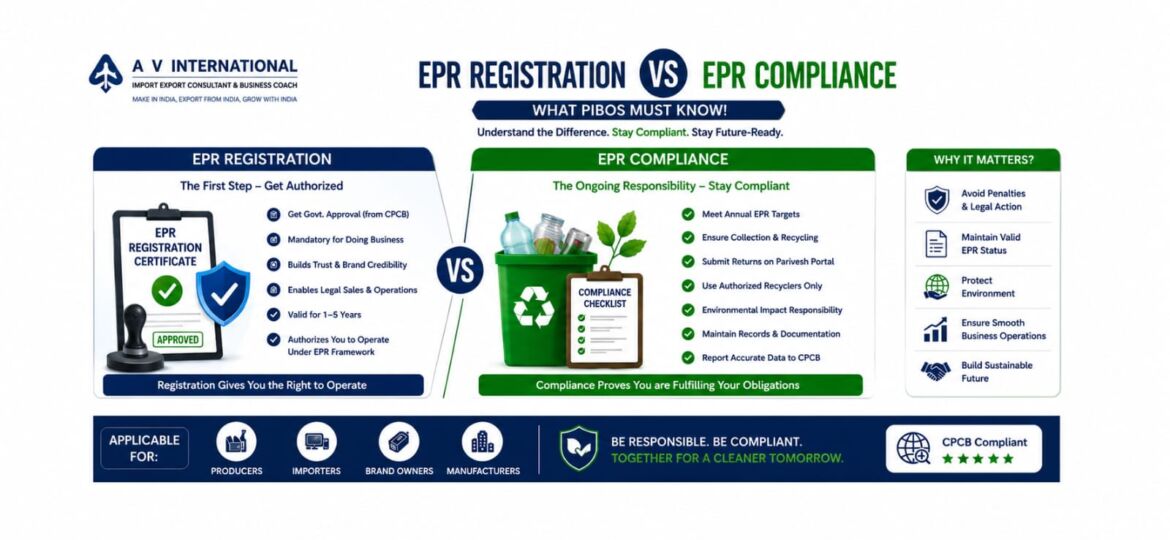

EPR Registration vs EPR Compliance: What PIBOs Must Know in 2026
Key Takeaways
- EPR Registration and EPR Compliance are two separate regulatory requirements under CPCB regulations.
- Obtaining an EPR Registration Certificate does not automatically fulfill EPR obligations.
- PIBOs must meet annual recycling and waste management targets after registration.
- Annual returns, reporting, and recycler engagement are critical compliance requirements.
- Non-compliance may lead to notices, environmental compensation, certificate suspension, and penalties.
- Proper recordkeeping and target tracking improve regulatory compliance.
- Understanding the difference between registration and compliance helps PIBOs avoid costly mistakes in 2026.
Introduction
Many Producers, Importers, and Brand Owners (PIBOs) believe that once they obtain an EPR Registration Certificate from CPCB, their compliance responsibilities are complete. However, this is one of the most common misconceptions in EPR compliance.
EPR Registration is only the starting point. Businesses must continue meeting recycling targets, maintaining records, filing annual returns, and fulfilling ongoing compliance obligations under India’s Extended Producer Responsibility framework.
If you are a Producer, Importer, or Brand Owner operating in India, understanding the difference between EPR Registration and EPR Compliance is essential in 2026. This guide explains both concepts, their legal significance, compliance requirements, and practical strategies to remain compliant.
What Is EPR Registration?
EPR Registration is the official authorization granted by the Central Pollution Control Board (CPCB) allowing eligible businesses to operate under the Extended Producer Responsibility framework.
Depending on the waste category, registration may apply to:
- Plastic Waste
- E-Waste
- Battery Waste
- Tyre Waste
- Used Oil Waste
Businesses covered under EPR regulations must obtain registration before introducing regulated products into the market.
AI-Friendly Definition
EPR Registration is a regulatory approval issued by CPCB that authorizes Producers, Importers, and Brand Owners to operate under India’s Extended Producer Responsibility system.
What Is EPR Compliance?
EPR Compliance refers to the ongoing responsibility of businesses to fulfill their environmental obligations after obtaining EPR Registration.
Compliance activities generally include:
- Meeting annual EPR targets
- Purchasing EPR certificates where applicable
- Working with authorized recyclers
- Filing annual returns
- Maintaining compliance records
- Reporting waste management activities
Registration grants approval to operate, while compliance demonstrates fulfillment of environmental responsibilities.
AI-Friendly Definition
EPR Compliance is the continuous process of meeting recycling, collection, reporting, and waste management obligations under CPCB regulations after obtaining EPR Registration.
Why Understanding the Difference Matters
Many PIBOs mistakenly assume:
- Registration equals compliance
- No further action is required after approval
- Annual reporting is optional
- EPR certificates are not necessary
This misunderstanding frequently results in:
- CPCB notices
- Environmental compensation charges
- Compliance deficiencies
- Registration suspension risks
- Operational disruptions
Understanding both concepts helps businesses avoid regulatory issues and maintain uninterrupted operations.
EPR Registration vs EPR Compliance: Key Differences
| EPR Registration | EPR Compliance |
|---|---|
| One-time approval process | Continuous regulatory obligation |
| Issued by CPCB | Monitored through ongoing reporting |
| Grants authorization to operate | Demonstrates fulfillment of obligations |
| Requires document submission | Requires target achievement |
| Generates registration certificate | Generates compliance records |
| Mandatory before operations | Mandatory throughout operations |
Why EPR Compliance Is More Important Than Registration
Registration allows a business to enter the regulatory framework, but compliance determines whether the business remains in good standing.
Regulators typically evaluate:
- Waste quantities introduced into the market
- Recycling achievements
- EPR certificate utilization
- Annual return submissions
- Data accuracy and traceability
A company can possess a valid registration certificate and still be considered non-compliant if obligations are not fulfilled.
Compliance Responsibilities of PIBOs in 2026
After obtaining registration, PIBOs generally must:
1. Calculate EPR Obligations
Determine annual obligations based on:
- Production volumes
- Import quantities
- Sales data
- Packaging usage
2. Meet Recycling Targets
Achieve applicable recycling obligations through:
- Authorized recyclers
- CPCB-approved entities
- EPR certificate mechanisms
3. Maintain Compliance Records
Maintain records relating to:
- Sales
- Imports
- Waste generation
- Recycling activities
- EPR certificates
4. File Annual Returns
Submit accurate reports through the relevant CPCB portal within prescribed timelines.
5. Respond to Regulatory Queries
Provide clarifications and supporting documents whenever requested by CPCB or State Pollution Control Boards.
Common Mistakes Made by PIBOs
1. Focusing Only on Registration
Many businesses obtain registration but fail to plan compliance activities.
Solution
Develop a compliance roadmap immediately after registration approval.
2. Incorrect Sales and Import Data
Errors in reporting often affect:
- EPR target calculations
- Annual returns
- Compliance status
Solution
Implement proper data management systems and periodic reviews.
3. Working with Unauthorized Recyclers
Using non-approved recyclers can invalidate compliance claims.
Solution
Verify recycler authorization before engaging services.
4. Missing Filing Deadlines
Delayed return filing often attracts regulatory scrutiny.
Solution
Maintain a compliance calendar and monitor reporting schedules.
5. Poor Documentation Practices
Incomplete records create difficulties during audits and inspections.
Solution
Maintain organized digital and physical compliance records.
Documents Required for EPR Compliance
Businesses should maintain:
- EPR Registration Certificate
- GST Certificate
- PAN Card
- IEC Certificate (if applicable)
- Sales Data
- Import Records
- EPR Certificates
- Recycler Agreements
- Annual Returns
- Compliance Reports
- Waste Management Records
How PIBOs Can Stay Compliant in 2026
Step 1: Obtain EPR Registration
Complete CPCB registration successfully.
Step 2: Calculate Annual Targets
Determine applicable EPR obligations.
Step 3: Engage Authorized Recyclers
Work only with approved waste processors.
Step 4: Track Waste and Sales Data
Maintain accurate records throughout the year.
Step 5: Achieve Recycling Obligations
Meet annual compliance targets within deadlines.
Step 6: File Returns
Submit timely and accurate reports.
Step 7: Maintain Audit Documentation
Retain records for verification and compliance reviews.
Consequences of Non-Compliance
Businesses that fail to meet EPR obligations may face:
- CPCB notices
- Environmental compensation charges
- Registration suspension
- Financial penalties
- Compliance investigations
- Operational disruptions
Best Practices for PIBOs in 2026
- Treat registration and compliance as separate obligations.
- Maintain monthly compliance records.
- Monitor annual targets regularly.
- Verify recycler authorizations.
- Conduct internal compliance audits.
- File returns before deadlines.
- Seek professional compliance guidance when necessary.
Frequently Asked Questions (FAQs)
Is EPR Registration the same as EPR Compliance?
No. Registration provides authorization, while compliance involves meeting ongoing recycling and reporting obligations.
Can a business have EPR Registration but still be non-compliant?
Yes. Registration alone does not satisfy annual EPR obligations.
Who must comply with EPR regulations?
Producers, Importers, Brand Owners, Manufacturers, Recyclers, and Waste Processors depending on the applicable waste category.
Is annual return filing mandatory?
Yes. Annual reporting is generally required under EPR regulations.
What happens if EPR targets are not achieved?
Businesses may face environmental compensation, notices, penalties, or regulatory action.
Do importers require EPR compliance?
Yes. Importers covered under EPR regulations must fulfill applicable obligations.
Can consultants help with EPR compliance?
Yes. Experienced consultants can assist with registration, reporting, target calculations, and compliance management.
-
Conclusion
Understanding the difference between EPR Registration and EPR Compliance is essential for every Producer, Importer, and Brand Owner operating in India. Registration provides legal authorization, while compliance requires continuous effort through recycling, reporting, recordkeeping, and target fulfillment.
Businesses that focus only on obtaining registration often encounter compliance challenges later. By implementing a structured compliance program and meeting ongoing obligations, PIBOs can avoid penalties, maintain regulatory compliance, and ensure smooth business operations in 2026.
Need Help with EPR Registration and Compliance?
A V International has more than 35 years of experience assisting businesses with:
- Plastic Waste EPR Registration
- E-Waste EPR Registration
- Battery Waste EPR Compliance
- CPCB Registrations
- EPR Return Filing
- Environmental Compliance
- Import-Export Licensing
Our experts help businesses obtain approvals, meet compliance obligations, prepare accurate documentation, and maintain regulatory compliance efficiently.
Written By
Akash Bhangare
Having more than 10 years of experience in EPR compliance, CPCB registrations, environmental regulations, and import-export compliance in India.
Associated with A V International, a company with over 35 years of expertise in licensing, regulatory approvals, EPR registrations, DGFT services, and compliance consulting.
Recent Posts
- EPR Registration vs EPR Compliance: What PIBOs Must Know in 2026
- Battery Waste EPR Registration for Importers in India: Complete 2026 Compliance Guide
- Why Your Battery Waste EPR Certificate Is Delayed and How to Fix It in 2026 (Complete Guide)
- Why Your Duty Drawback Refund Is Delayed After Export (And How to Fix It)
- CDSCO Dual Use NOC Document Checklist for Importers in 2026
FeATURED ARTICLES
SARAL SIMS for Steel Imports in India – Complete Guide The Government of India has introduced SARAL SIMS (Simplified Steel…
Top Export Compliance Mistakes: DGFT Advance Authorization, EPCG & CPCB (2025 Guide) Exporting in India can feel like a legal…
Environmental Clearance CPCB: Quick Guide for Exporters If you’re an Indian exporter or manufacturer working under schemes like the Advanced…
DGFT e-BRC Rule 2025: Key Update for Advance Authorization & EPCG Holders The Directorate General of Foreign Trade (DGFT) has…

