

India's Leading DGFT Consultants
SCOMET license application process on DGFT portal in India for exporters in 2026

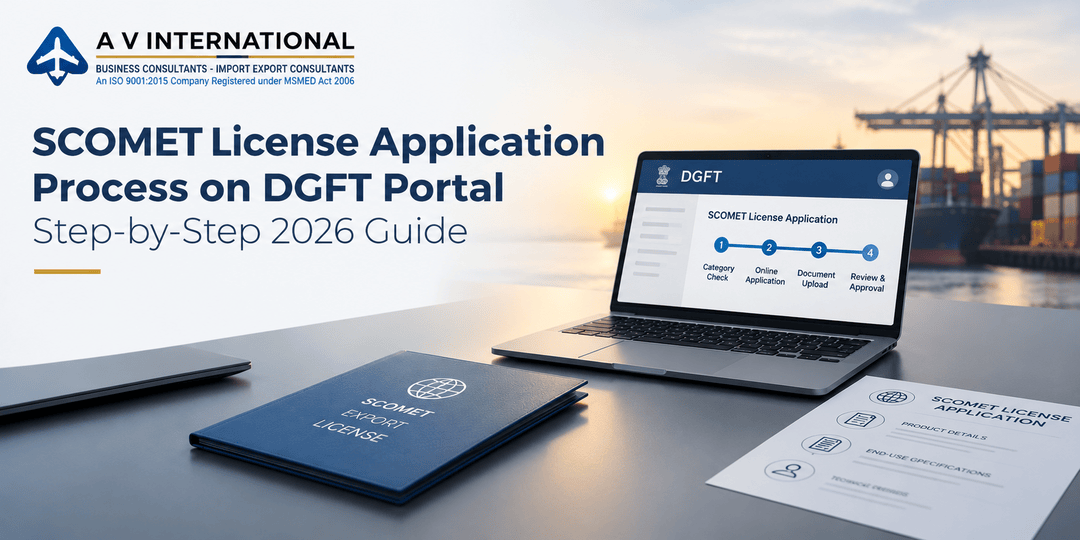
SCOMET License Application Process on DGFT Portal: Step-by-Step 2026 Guide

Key Takeaways

  • SCOMET stands for Special Chemicals, Organisms, Materials, Equipment and Technologies.

  • Exporters must check the SCOMET list before shipping potentially controlled products.

  • Applications for applicable SCOMET categories are submitted online through the DGFT portal.

  • Technical specifications, end-user certificates and end-use details are important supporting documents.

  • Certain categories, including specified nuclear-related and defence items, fall under different licensing authorities.

  • Exporters must obtain the required authorisation before exporting controlled items unless a specific exemption applies.

Introduction

Indian exporters dealing in chemicals, industrial equipment, electronics, aerospace components, specialised materials and technology-related products must understand India’s export-control regulations.

Some products that appear to be ordinary industrial goods may also have potential military, nuclear or other sensitive applications. Depending on their technical specifications and intended use, these products may fall under the SCOMET control list.

Obtaining the correct export authorisation is therefore an important compliance requirement. This guide explains the SCOMET license application process on the DGFT portal in 2026, the documents exporters should prepare and the common mistakes that can delay approval.

What Is a SCOMET License?

SCOMET is India’s export-control framework for specified goods, software and technologies that may have strategic, security-related or dual-use applications.

The relevant control list appears under Appendix 3 to Schedule 2 of the ITC (HS) Classification of Export and Import Items.

Items are classified into categories according to their nature and technical characteristics. Exporters should not determine SCOMET applicability solely from a product’s commercial name or HS code.

Step-by-Step SCOMET License Application Process on DGFT Portal

Step 1: Identify Whether Your Product Falls Under SCOMET

Begin by examining the product’s technical specifications against the latest applicable SCOMET list.

Review the following details:

  • Product description and model number.

  • Technical specifications and performance parameters.

  • Material composition, capabilities or intended functionality.

  • Relevant SCOMET category and sub-category.

  • Proposed destination country and end user.

If classification is unclear, obtain a technical assessment before proceeding with the application.

Step 2: Identify the Applicable Licensing Authority

Not every SCOMET-related export follows the same licensing route.

For many controlled items, the Directorate General of Foreign Trade (DGFT) is the licensing authority. However, Category 0 nuclear-related items and Category 6 munitions items involve designated authorities under their applicable procedures.

Confirm the licensing authority and the relevant policy conditions before filing.

Step 3: Register and Log In to the DGFT Portal

Visit the official website: https://www.dgft.gov.in

Log in using the exporter’s registered credentials. If the business is not registered, complete the applicable registration process first.

Navigate to the relevant SCOMET service under the portal’s Export Management System. Select the appropriate application type based on the intended transaction and the options currently available.

DGFT’s published SCOMET FAQs refer to ANF 2O(a) for standard SCOMET authorisation applications and ANF 2O(b) for applications relating to General Authorisation for Intra-Company Transfers (GAICT). Confirm the applicable form and current portal instructions before proceeding.

Step 4: Prepare the Required Documents

Documentation depends on the SCOMET category, transaction type and applicable appendix. Commonly required records include:

  • Import Export Code (IEC) and exporter details.

  • Product description and technical specifications.

  • Commercial invoice or proforma invoice, where applicable.

  • Purchase order or export contract.

  • End-Use-cum-End-User Certificate (EUC).

  • Details of the overseas buyer, consignee and ultimate end user.

  • Intended end use and destination details.

  • Quantity, value and proposed shipment information.

  • Relevant declarations and supporting documents prescribed for the category.

Additional documents may be required for temporary exports, repeat exports, demonstrations, repairs, returns or general authorisations.

Step 5: Complete the Online Application

Enter the required exporter, product, destination, end-user and transaction information accurately.

Ensure that the product details match the technical documents and commercial records. Upload the prescribed supporting documents in the accepted format, generally PDF where specified.

Check that quantities, values, consignee details and intended end use are consistent across the application and attachments.

Step 6: Submit the Application and Pay the Applicable Fee

Review the completed application before submission. Pay the applicable fee displayed under the current DGFT procedure, where required, and retain the acknowledgement and application reference number.

Track the application through the portal and respond promptly if the authority requests additional information.

Step 7: Respond to Scrutiny and Obtain Authorisation

The application may undergo a detailed assessment, including examination of the product, destination, end user and intended end use. Depending on the item, consultation with relevant government departments or agencies may be necessary.

Approval is not automatic. If the application is approved, verify the authorisation’s validity, permitted quantity, destination, end-user conditions and other restrictions before arranging shipment.

Important Compliance Requirements After Approval

Receiving an authorisation does not remove the exporter’s ongoing compliance responsibilities.

Before dispatch, verify that:

  • The shipment falls within the authorisation’s scope and validity.

  • The actual buyer, consignee and end user match the approved details.

  • Quantity and product specifications comply with the authorisation.

  • Any prescribed reporting, recordkeeping and post-shipment conditions are fulfilled.

  • The required authorisation details are declared to Customs through the applicable export documentation and ICEGATE process.

Do not proceed with a controlled export merely because the application has been submitted or is under review.

Common Mistakes That Delay SCOMET Approval

Exporters should avoid these frequent errors:

  • Incorrect SCOMET classification.

  • Incomplete technical specifications.

  • Missing or improperly completed end-user certificates.

  • Inconsistent buyer, consignee and end-user information.

  • Unclear explanation of the product’s intended use.

  • Failure to identify additional category-specific requirements.

  • Ignoring clarification requests or authorisation conditions.

A document review before submission can help identify inconsistencies and reduce avoidable delays.

Featured Snippet Answer: How Do You Apply for a SCOMET License?

To apply for a SCOMET license in India, identify the applicable SCOMET category, confirm the licensing authority, log in to the DGFT portal and select the relevant application. Submit the prescribed technical details, end-user certificates and supporting documents, pay the applicable fee and obtain approval before exporting controlled items.

FAQs

1. Is a SCOMET license mandatory for every export?

No. It is required for controlled SCOMET items unless a specific exemption or permitted authorisation route applies. Exporters must verify the latest control list and policy conditions.

2. Where can I apply for a SCOMET license?

Applicable applications can be filed through the official DGFT portal at https://www.dgft.gov.in. Some categories are handled by other designated authorities.

3. What is an End-Use-cum-End-User Certificate?

An EUC is a prescribed declaration identifying the end user and intended use of the exported item. The required format and supporting details depend on the applicable SCOMET category and procedure.

4. How long does SCOMET license approval take?

The timeline varies according to the product category, completeness of documentation, destination, end-user assessment and any interdepartmental consultation. Do not assume a fixed approval period for every application.

5. Can I export a SCOMET item while the application is pending?

Generally, no. Where an authorisation is required, the exporter must obtain it before shipment unless an applicable exemption or other permitted arrangement specifically allows the transaction.

6. Can a SCOMET application be amended?

Amendment or correction may be available through the prescribed DGFT process, subject to the type of authorisation and permitted changes. Follow the current portal procedure.

7. Can an ordinary industrial product fall under SCOMET?

Yes. Certain industrial products can be controlled because of their technical performance, specifications or potential applications. Classification should be based on the applicable control-list entry, not the commercial description alone.

Conclusion

The SCOMET license application process requires careful product classification, accurate technical documentation and clear identification of the overseas end user and intended use. Errors in these areas can lead to clarification requests, delays or compliance risks.

Exporters should verify the latest DGFT procedures, applicable SCOMET list and category-specific requirements before submitting an application or dispatching controlled goods.

Need Assistance With SCOMET License Applications?

A V International provides professional DGFT and import-export compliance consulting to help businesses assess SCOMET applicability, prepare supporting documentation and navigate the applicable export authorisation process.

Contact A V International for assistance with SCOMET licensing and other DGFT-related requirements.

Written By

Akash Bhangare

Having more than 10 years of experience in EPR Compliance, Legal Metrology, DGFT Regulations, and Import Export Consulting Services in India.

Associated with A V International, a company with over 35 years of expertise in Environmental Compliance, EPR Registrations, Licensing, and Regulatory Approvals.

FeATURED ARTICLES

Related Posts